

Fighting for You, a Friend, or a Loved One



Arrest Warrants
Arrest Warrants in Florida: What You Need to Know Now
Arrest Warrant? I am W.F. “Casey” Ebsary Jr., a Board-Certified Criminal Trial Lawyer. If you are reading this, chances are you—or someone you care about—are dealing with the stress of a possible or active arrest warrant. I’ve spent decades helping people navigate these exact situations across Tampa Bay, and I can tell you this: doing nothing is almost always the worst option.
👉 Call to Action:
If you suspect a warrant, contact me immediately: https://www.centrallaw.com/contact-us/
👉Search our Warrant for Arrest – Tampa Bay Search Portal https://www.centrallaw.com/blog/warrant-for-arrest-tampa-bay-search-portal/

My Experience Handling Arrest Warrants in Florida
From my perspective as a defense attorney, arrest warrants are rarely just paperwork—they are turning points. They often begin quietly: a missed court date, a misunderstanding, or an investigation that escalates behind the scenes. Then suddenly, law enforcement is looking for you.
Under Florida law, a judge must find probable cause before issuing a warrant. That means sworn facts must support the belief that a crime occurred.
But what matters most is not just how the warrant started—it’s what you do next.
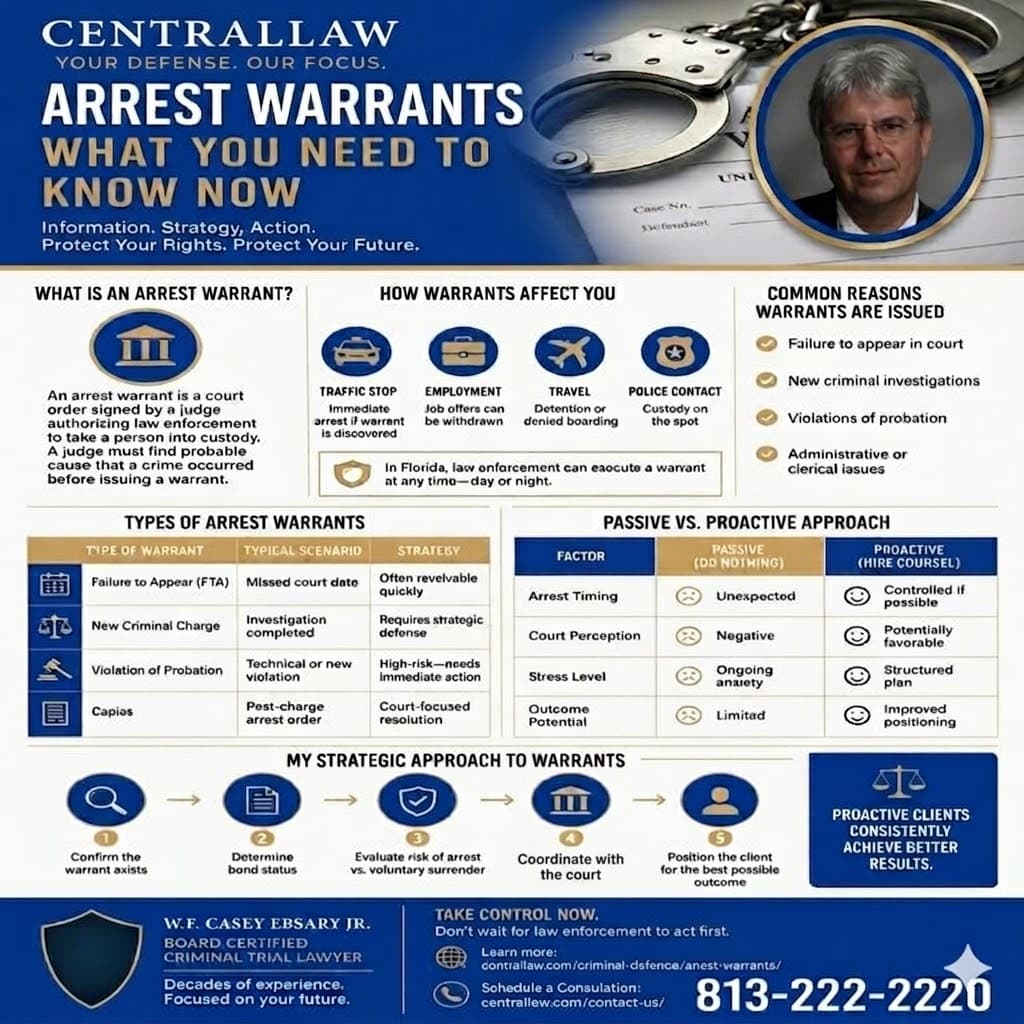
What Is an Arrest Warrant?
An arrest warrant is a court order signed by a judge authorizing law enforcement to take a person into custody.
In my practice, I see warrants issued for several common reasons:
- Failure to appear in court
- New criminal investigations
- Violations of probation
- Administrative or clerical issues
A warrant does not go away on its own. It sits in the system, waiting.
How Arrest Warrants Actually Affect You
Clients often underestimate the real-world consequences of a warrant. Here’s what I see happen regularly:
| Situation | What Happens |
|---|---|
| Traffic stop | Immediate arrest if warrant is discovered |
| Job background check | Offer withdrawn |
| Travel | Detention or denial |
| Routine police contact | Custody on the spot |
In Florida, law enforcement can execute a warrant at any time—day or night.
That unpredictability is what makes proactive action critical.
Types of Arrest Warrants I Commonly Handle
From my experience, not all warrants are created equal:
| Type of Warrant | Typical Scenario | Strategy |
|---|---|---|
| Failure to Appear (FTA) | Missed court date | Often resolvable quickly |
| New Criminal Charge | Investigation completed | Requires strategic defense |
| Violation of Probation | Technical or new violation | High risk—needs immediate action |
| Capias | Post-charge arrest order | Court-focused resolution |
Each requires a different approach. There is no “one-size-fits-all” solution.
My Strategic Approach to Warrants
When someone hires me, I don’t just react—I plan.
Here’s how I approach these cases:
- Confirm the warrant exists
- Determine bond status
- Evaluate risk of arrest vs. voluntary surrender
- Coordinate timing with the court when possible
- Position the client for the best possible outcome
In some situations, I can help arrange a controlled surrender or court appearance, which may improve how the judge views the case.
👉 Call to Action :
Learn more about how I handle these cases here:
https://www.centrallaw.com/lawyers/w-f-casey-ebsary-jr/
Chart: Passive vs. Proactive Approach
| Factor | Passive (Do Nothing) | Proactive (Hire Counsel) |
|---|---|---|
| Arrest timing | Unexpected | Controlled if possible |
| Court perception | Negative | Potentially favorable |
| Stress level | Ongoing anxiety | Structured plan |
| Outcome potential | Limited | Improved positioning |
From my experience, proactive clients consistently achieve better results.
What Happens After an Arrest?
After an arrest on a warrant, several things typically occur:
- Booking into jail
- First appearance before a judge
- Bond determination (if applicable)
- Scheduling of future court dates
Some warrants include a pre-set bond, while others may require a judge to decide.
Timing matters here. What happens in the first 24–48 hours can shape the entire case.
Can an Arrest Warrant Be Removed?
In many cases, yes—but how depends on the type of warrant.
Based on my experience:
- Some warrants can be resolved by posting bond
- Others require turning yourself in
- Some can be addressed directly in court with counsel
In certain situations, appearing voluntarily may lead to more favorable treatment than being arrested unexpectedly.
The Biggest Mistakes I See
Over the years, I’ve seen the same mistakes repeated:
- Ignoring the warrant
- Assuming it will “expire”
- Relying on second-hand advice
- Waiting until an arrest happens
Warrants do not disappear over time. They remain active until resolved.
10 Common Questions About Arrest Warrants

1. How do I know if I have a warrant?
In many cases, people find out through a traffic stop, background check, or notification from someone else. There is no universal system that automatically notifies you. If you suspect a warrant, it’s critical to verify it through proper channels. I can assist with that process. You can visit our Tampa Bay Warrant Search feature here https://www.centrallaw.com/blog/warrant-for-arrest-tampa-bay-search-portal/
2. Will police come to my house?
Sometimes they do, but not always. In many cases, arrests happen during routine encounters like traffic stops. Law enforcement has broad authority to execute warrants. That uncertainty is why proactive action matters.
3. Can I be arrested at work?
Yes, it happens. I’ve seen clients arrested at workplaces, homes, and even public events. Officers can execute a warrant in many different settings. Planning ahead can help reduce that risk.
4. What is a failure to appear warrant?
This type of warrant is issued when someone misses a required court date. It is one of the most common warrants I handle. These cases are often fixable, but timing is important. The longer you wait, the more complicated it can become.
5. Can I turn myself in?
Yes, and sometimes that is the best strategy. In certain situations, a planned surrender can improve how the court views your case. I help clients coordinate this when appropriate. It’s not something you want to do blindly.
6. Will I get bond?
Not always. Some warrants include a bond amount, while others require a judge to decide. The type of charge and history can influence this. I evaluate this issue before taking action.
7. Does a warrant mean I’m guilty?
No. A warrant only means a judge found probable cause to authorize an arrest. It is not a conviction. You still have the right to defend yourself.
8. Can a lawyer clear a warrant without arrest?
In some situations, yes—but not all. It depends on the type of warrant and the court involved. I look for every opportunity to resolve a case efficiently. However, I will not promise something that cannot be done.
9. Will a warrant affect my driver’s license?
It can, depending on the underlying issue. For example, failure to appear in certain cases may trigger additional consequences. Each situation is different. I review the full driver’s license picture before advising clients.
10. What should I do right now?
If you believe a warrant exists, take it seriously. Do not wait for law enforcement to act first. Speak with an experienced attorney and develop a plan. Early action often leads to better outcomes.
Why My Approach Matters
I don’t treat warrant cases as routine. Every case involves risk, timing, and strategy.
My focus is always on:
- Minimizing disruption to your life
- Protecting your record and future
- Positioning you for the best legal outcome
I bring board-certified experience to every case—and that matters when the stakes are high.
Final Thoughts
An arrest warrant is not just a legal issue—it’s a life issue. It affects your job, your family, and your future. The good news is that there are often options. The key is knowing how and when to act.
👉 Call to Action (End):
Take control now:
https://www.centrallaw.com/criminal-defense/arrest-warrants/
Schedule a consultation:
https://www.centrallaw.com/contact-us/
End of 2026 Update
2023 Original Post
Your Guide to Handling Arrest Warrants
The story of a typical arrest warrant begins when the police knock at the door, a detective’s business card is left for you, or a friend or relative calls you to let you know the police are looking for you – that is how it starts. Sometimes a background check for a new job uncovers a forgotten past. Other times a warrant is discovered during a routine traffic stop. In any event, the warrant will not go away.
Ready to take control of your legal situation? Contact us today for expert guidance on addressing arrest warrants and finding the best solution for your case. Don’t wait; let us help you navigate your options and resolve your legal concerns.
What Is an Arrest Warrant?
Under Florida State law, an arrest warrant can be issued in several ways. One warrant can arise from a failure to appear (FTA ) in court. For a valid warrant, there must be an order and proper legal notice. For some traffic tickets or a Notice to Appear ( NTA ) the only notice given is to the person who has been encountered by the police. Sometimes suspects give a false name, and an arrest warrant may be issued for the person who was unfortunate enough to have someone steal their identity. Notices to Appear are frequently issued for misdemeanor drug charges or shoplifting.
Another warrant can be issued after police refer a case to a local prosecutor. In Florida, local prosecutors are called State Attorneys. Sometimes an Assistant State Attorney or investigating law enforcement officer will request a Judge to issue an arrest warrant.
Dealing with Arrest Warrants: Your Options
1. Posting a Cash Bond:
Some warrants have a cash bond amount attached. By posting the bond, the warrant can be recalled.
2. Turning Yourself In:
In certain cases, suspects are required to voluntarily turn themselves in to the county jail.
Failure to do so may result in being held or transported to appear before a judge, especially if caught out-of-county or out-of-state.
3. Extradition and Different Jurisdictions:
Some warrants may involve arrests in out-of-county, out-of-state, federal, or international jurisdictions.
These cases may necessitate legal help with extradition.
4. Turning Yourself In Open Court:
Some suspects, with legal counsel’s assistance, choose to turn themselves in open court.
Certain County and Circuit judges may consider bond issues more favorably for those who voluntarily appear.

5. Consulting a Tampa Arrest Warrants Attorney:
If you’re dealing with an arrest warrant in Hillsborough County, Pinellas County, or Pasco County, a Tampa arrest warrants attorney can provide guidance.
An experienced Arrest Warrant Attorney can advise on the best approach to resolve the situation effectively.
6. Professional Assistance:
Some defendants with arrest warrants seek affordable help from a former prosecutor like W.F. “Casey” Ebsary, Jr.
Casey, an arrest warrant attorney, has extensive experience as an Assistant State Attorney in the Hillsborough County State Attorney’s Office.
7. Accessing Records and Seeking Resolution:
Legal professionals can access law enforcement and court records to assess your case.
Warrants can be issued for various crimes, from traffic offenses to felony charges.
8. Taking Prompt Action:
Whether you suspect a warrant has been issued or anticipate one, taking prompt action is crucial.
Legal experts can file appropriate motions and communicate with the local prosecutor to clear the warrant and address your legal concerns.
Understanding Arrest Warrants and Data Sharing
Introduction
In the digital age, law enforcement agencies have significantly enhanced their capabilities through data sharing and interconnected databases. Unlike the bygone era when records were manually maintained and stored locally, today’s systems enable almost instantaneous access to a wealth of information. This advancement, while beneficial in many ways, also presents unique challenges, particularly concerning arrest warrants. If you find yourself or a loved one facing an arrest warrant, immediate action is crucial. Contact us today or use our online form to get the assistance you need.
The Evolution of Data Sharing in Law Enforcement
From Paper to Digital
Historically, arrest warrant records were maintained in paper files at local law enforcement offices. This manual process often resulted in delays and limited access to information, making it difficult for officers in different jurisdictions to share critical data. Today, the advent of computer networks and sophisticated databases has revolutionized this process. Law enforcement agencies across the country now have the capability to share and access data with remarkable speed and efficiency.
The Role of Automation
Automation plays a pivotal role in modern data sharing. Information such as names, alleged aliases, dates of birth, and residency details are now cross-referenced across various databases. While this automation enhances efficiency, it also introduces potential pitfalls. Errors in cross-referencing can lead to incorrect information being shared, which in turn can result in wrongful arrests. It’s essential to understand these risks and know how to protect yourself.
The Impact of Data Sharing on Arrest Warrants
Increased Accuracy and Efficiency
The primary advantage of data sharing in law enforcement is increased accuracy and efficiency. Officers can quickly verify warrants, leading to more timely arrests of individuals who pose genuine threats to public safety. This streamlined process ensures that justice is served without unnecessary delays.
Risks of Misidentification
Despite the benefits, data sharing is not without its drawbacks. Errors in the system can lead to misidentification, where individuals are mistakenly linked to warrants that do not pertain to them. This can occur due to common names, outdated information, or mistakes in data entry. In such cases, even the most understanding law enforcement officer may make an arrest based on incorrect data.
Protecting Yourself from Errors
Verify Your Information
Given the potential for errors, it’s crucial to verify your personal information regularly. Ensure that your records are accurate and up-to-date. If you suspect that your data may have been compromised or inaccurately reported, take immediate steps to correct it.
Legal Assistance
If you or someone you know is facing an arrest warrant, obtaining legal assistance is essential. A knowledgeable attorney can help navigate the complexities of the legal system and address any errors in the warrant data. Don’t wait until it’s too late—call us now or use our online contact form to get the help you need.
The Importance of Legal Support
Navigating the Legal System
The legal system can be overwhelming, particularly when dealing with arrest warrants and potential misidentification. Legal professionals are equipped to handle these complexities and can provide invaluable support. They can assist in verifying the accuracy of the warrant, correcting any errors, and representing you in court if necessary.
Preventing Wrongful Arrests
By seeking legal advice promptly, you can significantly reduce the risk of wrongful arrest. Attorneys can proactively address discrepancies in your data and communicate with law enforcement on your behalf. This proactive approach can prevent misunderstandings and protect your rights.
Conclusion
In today’s interconnected world, the sharing of data among law enforcement agencies has streamlined the process of issuing and executing arrest warrants. While this system offers numerous benefits, it also poses risks of misidentification and wrongful arrests. Staying informed and proactive is key to protecting yourself and your loved ones from potential errors in the system.
If you are dealing with an arrest warrant, immediate action is essential. Contact our team of legal experts today or use our online form to get the support you need. By addressing these issues promptly, you can safeguard your rights and ensure that justice is served accurately.
Take Action Now
Don’t let a potential error in the system disrupt your life. Verify your information, seek legal assistance, and stay informed. Call us today or reach out through our online contact form. Our team is here to help you navigate the complexities of the legal system and protect your rights.
By expanding your understanding of how data sharing impacts arrest warrants, you can better navigate potential challenges and ensure that you are adequately protected. Whether you’re a tech-savvy individual, a business professional, or a concerned parent, staying informed and taking prompt action is crucial. Contact us now for the assistance you need.
How Can an Arrest Warrant Be Removed from the System?
In any event, some warrants have a cash bond amount set, and upon posting the bond, the warrant can be recalled. Other warrants will require the suspect to turn themselves in to the county jail. Failure to turn in or upon being caught out-of-county or out-of-state, the person will be held or transported to appear before a judge in court. Some warrants call for an arrest on out of county, out of state, or federal, or international warrants. These cases may require help with extradition.
Some suspects, with the assistance of Counsel, choose to turn themselves in in open court. Some County and Circuit judges will immediately consider the issue of bond and may look favorably upon those who voluntarily appear versus those who are arrested by law enforcement and then hauled into the system. Once the issue of bond is addressed and the person is released, the warrant will disappear.
A Tampa arrest warrants attorney may help you in Hillsborough County, Pinellas County, or Pasco County Florida. A qualified Arrest Warrant Attorney can help and advise you as to the easiest way to put this situation behind. Some Defendants with Arrest Warrants get professional affordable help from a Former Prosecutor. W.F. “Casey” Ebsary, Jr., is an arrest warrant attorney who was an Assistant State Attorney / Prosecutor in the Hillsborough County State Attorney’s Office. People with Outstanding Warrants in Tampa Bay area counties can call Casey for free advice and get recommendations for help when troubles arise. We can access law enforcement and court records to find out what we can do for you. Warrants for all types of crimes from traffic offenses to felony charges can be issued by law enforcement or Judges. Whether you believe there is or is going to be a warrant issued or has been issued for your arrest, you can contact us and we can file appropriate motions and make contact with the local prosecutor so the warrant can be cleared.
Arrest Warrants Attorney
When an arrest warrant is a problem, we can provide a solution. Call us today at (813) 222-2220 for a free initial consultation with an Arrest Warrant Attorney. If it is more convenient for you, we respond quickly to your call for help via our Call For Help web submission. Your requests are sent to us wirelessly.
We are constantly checking and responding, and will quickly get back to you via telephone or email.
Pinellas County Arrest Warrants are handled by the Pinellas County Sheriff’s Office.
Update from Tampa Police on Record-Breaking Roundup of Persons With Outstanding Arrest Warrants.
“At dawn Tuesday, Tampa police launched what they say is the biggest warrant roundup in the department’s history. With nearly 6,000 outstanding warrants on their list, their first action was to go after 459 violent felons, including eight wanted for murder.”
Source: tampabay.com
Code Name is Operation Summer Heat
72 Warrants Cleared
33 of the warrants were cleared by arrest, and 5 of those arrests were by the US Marshals Service in Georgia, Ohio, Virginia, Texas, and Jacksonville.
19 suspects were deceased
20 suspects were located in prison and will be charged with TPD warrant when released.
The arrests include: Attempted Murder (2) Robbery cases, (3) Felony Battery cases, Armed Robbery VOP, False Imprisonment, Deriving Proceeds from Prostitution, Compelling Individual to Become a Prostitute, Trafficking Oxycodone, and multiple Felony Drug Charges.
Tampa Arrest Warrant Attorney
Outstanding Arrest Warrants – You Need a Serious Defense – I can help.