- Free Consultation: (813) 222-2220 Tap Here to Call Us


Facing Worthless Check Charges in Florida: Defense Strategies That Work


Worthless Check Charges in Florida: A Defendant’s Guide
Worthless Check – If you have been notified that a check you wrote has “bounced,” or if you are facing a criminal investigation under Florida Statute § 832.05, the situation is serious. In Florida, passing a worthless check isn’t just a civil debt issue—it is a crime that can range from a first-degree misdemeanor to a third-degree felony.
However, a “bad check” does not always equal a Worthless Check criminal conviction. Understanding the legal requirements from a defense perspective is the first step in protecting your rights.
Speak With an Experienced Florida Criminal Defense Lawyer Today
I am W.F. “Casey” Ebsary Jr., a Board-Certified Criminal Trial Lawyer, and I have defended individuals across Florida facing financial crime allegations—including worthless check charges. These cases often look simple on the surface but are filled with legal nuance, evidentiary weaknesses, and defenses that can make or break the outcome.
👉 Visit my bio: https://www.centrallaw.com/lawyers/w-f-casey-ebsary-jr/
👉 Contact me now: https://www.centrallaw.com/contact-us/
Early intervention matters. I often resolve these cases before charges are even filed.
1. The Prosecution’s Burden: Intent and Knowledge
The most critical element the State must prove is intent to defraud. That means at the exact time you issued the check, you knew there were insufficient funds or the account was closed.
From my experience, this is where most cases fall apart for the prosecution.
An honest mistake—such as relying on a pending deposit, a bookkeeping error, or even confusion about account balances—can defeat the State’s case entirely. Criminal law does not punish negligence; it punishes intentional wrongdoing.
Key Legal Distinction
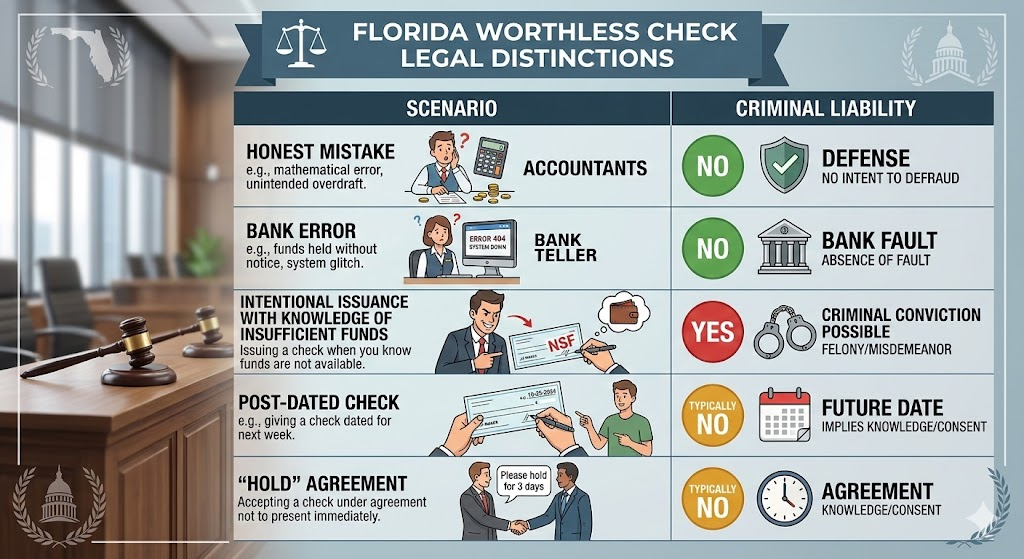
| Scenario | Criminal Liability |
|---|---|
| Honest mistake | No |
| Bank error | No |
| Intentional issuance with knowledge of insufficient funds | Yes |
| Post-dated check | Typically No |
| “Hold” agreement | Typically No |
The “Hold” or Post-Dated Worthless Check Defense
If you told the recipient to wait before depositing the check—or if the check was post-dated—the law generally recognizes that there was no intent to defraud. The recipient accepted the risk.
I frequently use this defense to dismantle the State’s presumption of intent.
2. The 15-Day Statutory Notice: Your Critical Opportunity
Florida law builds in a safeguard: the 15-day demand letter requirement.
Before prosecutors can rely on a presumption of intent, the payee must send a certified or registered letter giving you 15 days to make the check good.
Why This Matters
If you pay the full amount plus the statutory service fee within that 15-day window, the legal presumption of intent disappears. In many cases, that ends the criminal exposure entirely.
Worthless Check Timeline Chart
| Day | Event |
|---|---|
| Day 0 | Certified notice mailed |
| Day 1–5 | Delivery period |
| Day 5–20 | 15-day response window |
| After Day 20 | Possible criminal referral |
Strategic Insight
I often advise clients to act immediately upon receiving notice—not out of panic, but as a calculated legal strategy to eliminate the State’s leverage.
3. Common Defenses I Use in Worthless Check Cases
Every case is different, but the strongest defenses often fall into a few key categories:
Lack of Intent
This is the cornerstone of most defenses. If I can show you believed funds were available, the prosecution’s case weakens significantly.
Identity Issues
The State must prove beyond a reasonable doubt that you wrote the check. If the merchant failed to verify identification, this becomes a powerful defense.
Pre-Existing Debt
Checks written for past obligations—like back rent—are often treated differently. These cases may not satisfy the criminal statute because no present exchange of value occurred.
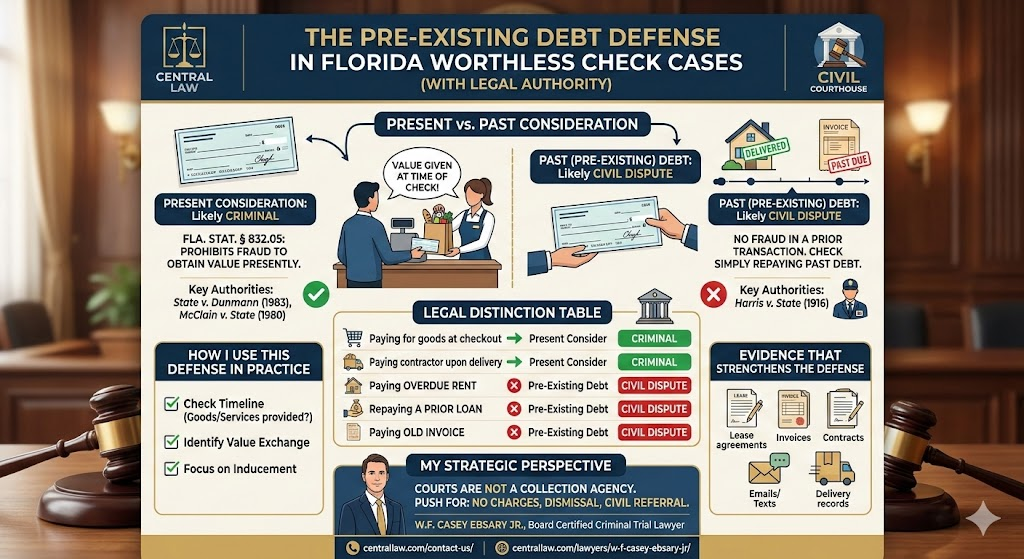
The “Pre-Existing Debt” Defense in Florida Worthless Check Cases (With Legal Authority)
One of the most powerful—and frequently misunderstood—defenses to a worthless check charge under Florida Statute § 832.05 is the concept of pre-existing debt. I rely on this defense often because it goes directly to the heart of what the statute actually criminalizes: fraud in obtaining something of value, not the failure to pay an already-existing obligation.
The Controlling Legal Principle
Florida courts have consistently held that the worthless check statute applies only when a check is issued in exchange for present consideration—meaning something of value is given at the time the check is delivered.
When a check is written to satisfy a pre-existing debt, the required element of fraudulent intent tied to a contemporaneous exchange is often missing.
Statute Supporting This Defense
Florida Statute § 832.05
The statutory framework itself contemplates a transaction involving the receipt of goods, services, or property in reliance on the check.
Why Pre-Existing Debt Falls Outside the Statute
The reasoning is straightforward and powerful in court:
If the payee has already provided the goods or services, then:
- There is no new reliance on the check
- There is no inducement to part with property
- There is no contemporaneous exchange of value
Instead, the check is simply a method of attempting to repay a debt—which is a civil matter, not a criminal one.
Legal Distinction Table
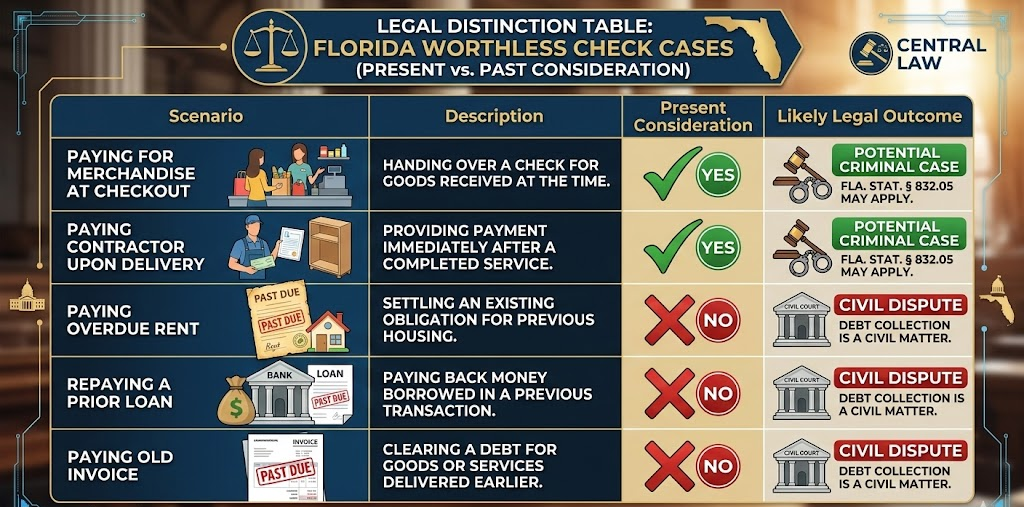
| Scenario | Present Consideration | Likely Legal Outcome |
|---|---|---|
| Paying for merchandise at checkout | Yes | Potential criminal case |
| Paying contractor upon delivery | Yes | Potential criminal case |
| Paying overdue rent | No | Civil dispute |
| Repaying a prior loan | No | Civil dispute |
| Paying old invoice | No | Civil dispute |
How I Use This Defense in Practice
When I raise a pre-existing debt defense, I focus the analysis on timing and inducement.
I ask:
- When did the alleged victim provide the goods or services?
- What, if anything, did they give up in reliance on the check?
- Did the check cause them to change their position in any way?
If the answer is “nothing new was given,” the criminal case begins to unravel.
Evidence That Strengthens the Defense
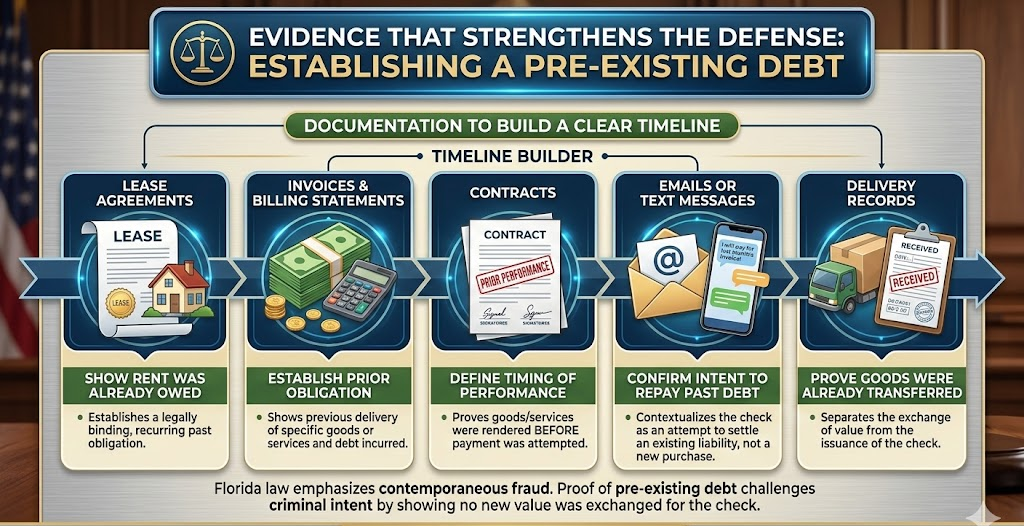
To establish that a debt was pre-existing, I build a clear timeline using:
| Evidence | Purpose |
|---|---|
| Lease agreements | Show rent was already owed |
| Invoices and billing statements | Establish prior obligation |
| Contracts | Define timing of performance |
| Emails or text messages | Confirm intent to repay past debt |
| Delivery records | Prove goods were already transferred |
This documentation allows me to demonstrate that the transaction lacked the present consideration required under Florida law.
Prosecutorial Arguments—and How I Counter Them
In some cases, prosecutors attempt to blur the line by arguing:
- The check was part of a continuing business relationship
- The payment induced delay in collection efforts
- There was an ongoing expectation of value
I counter these arguments by returning to the statute and case law:
The focus is not on the relationship—it is on the moment the check was issued.
If no new value changed hands at that moment, the statute does not apply.
Mixed Transactions: Where the Analysis Gets Complex
Some cases involve both past and present consideration—for example:
- A partial payment of old debt combined with new goods
- A check used to secure additional services while paying a balance
In these situations, I break the transaction down line-by-line to determine whether any portion of the check could arguably fall within the statute—and whether that portion can be separated or challenged.
My Strategic Perspective
From a defense standpoint, the pre-existing debt doctrine is more than a technicality—it is a gatekeeping principle that prevents misuse of the criminal justice system.
Florida law is clear:
The courts are not a collection agency.
When the facts show that a check was written to pay an already-existing obligation, I move aggressively—often before charges are filed—to present controlling authority and push for:
- No filing of charges
- Dismissal
- Referral to civil court
Take Action Before the Case Escalates
If you are facing allegations involving a bounced check tied to rent, a loan, or an old invoice, you may have a strong, legally supported defense.
👉 Contact me now: https://www.centrallaw.com/contact-us/
👉 Learn more about my experience: https://www.centrallaw.com/lawyers/w-f-casey-ebsary-jr/
I handle these cases personally and use proven legal authority to protect your record and your future.
Bank Errors
I defend cases where banks froze accounts, misapplied deposits, or caused overdrafts. Documentation is critical.
4. How Charges Are Classified in Florida
The amount of the check determines whether the charge is a misdemeanor or felony.
| Amount | Charge | Maximum Penalty |
|---|---|---|
| Less than $150 | First-degree misdemeanor | 1 year jail / $1,000 fine |
| $150 or more | Third-degree felony | 5 years prison / $5,000 fine |
Real-World Impact
Beyond jail or prison, a conviction can affect:
- Professional licenses
- Employment opportunities
- Creditworthiness
- Immigration status
This is why early legal representation is essential.
5. The Investigation Process: What to Expect
Most worthless check cases do not start with an arrest. Instead, they begin with:
- Merchant complaint
- 15-day demand letter
- Referral to State Attorney or Worthless Check Program
- Possible warrant or summons
In many cases, I can intervene before formal charges are filed.
6. Pretrial Diversion and Worthless Check Programs
Florida offers diversion programs designed to resolve these cases without a conviction.
Typical Requirements
| Requirement | Description |
|---|---|
| Restitution | Full repayment |
| Fees | Program administrative costs |
| Financial course | Education requirement |
| Monitoring | Compliance period |
My Approach
I evaluate whether entering a program is in your best interest—or whether we should fight the charge outright. Not every case should be resolved through diversion.
7. Evidence That Can Strengthen Your Defense
When I prepare a defense, I focus on documentation that tells your side of the story:
- Bank statements
- Deposit records
- Text messages or emails
- Copies of the check
- Witness statements
The goal is to show lack of intent and create reasonable doubt.
8. Defense Strategy Flowchart
| Step | Legal Focus | Strategy |
|---|---|---|
| Investigation | Intent | Analyze financial records |
| Notice stage | Compliance | Pay or dispute |
| Pre-charge | Intervention | Negotiate with prosecutor |
| Post-charge | Litigation | File motions, challenge evidence |
| Resolution | Outcome | Dismissal, diversion, or trial |
Protect Your Record Now

Worthless check cases move quickly—but so can effective defenses.
If you’ve received a demand letter or suspect charges may be filed, now is the time to act.
👉 Contact me today: https://www.centrallaw.com/contact-us/
👉 Learn more about my experience: https://www.centrallaw.com/lawyers/w-f-casey-ebsary-jr/
I handle these cases personally and strategically from day one.
9. Collateral Consequences You Cannot Ignore
Many people underestimate these charges because they seem financial rather than criminal. That’s a mistake.
A conviction can:
- Appear on background checks
- Impact professional licensing boards
- Affect housing applications
- Trigger probation conditions
In my practice, I focus not just on the immediate case—but on protecting your long-term future.
10. Can These Charges Be Dismissed?
Yes—and often they are.
Dismissals typically occur when:
- The 15-day notice was defective
- Intent cannot be proven
- Identity is unclear
- Restitution eliminates prosecutorial interest
The earlier I get involved, the more options we have.
Frequently Asked Questions (10 Q&A)

No, it is not automatically a crime. The State must prove that you had intent to defraud at the time the check was written, which is often the most difficult element to establish. Many situations involve mistakes, timing issues, or banking errors that do not rise to criminal conduct. I routinely challenge the prosecution on this exact issue.
If you pay within the 15-day statutory window, the presumption of intent is removed. This significantly weakens the prosecution’s case and often prevents charges from being filed. However, timing and documentation are critical to ensure compliance. I guide clients through this process to protect them legally.
Yes, but usually only after the statutory notice process has been completed. Many cases begin as investigations before escalating to warrants or summons. Early legal intervention can often prevent an arrest altogether. I focus on resolving matters before they reach that stage.
A civil debt arises from a financial obligation, while a criminal charge involves intent to defraud. The key distinction is whether you knowingly issued a worthless check. Many cases blur this line, which creates opportunities for defense. I use this distinction to challenge improper prosecutions.
In many cases, yes. A post-dated check signals that funds are not currently available, putting the recipient on notice. This undermines the claim of fraudulent intent. Courts often recognize this as a valid defense when properly supported.
Bank errors can be a powerful defense. If the issue resulted from a processing error, account freeze, or misapplied deposit, it can negate intent. Documentation from the bank is essential in these cases. I work to obtain and present that evidence effectively.
Yes, depending on the amount and circumstances. Misdemeanor cases carry up to one year in jail, while felony cases can result in up to five years in prison. However, many cases are resolved without incarceration through defense strategies or diversion. My goal is always to minimize or eliminate that risk.
It can, especially for licensed professionals. Financial crimes may trigger disciplinary reviews by licensing boards. Even an arrest can have consequences in certain professions. I take these collateral issues seriously when building your defense.
I generally advise against it. Statements you make can be used against you later, even if you are trying to resolve the issue. It is better to have an experienced attorney handle communications strategically. This protects your rights and avoids unintended admissions.
Immediately. The earlier I get involved, the more options we have to resolve the case favorably. Waiting can limit defenses and allow the situation to escalate unnecessarily. Early representation often leads to better outcomes.
Final Call to Action: Take Control of Your Case Today
If you are facing a worthless check allegation in Florida, do not treat it as a simple misunderstanding. These cases carry real criminal consequences—but they are also highly defensible with the right legal strategy.
I bring years of courtroom experience and Board Certification in Criminal Trial Law to every case I handle.
👉 Contact me now: https://www.centrallaw.com/contact-us/
👉 Learn more about my background: https://www.centrallaw.com/lawyers/w-f-casey-ebsary-jr/
Let’s take immediate steps to protect your record, your reputation, and your future.
SEO Title
Facing Worthless Check Charges in Florida: Defense Strategies That Work