- Free Consultation: (813) 222-2220 Tap Here to Call Us


What Is Up with Miranda Warnings in Florida — When Are They Required?


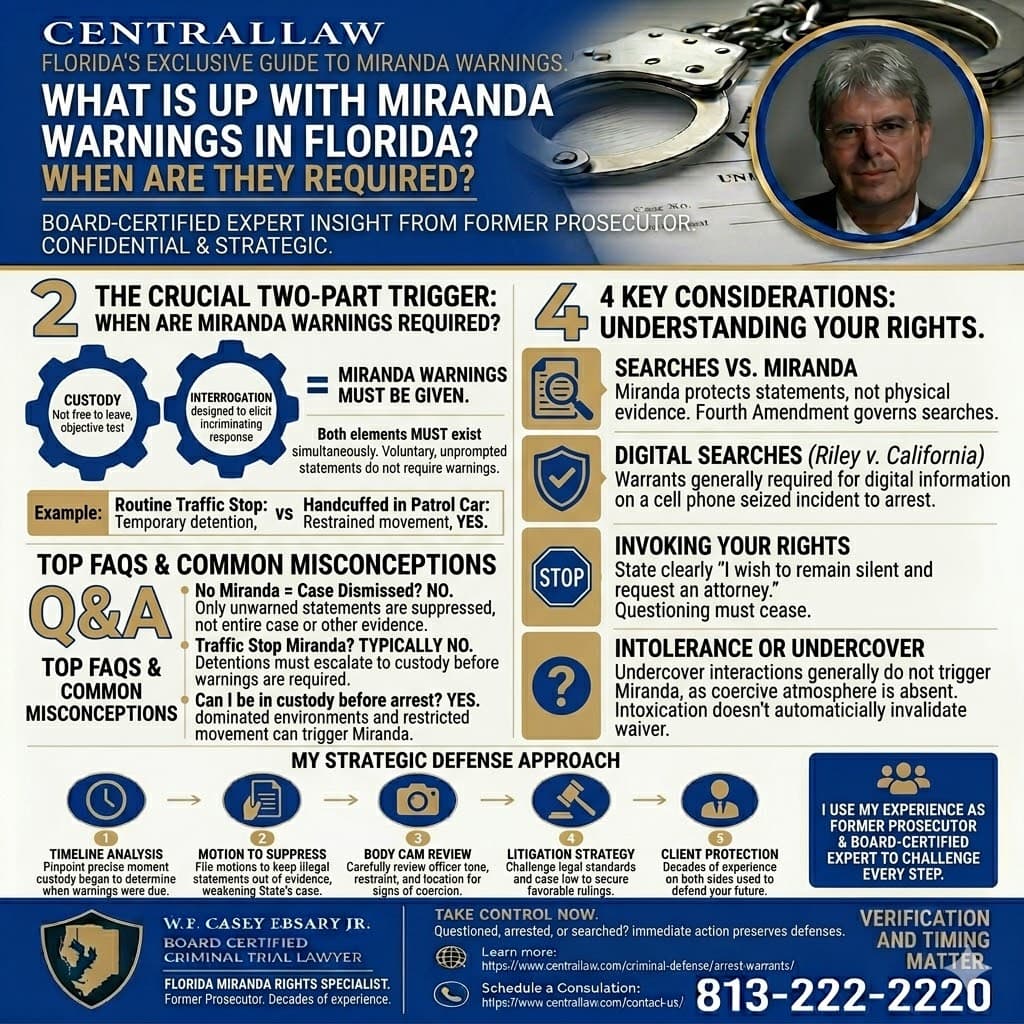
Miranda Warnings in Florida
Miranda Warnings in Florida? In many situations, you have the right to refuse consent to a search of your home, vehicle, or phone. Law enforcement generally needs a valid search warrant signed by a judge, probable cause under a recognized exception, or your voluntary consent. If an officer asks for permission to search, you have the right to clearly and respectfully say that you do not consent. However, you should never physically resist or interfere, even if you believe the search is unlawful.
As a board-certified criminal trial lawyer and former prosecutor, I carefully examine the legality of searches and seizures in every case. If your constitutional rights were violated, I can file motions to suppress evidence, which may significantly weaken or even result in dismissal of the charges.
Learn more about my experience here:
👉 https://www.centrallaw.com/lawyers/w-f-casey-ebsary-jr/
Contact me immediately if your property or phone has been searched:
👉 https://www.centrallaw.com/contact-us/
The Foundation: Miranda v. Arizona
Miranda warnings originate from the United States Supreme Court decision in Miranda v. Arizona (1966). The Court held that under the Fifth Amendment, individuals must be advised of specific rights before custodial interrogation. These protections are designed to safeguard against compelled self-incrimination. However, they are triggered only under defined legal circumstances, not every police interaction.
The key legal trigger is custodial interrogation. That means both custody and questioning designed to elicit incriminating responses must exist at the same time. If one element is missing, Miranda warnings are not legally required. Much of my litigation focuses on precisely where that line is drawn.
When Are Miranda Warnings Required in Florida?
Miranda warnings are required only when a person is in custody and subjected to interrogation. Courts apply an objective test that asks whether a reasonable person would feel free to leave. The officer’s internal belief does not control the analysis. The surrounding circumstances determine the outcome.
Below is a simplified framework I use in court:
| Requirement | Legal Meaning | Litigation Focus |
|---|---|---|
| Custody | Not free to leave under objective circumstances | Timing and restraint |
| Interrogation | Words or actions likely to elicit incriminating response | Nature of questioning |
Understanding Custody
Custody is more than just an arrest. A person can be in custody even before formal arrest if the environment is police dominated and movement is restricted. Courts evaluate the totality of circumstances including location, duration, tone, physical restraint, and whether transportation occurred. I carefully analyze body camera footage and reports to pinpoint the moment custody began.
For example:
| Scenario | Custody? | Miranda Required? |
|---|---|---|
| Routine roadside traffic stop | Typically No | No |
| Handcuffed in patrol vehicle | Yes | Yes |
| Voluntary station interview | Often No | No |
| Formal arrest questioning | Yes | Yes |
What Constitutes Interrogation?
Interrogation includes direct questioning and its functional equivalent. Statements or tactics designed to provoke a response may qualify even if phrased casually. However, spontaneous volunteered statements are usually admissible. I examine whether officers intentionally structured conversation to bypass Miranda requirements.
The Relationship Between Searches and Miranda
Miranda protections apply to statements, not physical evidence obtained through searches. The Fourth Amendment governs search and seizure law. A search can be unlawful even if no Miranda violation occurred. Conversely, Miranda can be violated even if the search was legal.
Courts recognize several search exceptions:
| Exception | Legal Basis | Example |
|---|---|---|
| Consent | Voluntary agreement | Granting permission to search |
| Search Incident to Arrest | Officer safety and evidence preservation | Searching pockets after arrest |
| Automobile Exception | Probable cause vehicle contains evidence | Detecting contraband odor |
| Exigent Circumstances | Emergency | Imminent destruction of evidence |
| Plain View | Immediately apparent illegality | Contraband visible |
In my practice, the issue often turns on whether consent was truly voluntary or subtly coerced.
Digital Searches and Riley v. California
The Supreme Court in Riley v. California held that officers generally must obtain a warrant before searching digital information on a cell phone seized incident to arrest. This decision fundamentally changed how phone evidence is handled. Your smartphone contains extensive personal information, far beyond what traditional search doctrines contemplated. When officers bypass warrant requirements, suppression becomes a powerful defense strategy.
Timeline Analysis in Litigation
I often map events chronologically to determine constitutional violations.
| Stage | Legal Status | Miranda Triggered? |
|---|---|---|
| Initial encounter | Consensual or temporary detention | No |
| Investigative detention | Limited restraint | Usually No |
| Custodial restraint | Not free to leave | Yes |
| Interrogation | Questioning begins | Yes |
Precise timing is everything. A shift of even minutes can determine admissibility.
Frequently Asked Questions About Miranda in Florida

No, a Miranda violation does not automatically result in dismissal of the entire case. The remedy is suppression of improperly obtained statements, not suppression of all evidence. If the prosecution has independent physical evidence or witness testimony, the case may proceed. However, in many cases, a suppressed confession significantly weakens the State’s position and may lead to reduced charges or dismissal.
Generally, they do not because a routine traffic stop is considered a temporary detention rather than custody. Courts view roadside questioning as part of an investigative stop. However, if the stop escalates into a custodial situation, such as prolonged restraint or transport, Miranda may be required. Each case depends on the specific facts and the level of restraint imposed.
If you voluntarily appear and are told you are free to leave, Miranda may not be triggered. Courts analyze whether the encounter remained voluntary or evolved into custody. Factors such as locked doors, officer positioning, or accusatory tone can transform the setting. I examine whether a reasonable person would truly have felt free to walk out.
Yes, you may clearly and unequivocally state that you wish to remain silent and request an attorney. Once properly invoked, interrogation must cease. Ambiguous statements may not be sufficient, which is why clarity matters. Courts carefully review the language used during invocation disputes.
If questioning continues after a clear request for counsel, statements obtained may be suppressed. Courts view post-invocation interrogation as a serious constitutional violation. The prosecution then bears a heavy burden to justify admissibility. These issues frequently arise in suppression hearings.
Undercover interactions generally do not trigger Miranda because the suspect does not perceive custody. The Supreme Court has held that coercive police-dominated atmosphere is the concern Miranda addresses. Without custody, the warnings are not required. This distinction surprises many clients.
They can apply if the probationer is in custody and subjected to interrogation about new criminal conduct. Routine supervisory questioning is typically not custodial. However, if law enforcement participation increases restraint, the analysis may change. I examine the structure and purpose of the interview.
Yes, consent can be revoked at any time prior to completion of the search. The revocation must be clearly communicated. Once withdrawn, officers must stop unless another legal basis exists. Disputes often center on whether revocation was explicit.
Intoxication alone does not automatically invalidate a Miranda waiver. Courts evaluate whether the waiver was knowing, intelligent, and voluntary under the totality of circumstances. Severe impairment can undermine voluntariness. I review video and audio evidence carefully in these cases.
You should contact counsel immediately after arrest or questioning. Early legal intervention can prevent further damaging statements and preserve evidence. Strategic action at the outset often shapes the entire trajectory of the case. Delay can permanently limit available defenses.
Why My Experience Matters

As a board-certified criminal trial lawyer and former prosecutor, I approach Miranda and search issues with practical courtroom insight. I understand how officers are trained to conduct interrogations and draft reports. I know where procedural shortcuts occur. Most importantly, I know how to present suppression arguments persuasively before judges.
I do not assume the police followed every constitutional requirement. I test every step of the investigation. When rights are violated, I act decisively.
Learn more about my qualifications here:
👉 https://www.centrallaw.com/lawyers/w-f-casey-ebsary-jr/
If you or a loved one has been questioned, arrested, or subjected to a search, immediate legal analysis is critical.
👉 Contact me now: https://www.centrallaw.com/contact-us/
Your constitutional rights are not technicalities.
They are protections.
I am here to defend them.