- Free Consultation: (813) 222-2220 Tap Here to Call Us


Say Hello to My Little Evidence: Federal Rule of Evidence 403


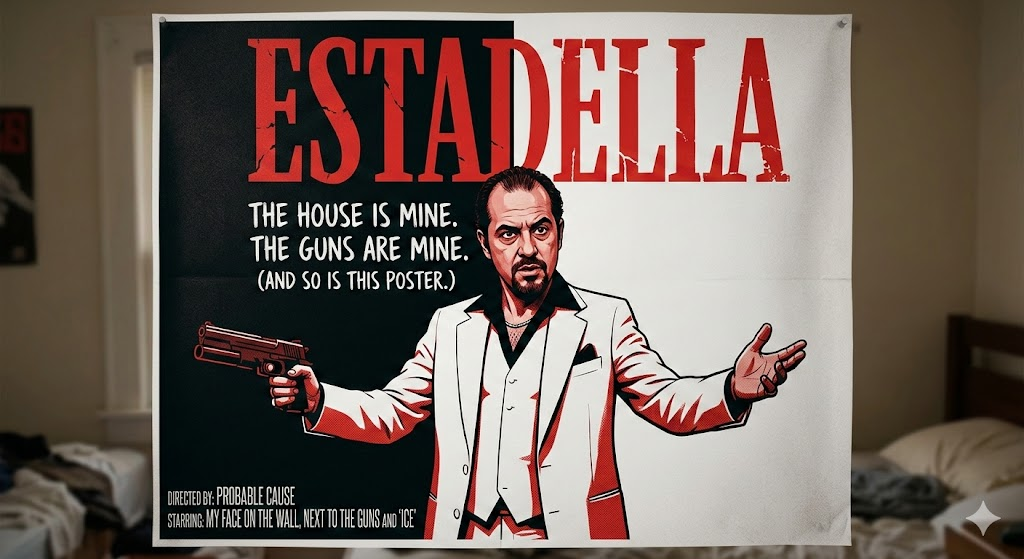
Say Hello to My Little Evidence: The 11th Circuit, the ‘Scarface’ Poster, and the Death of ‘Constructive’ Anonymity in Estadella
Federal Rule of Evidence 403 – When we think of critical evidence in a federal drug and firearm trial, we usually visualize transparent bags of crystal meth, sterile lab reports, and serialized handguns laid out on a felt table. We don’t typically imagine a glossy, customized movie poster featuring the defendant looking really intense in a white three-piece suit.
Yet, that is exactly what the 11th Circuit Court of Appeals had to analyze in United States v. Joan Manuel Estadella, No. 23-11061, decided February 20, 2026. This case, primarily remembered for clarifying the Fourth Amendment rule regarding “common authority” consent when a violent occupant forces a co-resident to flee, also offers a fascinating, almost surreal, case study on Federal Rule of Evidence 403.
The central evidentiary fight was over a poster. Specifically, a standard-issue movie poster for the 1983 classic Scarface (the iconic red, black, and white split-screen design), but with a modification: Joan Manuel Estadella’s own face had been professionally (or perhaps not-so-professionally) superimposed over the face of actor Al Pacino, who played the fictional drug kingpin Tony Montana.
This single object, found on a bedroom wall during a warrantless search that Estadella tried desperately to suppress, became the focal point of a major appellate argument. Was it highly relevant evidence, or was it a cheap, prejudicial shot designed to paint the defendant as a dangerous narco-wannabe?
We are going to explore why the 11th Circuit affirmed the trial court’s decision to show this poster to the jury. We’ll look at the balancing act of Federal Rule of Evidence 403 , how a person’s chosen persona can be used against them in court, and the practical takeaways for criminal defense lawyers in an age of personalized, digital bravado.
Is Your Social Media or Home Decor a Prosecution Exhibit in Waiting? The Estadella case proves that what you think is just “style” or “bravado” can be used as a roadmap for federal prosecutors. If you or a loved one are facing charges where “constructive possession” is a key issue, you need an attorney who understands how the government builds these “persona-based” cases.
Learn more about my experience as a Board Certified Criminal Trial Expert on my Professional Bio Page, or if you need immediate help, Contact the Law Offices of W.F. “Casey” Ebsary, Jr. for a confidential strategy session.
The Setup: The Flight, the Search, and the Discovery
To understand why the poster was relevant, you must understand how the police found it. The entire chain of events began with an incident at a nearby Star Motel, involving a shooting linked to Estadella. Following this leads, police arrived at a residence where Estadella lived with his mother and stepfather.
Upon arrival, officers encountered the stepfather outside a different, nearby home. The stepfather informed police that earlier that day, Estadella had been violent and had chased him out of the main house by pulling a firearm on him. Fearing for his life, the stepfather fled to the nearby address but confirmed he still legally resided at the main house.
Critically, the stepfather gave the officers verbal and written consent to search the main residence. When they entered, they focused on a specific bedroom that appeared to be Estadella’s sanctuary. Inside this room, they recovered multiple firearms, ammunition, and a significant quantity of “ice” methamphetamine (a high-purity, potent form of the drug).
And there, prominently displayed on the wall, right next to the dresser where key Federal Rule of Evidence 403 material was found, was the “Tony Montana/Estadella” hybrid poster.
Rule 403. Exclusion of Relevant Evidence on Grounds of Prejudice, Confusion, or Waste of Time
Although relevant, evidence may be excluded if its probative value is substantially outweighed by the danger of unfair prejudice, confusion of the issues, or misleading the jury, or by considerations of undue delay, waste of time, or needless presentation of cumulative evidence.
Federal Rule of Evidence 403
The Legal Sandbox: Constructive Possession vs. Unfair Prejudice
At trial, Estadella moved to exclude the poster, arguing it violated Federal Rule of Evidence 403. Federal Rule of Evidence 403 is the “great balancer” in American law. It states that a judge may exclude relevant evidence if its “probative value” (its usefulness in proving a fact) is substantially outweighed by the danger of “unfair prejudice.”
1. The Defendant’s Argument: The “Tony Montana” Smear – Federal Rule of Evidence 403
Estadella’s defense was straightforward. The poster, they argued, served only one purpose: to incite the passions of the jury by suggesting Estadella fantasized about being a legendary drug kingpin.
It was character evidence masked as property identification. The defense argued that a jury, seeing his face superimposed over a character synonymous with narcotics violence and the “rise and fall” of a crime empire, wouldn’t convict him based on the evidence found in the dresser. They would convict him because he admired a monster. This, they claimed, was the definition of unfair prejudice—it invited the jury to convict him for his persona rather than his actions.
2. The Government’s Position: Identification and Control
The prosecution argued that the poster was not about character or fantasizing; it was about identity and constructive possession.
In a search that recovers contraband (guns, drugs) from a common dwelling, the government must link those specific items to the defendant. Often, this means proving constructive possession: showing that the defendant, even if not holding the object at the moment of arrest, exercised dominion and control over the area where it was found.
The poster, featuring the defendant’s own face, found inside the single bedroom where the bulk of the drugs and guns were recovered, was powerful evidence that it was his room. It established that he controlled the space. It wasn’t character evidence—it was a location identifier that was impossible to refute. His face was, literally, on the wall.
The 11th Circuit Ruling: Context and Persona under Federal Rule of Evidence 403
The 11th Circuit Court of Appeals upheld the district court’s admission of the poster. They agreed that the Rule 403 balancing test landed in favor of the prosecution.
The court’s logic centered on several key points:
- Proximity and Specificity: The poster was not found in a shared living room; it was in the single bedroom containing the critical contraband. Its proximity made it highly probative of his control over that specific space.
- The Power of Superimposition: The court noted that it wasn’t just any Scarface poster; it was a custom piece featuring his face. This personalization elevated its relevance significantly. It wasn’t a poster owned by just “anyone in the house.” It was unique to the defendant.
- The Intrinsic Link (The YouTube Video): The court also noted that this was part of a larger pattern of self-identification. The trial court had also admitted a YouTube music video where Estadella appeared, handling narcotics at a table covered in guns, and sitting next to ammunition found at the same address. The poster and the video, taken together, created a cohesive and powerful digital and physical footprint of ownership and dominion.
- A “Kingpin” Persona as a Fact: The court noted that Rule 403 does not require evidence to be “sterile” or “pretty.” If a defendant cultivates a persona of being a drug dealer, and that persona helps identify him in a room full of drugs, it is not “unfair” prejudice. It is relevant prejudice.
The court concluded that while the nature of the poster (drug kingpin iconography) had some potential for prejudice, that risk did not substantially outweigh the overwhelming relevance of the object in identifying Estadella as the person who controlled the specific room where the guns and the “ice” meth were stored. The Rule 403 challenge was denied.
Analysis and Takeaway for Practitioners
Your Decor is Evidence
For criminal defense attorneys, Estadella is a stern warning. In a constructive possession case, the “personal items” found during a search—letters, medicine bottles, utilities—are always used to tie a defendant to a room. But Estadella confirms that customized self-image items (like personalized movie posters, custom t-shirts, or even large framed photographs of the defendant in a specific “pose”) are fair game, and highly potent, evidence.
If a client surrounds themselves with customized, idealized versions of themselves, they are essentially providing the government with a localized GPS of their dominion. The argument “It wasn’t my bedroom” crashes against the reality of a giant customized portrait on the wall.
Don’t Let a Misunderstanding of Consent Cost You Your Freedom. The rules for “common authority” and warrantless searches are complex. Understanding when a co-resident can let police into your private space is the first line of defense. I have spent my career navigating these specific Fourth Amendment hurdles in Florida and Federal courts.
Explore my background in complex criminal defense on my About Me page, and reach out via our Secure Contact Form to discuss your search and seizure concerns.
Q&A: Answering Your Common Questions on Estadella and Scarface

Here, we break down the crucial nuances of the 11th Circuit’s ruling for non-lawyers.
A: This was the primary Fourth Amendment challenge in the case, and the 11th Circuit clarified the law. Yes, the search was upheld. Under the “common authority” doctrine, any person who shares access and control over a property (like a spouse, parent, or co-tenant) can provide valid consent to search shared areas. Estadella argued that his stepfather had “abandoned” the property and lost authority when he fled. The court rejected this, ruling that Estadella could not use violence to chase his stepfather out of the home and then legally claim the stepfather had “no say” over the premises. The stepfather remained a co-resident and retained the legal authority to consent to the search.
A: Estadella did object under Rule 404(b), but the court treated the poster primarily as identification evidence under the balancing test of Rule 403, rather than Rule 404(b) “other act” evidence. The government was not arguing that ordering a customized poster was a “prior crime.” They were arguing the poster was an object found in the room that identified the occupant.
Rule 404(b) did apply to the other major piece of controversial evidence—the YouTube music video. The court admitted the video under 404(b), using it to show that Estadella “knowingly possessed both guns and drugs” in the very house where the video was filmed, which was a separate point from simply identifying whose room it was. The poster, however, was treated primarily as physical evidence of possession.
A: Absolutely not. The key feature that made this poster admissible was that the defendant had superimposed his own face onto it.
The 11th Circuit emphasized that this level of personalization is what provided the overwhelming probative value. If the police had found a standard, unmodified Scarface poster (available for $9.99 at any mall kiosk) in a bedroom where three roommates lived, its relevance would be near zero. But because his face was on this poster, it was the closest thing the government had to a signed deed for the room.
A: This is a vital distinction in evidence law. Almost all good evidence used by the prosecution is prejudicial—it is intended to harm the defense’s case.
Rule 403 only bars evidence where the prejudice is unfair. “Unfair” prejudice means it invites the jury to make a decision on an improper, emotional basis, unrelated to the facts of the case. (Example: showing the jury gruesome, graphic autopsy photos of a non-violent financial fraud victim.)
In Estadella, the court ruled the poster was relevant prejudice. It was admitted to show possession (a fact) by linking him to the room where his face was displayed. The fact that the image was also drug-dealer iconography did not make its relevance unfair. It was relevant to who was occupying that drug-and-gun-filled bedroom.
Conclusion: The End of “Just Pretending” in Constructive Possession
The Estadella case is a significant marker for how courts handle personalization and self-mythologizing in the age of custom print-on-demand and social media identities. Joan Manuel Estadella’s mistake wasn’t admiring a movie character; it was creating a personalized, customized link between that character’s fictional criminality and the very real bedroom where real crimes were being plotted.
For defense attorneys, this case highlights that Rule 403 balancing on personal effects is shifting. When the physical evidence literally has the defendant’s face on it, the argument of “dominion and control” is almost impossible for the government to lose. Your decor, your customized apparel, and your digital footprint of bravado aren’t just “likes”; they are location-specific admissions of possession. Joan Manuel Estadella’s customized poster was a “little friend” that the jury got to say hello to, and it helped secure his 96-month sentence.
Facing Federal Charges? You Need an Attorney Who Understands the “New” Evidence. From custom Scarface posters to YouTube music videos, the landscape of criminal evidence is shifting. You need a defense team that isn’t just familiar with the law, but knows how to aggressively challenge the “persona” the government tries to build against you.
As a Florida Board Certified Criminal Trial Lawyer with almost 40 years of experience, I am ready to fight for your rights.
- Review my credentials and case history: W.F. “Casey” Ebsary, Jr. Bio
- Get started on your defense today: Contact Us Online or call our office directly to protect your future.
Complete Opinion located here:
Official Opinion Link: USCA11 Case: 23-11061 – United States v. Estadella (PDF)
USCA11 Case: 23-11061 Document: 74-1 Date Filed: 02/20/2026 Page: 1 of 43
FOR PUBLICATION
In the United States Court of Appeals
For the Eleventh Circuit
____________________ No. 23-11061 ____________________
UNITED STATES OF AMERICA,
Plaintiff-Appellee, versus
JOAN MANUEL ESTADELLA,
Defendant-Appellant. ____________________ Appeal from the United States District Court for the Southern District of Florida D.C. Docket No. 1:21-cr-20374-RKA-1 ____________________
Before JORDAN, HULL, and MARCUS, Circuit Judges.
HULL, Circuit Judge:
Following a jury trial, defendant Joan Estadella appeals his convictions and 96-month sentence on an 18 U.S.C. § 922(g)(1) felon in possession of a firearm count and a 21 U.S.C. § 841(a)(1) possession with intent to distribute methamphetamine count. On
USCA11 Case: 23-11061 Document: 74-1 Date Filed: 02/20/2026 Page: 2 of 43
2 Opinion of the Court 23-11061
appeal, Estadella challenges (1) the denial of his motion to suppress evidence; (2) the admission of parts of the government’s evidence; (3) the denial of his Federal Rule of Criminal Procedure 29 motion for judgment of acquittal as to his § 841(a)(1) drug conviction; (4) the overruling of his prosecutorial misconduct objection; (5) all of these rulings as cumulative error; and (6) the calculation of his base offense level at sentencing.
After careful review of the record and the parties’ briefs, and with the benefit of oral argument, we affirm Estadella’s convictions and sentence.
I. INDICTMENT
An indictment in the Southern District of Florida charged Estadella with (1) possessing a Taurus 9mm pistol with serial number TLZ57339 and its ammunition as a convicted felon between November 28, 2020, and December 1, 2020, in violation of 18 U.S.C. §§ 922(g)(1) and 924(a)(2) (Count 1); (2) possessing a Springfield Armory .380 caliber pistol with serial number CC121963 and its ammunition as a convicted felon between November 30, 2020, and December 1, 2020, in violation of 18 U.S.C. §§ 922(g)(1) and 924(a)(2) (Count 2); (3) possessing methamphetamine with intent to distribute, in violation of 21 U.S.C. § 841(a)(1) (Count 3); and (4) possessing a firearm in furtherance of a drug trafficking crime, in violation of 18 U.S.C. § 924(c)(1)(A)(i) (Count 4). Estadella pled not guilty and proceeded to trial.
USCA11 Case: 23-11061 Document: 74-1 Date Filed: 02/20/2026 Page: 3 of 43
23-11061 Opinion of the Court 3
II. TRIAL EVIDENCE
During a four-day jury trial, the government called eleven witnesses. Multiple members of the Hialeah Police Department testified, including: Detectives Kinshun Mui and Daniel Gato, Crime Scene Technicians Amber Perez and Genesis Prescott, and Sergeant Gene De Lima. Three members of the Miami-Dade Police Department’s crime laboratory testified: Tyler Brown as a firearms identification expert, and Jonathan Lawrence and Cara Lopez as DNA analysts. From the Drug Enforcement Administration (“DEA”), forensic chemist Manuel Febo testified and described lab results for narcotics seized, and Special Agent Shaun Perry testified as an expert in street-level drug trafficking. Dianellys Estadella—the defendant’s fraternal twin sister—also testified. Collectively, their testimony showed as follows.
A. Star Motel Shooting and Arrest
On November 28, 2020, a shooting and possible abduction occurred at the Star Motel, located in Hialeah, Florida. Two days later, Detective Mui of the Hialeah Police Department began investigating the incident. As part of his investigation, Mui collected surveillance video from the Star Motel and surrounding businesses. Surveillance videos were played for the jury, and Mui described their contents at length.
The suspects arrived at the Star Motel in a white work van with two ladders on the roof. Two men wearing distinctive clothing exited the van and walked to the rear of the building. The taller man had on a neon yellow-green mask, while the shorter
USCA11 Case: 23-11061 Document: 74-1 Date Filed: 02/20/2026 Page: 4 of 43
4 Opinion of the Court 23-11061
man wore a dark olive-green shirt, dark mask, Jordan brand sneakers, rubber-coated work gloves, and a blue hat with “Miami” in white, cursive font embroidered on the front.
The two men approached one of the guest rooms of the motel and drew their pistols. The taller man wielded a medium- framed silver and purple pistol, while the shorter man bore a small, black pistol. The suspects tried to force their way into the room. During the ensuing struggle, the taller man fired a shot into the room. The two men then departed, escorting a woman from the motel room. The assailants and their apparent captive drove away in the white work van.
During his review of the surveillance footage, Detective Mui observed an occupational license number on the white work van. The number was associated with J and M Electric LLC (“J&M Electric”), an entity whose registered agent and manager was listed as Defendant Estadella. J&M Electric’s principal place of business was a residential address on West 17th Street in Hialeah, Florida (the “West 17th property”).
Shortly after performing a “drive through” of the residential neighborhood where J&M Electric was based, Sgt. De Lima spotted the white work van from the surveillance footage and initiated a traffic stop. Officers identified Estadella, whom Sgt. De Lima described as “very short and stocky,” as the driver of the van. Estadella’s girlfriend, Yoana Quevedo, was riding along as a passenger. Based on their possible connection to the Star Motel
USCA11 Case: 23-11061 Document: 74-1 Date Filed: 02/20/2026 Page: 5 of 43
23-11061 Opinion of the Court 5
incident, both Estadella and his girlfriend were taken into custody, and the van was impounded.
B. The West 17th Property
In addition to being J&M Electric’s listed address, the West 17th property served as Estadella’s residence. Acquired in 2011, the property initially functioned as a “family home” for multiple generations of the Estadella family, including Estadella, his sister Dianellys, their mother and stepfather, Estadella’s son, and Dianellys’s two daughters. The West 17th property was owned by Estadella’s (1) mother and (2) stepfather, Lazaro Soriano.
Later in 2011, Dianellys and her daughters moved out. Estadella then took possession of the main bedroom with a connected bathroom. Estadella also converted a back bedroom into an office and placed a keypad lock on the door. Around 2017, shortly after Estadella’s mother passed away, Estadella’s girlfriend moved into the property with Estadella.
After the mother’s passing, Soriano became the sole owner of the house. At the time Estadella was arrested, Detective Mui and Sgt. De Lima believed Soriano owned the residence.
C. Searches of the West 17th Property
On November 30, Soriano gave detectives verbal and written consent to search the West 17th property. At the home, Soriano even used his key to allow officers into the house.
Once inside, Detective Mui saw the same Jordan shoes and “Miami” baseball cap that he had observed in the surveillance
USCA11 Case: 23-11061 Document: 74-1 Date Filed: 02/20/2026 Page: 6 of 43
6 Opinion of the Court 23-11061
footage from the Star Motel. These items were in Estadella’s bedroom and the connected bathroom. Later on, DNA in the baseball cap matched a sample taken from Estadella.
Based on their observations, the officers withdrew, and Detective Mui applied for a search warrant allowing officers to search the residence for evidence related to the Star Motel shooting. On December 1, while the application for a search warrant was pending, Mui allowed Soriano to enter the residence under police escort to retrieve his dogs and medicine. The search warrant on the residence was issued later that day.
After obtaining the search warrant, officers continued their search of the West 17th property. In common areas, officers found an olive-green shirt and gardening gloves with rubberized palms—items believed to have been worn by the shorter suspect in the Star Motel incident. Within Estadella’s bathroom, officers found the firearm and ammunition charged in Count 2: a black, compact pistol manufactured by Springfield Armory with serial number CC121963 and loaded with five rounds of ammunition.
During execution of the search warrant, officers discovered Estadella’s locked office with a keypad code at the back of the house. Without the code, officers forced their way into the room. The room contained a large J&M Electric poster, a desk, business files, and computers. A bulletin board had J&M Electric flyers and business cards pinned to it. A small Scarface movie poster sat atop a mess of files on the desk. Instead of depicting Al Pacino as the
USCA11 Case: 23-11061 Document: 74-1 Date Filed: 02/20/2026 Page: 7 of 43
23-11061 Opinion of the Court 7
fictional drug kingpin Tony Montana, the poster was altered, with Estadella’s face superimposed over Pacino’s.
In a file box underneath the desk, officers uncovered a black bag with suspected narcotics inside. This prompted the officers to withdraw and obtain a search warrant allowing them to search for and seize narcotics-related evidence.
After obtaining the additional warrant, Detective Gato of the narcotics unit continued searching the office. Gato described the black bag as a narcotics “trafficking kit” containing “basically everything that someone would need to sell or distribute narcotics,” including: spoons, a measuring cup, digital scales, empty plastic baggies, and several baggies of suspected narcotics. Gato collected thirty baggies of suspected narcotics from the back office. Lab tests showed the substances recovered contained 31 grams of methamphetamine with 93% purity, or 28.8 grams of pure methamphetamine. Special Agent Shaun Perry opined that the packaging and quantity of methamphetamine was consistent with the distribution and sale of narcotics, rather than personal use.
Other officers returned to Estadella’s bedroom and found the firearm and ammunition charged in Count 1: a loaded silver and purple Taurus 9mm pistol with serial number TLZ57339. The government’s firearm identification expert testified that a shell casing recovered from the Star Motel was ejected from this Taurus 9mm.
USCA11 Case: 23-11061 Document: 74-1 Date Filed: 02/20/2026 Page: 8 of 43
8 Opinion of the Court 23-11061
D. Search of Estadella’s Van
Pursuant to a separate search warrant, Detective Mui and others searched the white van Estadella was driving at the time of his arrest. Within a bag stored in the center console, they found a Smith and Wesson pistol. This pistol was not charged in the indictment. The district court instructed the jury to consider it only for the purpose of determining Estadella’s state of mind. See Fed. R. Evid. 404(b).
E. YouTube Music Video
The government played a YouTube music video filmed within the West 17th property. As one individual freestyle raps in Spanish, the video depicts Estadella and others playing poker at a table covered in poker chips and firearm magazines. Detective Mui viewed the video and (1) identified Estadella based on his distinctive tattoos; and (2) stated the video took place inside the West 17th property. The singer repeatedly bears a pistol. At one point, the camera focuses on a plate covered by small baggies of suspected narcotics. Dianellys testified that the hands holding the plate belonged to her brother, Estadella.
The district court provided a limiting instruction both times the YouTube video was mentioned. The district court told the jury they must consider the video “only . . . to determine whether or not the defendant had the state of mind to commit the crimes that are charged in the indictment.”
USCA11 Case: 23-11061 Document: 74-1 Date Filed: 02/20/2026 Page: 9 of 43
23-11061 Opinion of the Court 9
F. Stipulations
The parties stipulated that Estadella (1) was convicted of a felony offense prior to November 28, 2020; and (2) knew he was convicted of a felony offense.
The parties also stipulated that the Springfield Armory .380 caliber pistol, Taurus 9mm pistol, and associated ammunition qualified as “firearms” and “ammunition” as defined in 18 U.S.C. § 921(a)(3) and (17). The parties agreed the firearms and ammunition described “were all manufactured outside of the State of Florida and thus have moved in interstate or foreign commerce prior to November 28, 2020.”
G. Verdict and Sentence
The jury found Estadella guilty (1) of the felon in possession of a firearm charges in Counts 1 and 2; and (2) of the possession with intent to distribute methamphetamine charge in Count 3. The jury found Estadella not guilty of the possession of a firearm in furtherance of a drug trafficking crime charge in Count 4.
After his conviction, Estadella moved to dismiss Count 2, which charged him with possessing the Springfield Armory .380 caliber pistol as a convicted felon. Estadella argued his conviction on Count 2 and for the Taurus 9mm pistol in Count 1 created a double jeopardy problem because “[t]he ‘simultaneous possession of several weapons constitutes only one offense under Section [922(g)].’” United States v. Grinkiewicz, 873 F.2d 253, 255 (11th Cir. 1989) (per curiam) (quoting United States v. Smith, 591 F.2d 1105, 1107 (5th Cir. 1979)), abrogated in part on other grounds by, United
USCA11 Case: 23-11061 Document: 74-1 Date Filed: 02/20/2026 Page: 10 of 43
10 Opinion of the Court 23-11061
States v. Clarke, 822 F.3d 1213 (11th Cir. 2016) (per curiam). Estadella’s motion indicated that the government joined the request to dismiss Count 2.
The district court granted Estadella’s unopposed motion and dismissed Count 2 of the indictment. The district court sentenced Estadella to concurrent 96-month terms of imprisonment on Counts 1 and 3.
Estadella timely appealed.
III. STANDARDS OF REVIEW
We review the denial of a motion to suppress under a mixed standard, reviewing the district court’s factual findings for clear error and the application of the law to those facts de novo. United States v. Graham, 123 F.4th 1197, 1238 (11th Cir. 2024) (citing United States v. Ford, 784 F.3d 1386, 1391 (11th Cir. 2015)).
We review evidentiary rulings under an abuse of discretion standard. United States v. Akwuba, 7 F.4th 1299, 1313 (11th Cir. 2021). “Because we recognize a significant range of choice for the district court on evidentiary issues, our review of such rulings is very limited[,] and we defer to the district court’s decisions to a considerable extent.” Id. (citation modified).
Generally, we review de novo the denial of a motion for a judgment of acquittal based on the sufficiency of the evidence. United States v. Hano, 922 F.3d 1272, 1283 (11th Cir. 2019). “This Court views the evidence ‘in the light most favorable to the government, with all reasonable inferences and credibility choices
USCA11 Case: 23-11061 Document: 74-1 Date Filed: 02/20/2026 Page: 11 of 43
23-11061 Opinion of the Court 11
made in the government’s favor.’” United States v. Anderson, 326 F.3d 1319, 1326 (11th Cir. 2003) (quoting United States v. Miles, 290 F.3d 1341, 1355 (11th Cir. 2002) (per curiam)). “But when a defendant challenges the sufficiency of the evidence on a ground not argued before the district court, we review for plain error.” United States v. Al Jaberi, 97 F.4th 1310, 1322 (11th Cir. 2024) (citing United States v. Baston, 818 F.3d 651, 664 (11th Cir. 2016)).
We typically review de novo a claim of prosecutorial misconduct. Id. (citing United States v. Horner, 853 F.3d 1201, 1206 (11th Cir. 2017)).
We review de novo claims of cumulative error. United States v. Green, 158 F.4th 1347, 1365 (11th Cir. 2025) (citing United States v. Pendergrass, 995 F.3d 858, 881 (11th Cir. 2021)).
“We review de novo the interpretation and application of the Sentencing Guidelines.” United States v. Kluge, 147 F.4th 1291, 1296 (11th Cir. 2025) (quoting United States v. Dupree, 57 F.4th 1269, 1272 (11th Cir. 2023) (en banc)). The district court’s factual findings at sentencing, however, are reviewed under the clearly erroneous standard. United States v. Bergman, 852 F.3d 1046, 1070 (11th Cir. 2017) (citing United States v. Moran, 778 F.3d 942, 959 (11th Cir. 2015)).
IV. MOTION TO SUPPRESS
Estadella contends that the district court erred when it denied his motion to suppress all evidence discovered during search of his residence. Particularly, Estadella argues Soriano was neither a co-occupant nor owner of the West 17th property as of
USCA11 Case: 23-11061 Document: 74-1 Date Filed: 02/20/2026 Page: 12 of 43
12 Opinion of the Court 23-11061
November 30, 2020, meaning Soriano could not provide valid consent to the initial search of the residence.
The district court held an evidentiary hearing on Estadella’s motion and heard testimony that provided more detail regarding both (1) ownership and possession of the West 17th property and (2) the events leading to the search. We summarize the relevant testimony and the district court’s findings.
A. Evidentiary Hearing
1. Move Out and Quitclaim Deed
By November 2020, Estadella, his son, Quevedo, and Soriano lived in the West 17th property. Around a week before Estadella’s arrest, near Thanksgiving of 2020, Soriano and Estadella had a disagreement over Estadella’s use of Soriano’s car. Estadella escalated the disagreement by punching Soriano in the face, breaking his nose.
Estadella’s violence caused Soriano to move temporarily to Dianellys’s nearby home. Soriano testified that he feared Estadella, but felt safe with Dianellys, who took “very good care of” the elderly Soriano. A relative and her boyfriend helped Soriano move his bed to Dianellys’s home.
Nonetheless, Soriano’s other furniture, clothing, personal objects, and even his dogs remained in the West 17th property. During his testimony, Soriano emphasized that he only intended to stay with Dianellys “temporarily.”
USCA11 Case: 23-11061 Document: 74-1 Date Filed: 02/20/2026 Page: 13 of 43
23-11061 Opinion of the Court 13
On November 23, 2020, Soriano executed a quitclaim deed conveying his interest in the West 17th property to Dianellys and one of Dianellys’s daughters. Execution of the deed was witnessed by two people, and the deed was notarized. Dianellys filed the deed with Miami-Dade County. As of November 30, the deed was not yet processed and recorded. Dianellys believed the deed was not legally effective until it was recorded. Soriano similarly believed he retained title to the property after his execution of the quitclaim deed.
2. Obtaining Search Consent on November 30
Detectives Mui, Joseph Elosegui, and Daniel Pelaez testified and described the events of November 30, 2020, which led to them seeking and receiving Soriano’s consent to search the West 17th property. During his initial traffic stop and arrest, Estadella told Mui that he lived at the West 17th property with his girlfriend, son, and Soriano. Back at the station, Estadella refused to consent to the search of the West 17th property. Estadella told the detectives that his stepfather, Soriano, owned the home.
Detective Pelaez traveled to the West 17th property and was greeted by Estadella’s juvenile son. Estadella’s son informed Pelaez that the home belonged to Soriano, who was at a nearby residence. Pelaez, now joined by Detective Elosegui, went to Dianellys’s nearby home. The two detectives found Soriano and Dianellys. While en route, Elosegui searched Miami-Dade County records
USCA11 Case: 23-11061 Document: 74-1 Date Filed: 02/20/2026 Page: 14 of 43
14 Opinion of the Court 23-11061
and verified that Soriano was listed as the owner of the West 17th property.1
Soriano informed the two detectives that he owned the West 17th property, although Soriano mentioned he was transferring the property to Dianellys via quitclaim deed. Soriano gave the detectives verbal and written consent to search the entire West 17th property. Dianellys too gave verbal consent to search the home.
Soriano accompanied Detectives Elosegui and Pelaez back to the West 17th property. There, Detective Mui reunited with the group. Soriano used his key to open the door to the residence and allow the detectives to enter.
As recounted previously, the discovery of distinctive clothing seen in the Star Motel surveillance footage caused the detectives to stop and go obtain several search warrants and uncover most of the remaining evidence in this case.
B. District Court’s Findings
The district court denied Estadella’s motion to suppress for at least three alternative reasons. First, the district court found Soriano had actual authority to consent to a search of the West 17th property as a co-possessor of the property. The district court credited Soriano and Dianellys’s testimony that Soriano
1 As we noted earlier, the quitclaim deed conveying the West 17th property to Dianellys and her daughter was not yet recorded. It is not disputed that under Florida law the deed was effective at the date of execution.
USCA11 Case: 23-11061 Document: 74-1 Date Filed: 02/20/2026 Page: 15 of 43
23-11061 Opinion of the Court 15
temporarily left the property only because of Estadella’s physical attack. The district court reasoned that a defendant could not force a co-occupant out of a property and then successfully claim the former co-occupant had lost their co-possessory interest and ability to consent to search of that property.
Further, the district court found ample evidence supported a finding that Soriano still resided at and co-possessed the West 17th property, including (1) Estadella’s own statement that Soriano resided at the property; and (2) testimony that most of Soriano’s belongings remained at the property. In the district court’s view, Soriano remained a co-possessor of the West 17th property with actual authority to provide consent to search on November 30, 2020.
Second, the district court found Soriano’s consent to search was effective since Soriano had apparent authority over the property as the purported owner. The district court explained that officers reasonably believed Soriano owned the West 17th property based on several facts, including: (1) Estadella, his son, Soriano, and Dianellys all told the detectives that Soriano owned the property; (2) Soriano possessed a key to the home and opened the home for the officers; and (3) Miami-Dade County property records listed Soriano as the owner of the home.
Third, the district court found Dianellys had consented to the search as the true owner of the property. In this regard, the district court concluded that, under Florida law, the quitclaim deed was effective at the date of execution, regardless of whether the
USCA11 Case: 23-11061 Document: 74-1 Date Filed: 02/20/2026 Page: 16 of 43
16 Opinion of the Court 23-11061
deed was recorded. As of November 30, 2020, Dianellys thus owned the West 17th property and had actual authority to consent to the search.
As to both Soriano and Dianellys’s consent, the district court found that their consent to search the property was unlimited. Even assuming their consent could not extend to parts of the house, such as Estadella’s locked office, the district court noted the detectives obtained a search warrant before entering the locked office inside the property.
C. The Fourth Amendment and Consent Searches
The Fourth Amendment protects “[t]he right of the people to be secure . . . against unreasonable searches and seizures.” U.S. Const. amend. IV. “As the text makes clear, ‘the ultimate touchstone of the Fourth Amendment is reasonableness.’” United States v. Harden, 104 F.4th 830, 833 (11th Cir. 2024) (quoting Riley v. California, 573 U.S. 373, 381 (2014)). The Fourth Amendment evinces a “strong preference” that searches be performed pursuant to a warrant, and warrantless searches of a home are presumptively unreasonable. United States v. Grushko, 50 F.4th 1, 10–11 (11th Cir. 2022) (citing Payton v. New York, 445 U.S. 573, 586 (1980)).
While the “Fourth Amendment generally prohibits the warrantless entry of a person’s home[,] . . . [t]he prohibition does not apply . . . to situations in which voluntary consent has been obtained, either from the individual whose property is searched . . . or from a third party who possesses common authority over the premises.” Illinois v. Rodriguez, 497 U.S. 177, 181
USCA11 Case: 23-11061 Document: 74-1 Date Filed: 02/20/2026 Page: 17 of 43
23-11061 Opinion of the Court 17
(1990) (citations omitted); see also Fernandez v. California, 571 U.S. 292, 298 (2014) (providing that law enforcement may carry out a warrantless search when they obtain consent from the sole owner or occupant of a home).
A consent to search “must be voluntary—not the ‘product of duress or coercion.’” Dukes v. Sheriff of Levy Cnty., 155 F.4th 1291, 1297 (11th Cir. 2025) (quoting Schneckloth v. Bustamonte, 412 U.S. 218, 227 (1973)). The permissible reach of a consent search is limited by the scope of the given consent, as understood by a reasonable person. Florida v. Jimeno, 500 U.S. 248, 251 (1991).
D. Consent and Co-occupants
On several occasions, the Supreme Court has analyzed the constitutionality of a warrantless search when one occupant consents to a search of a space shared with another occupant who (1) objects to the search and (2) later moves to suppress evidence discovered during the search. See United States v. Matlock, 415 U.S. 164 (1974); Georgia v. Randolph, 547 U.S. 103 (2006); Fernandez, 571 U.S. at 301–07. We review these decisions.
In United States v. Matlock, the Supreme Court held voluntary consent to search may be “obtained from a third party who possessed common authority over or other sufficient relationship to the premises or effects sought to be inspected.” 415 U.S. at 171 (emphasis added). The Supreme Court explained that “common authority” was not based upon a person’s property interest and, instead, reasoned:
USCA11 Case: 23-11061 Document: 74-1 Date Filed: 02/20/2026 Page: 18 of 43
18 Opinion of the Court 23-11061
Common authority . . . rests rather on mutual use of the property by persons generally having joint access or control for most purposes, so that it is reasonable to recognize that any of the co-inhabitants has the right to permit the inspection in his own right and that the others have assumed the risk that one of their number might permit the common area to be searched. Id. at 171 n.7; see also Randolph, 547 U.S. at 110 (summarizing Matlock). The Supreme Court later clarified that common authority could be actual or apparent, and a consent search was not impermissible if law enforcement reasonably, but mistakenly, believed the person providing consent had common authority over the property. Rodriguez, 497 U.S. at 186.
Next came Georgia v. Randolph, where law enforcement searched a couple’s marital home after the wife “readily gave” consent for the search, but the physically present husband “unequivocally refused” to give consent. 547 U.S. at 107. The Supreme Court turned to “widely shared social expectations” to assess the Fourth Amendment reasonableness of the search and noted that a visitor would not feel confident entering a home on one occupant’s invitation when the “fellow tenant stood there saying, ‘stay out.’” Id. at 111, 113. Because neither co-occupant had a superior right vis-à-vis the other, the Supreme Court reasoned that the objected-to consent was akin to “the absence of any consent at all.” Id. at 114. The Supreme Court therefore held “that a warrantless search of a shared dwelling for evidence over the express refusal of consent by a physically present resident cannot be
USCA11 Case: 23-11061 Document: 74-1 Date Filed: 02/20/2026 Page: 19 of 43
23-11061 Opinion of the Court 19
justified as reasonable as to him on the basis of consent given to the police by another resident.” Id. at 120 (emphasis added).
Then, in Fernandez v. California, the Supreme Court clarified that Randolph applied only to situations where the objecting co-occupant is physically present at the premises. Fernandez, 571 U.S. at 294. In other words, a co-occupant’s objection to a search does not vitiate another co-occupant’s consent when the objecting occupant is not physically present at the premises. Id. The Supreme Court also reasoned that it did not matter that the objecting co-occupant’s absence was caused by an objectively justifiable arrest. Id. at 302–03.
E. Discussion
We readily conclude, as the district court found, that the evidence demonstrated that Soriano had actual authority to consent to the search of the West 17th property.
At the time he consented to the search, Soriano qualified as a co-occupant with common authority over the West 17th property. Estadella himself told detectives on November 30, 2020, that Soriano resided at the property. Soriano possessed a key to the property. Nearly all of Soriano’s possessions—even his dogs—remained at the West 17th property. Cf. United States v. Backus, 349 F.3d 1298, 1301, 1304 (11th Cir. 2003) (concluding wife retained common authority over home where almost all her belongings, including her pets, remained in the home). And Soriano had moved his bed from the property only days earlier. Soriano testified that his absence from the property was only
USCA11 Case: 23-11061 Document: 74-1 Date Filed: 02/20/2026 Page: 20 of 43
20 Opinion of the Court 23-11061
intended to be temporary. Everyone involved—including Estadella—believed Soriano owned the property.
These facts clearly show Soriano retained the type of joint access and control of the West 17th property to provide him with “common authority” over the property. Cf. Rodriguez, 497 U.S. at 181–82 (stating no common authority over apartment was had by person who moved out a month prior, left some furniture behind but was not on the lease, had stolen a key to the apartment, and never accessed the premises without the leaseholder present). And, as the district court found, Soriano’s consent was unlimited in scope and given voluntarily.
Estadella argues that Soriano lacked common authority over the property because he no longer resided there. That argument fails because one occupant cannot force a co-occupant out of a property through physical violence and then successfully claim the co-occupant lacks common authority over the property. This Court held as much in United States v. Backus, where a wife and child fled the marital home due to the husband’s abuse. 349 F.3d at 1304. We refused to “condone and reward violent, abusive behavior” and, instead, concluded that the wife, who had fled six months prior, had maintained sufficient common authority over the marital home to consent to a search of the home. Id. at 1302, 1304–05. Backus applies with equal force here, where the district court found the elderly Soriano would not have departed the West 17th property but for Estadella’s violence against him.
USCA11 Case: 23-11061 Document: 74-1 Date Filed: 02/20/2026 Page: 21 of 43
23-11061 Opinion of the Court 21
Estadella’s argument also fails because Soriano (1) moved his bed but kept his other possessions, furniture, and dogs at the West 17th property; (2) retained his key to the property; and (3) testified he only intended to stay at Dianellys’s temporarily. Given this evidence, the district court did not err in its finding Soriano remained a co-resident at the West 17th property.
We conclude that Soriano retained common authority over the West 17th property despite his brief departure from the property. We recognize that Estadella declined to give consent to search the property before detectives sought out Soriano. But Estadella’s objection was made at the police station. When Soriano consented to the search and opened the home for detectives, Estadella was not physically present at the West 17th property. Under Fernandez, therefore, Estadella’s objections were ineffectual and did not prevent detectives from permissibly acting on Soriano’s consent. That Estadella’s absence was caused by his arrest matters not, because his arrest was objectively justified for his suspected role in the Star Motel incident. See Fernandez, 571 U.S. at 302–03.
In sum, we conclude that law enforcement (1) obtained consent from Soriano, who had common authority over the property, and thus (2) carried out an initial warrantless search of the West 17th property consistent with the Fourth Amendment.
USCA11 Case: 23-11061 Document: 74-1 Date Filed: 02/20/2026 Page: 22 of 43
22 Opinion of the Court 23-11061
We therefore affirm the district court’s denial of Estadella’s motion to suppress.2
V. ADMISSION OF STAR MOTEL, MOVIE POSTER, AND
YOUTUBE VIDEO EVIDENCE
Estadella argues the district court erroneously admitted evidence regarding the Star Motel incident, Scarface poster, and YouTube music video. We disagree and explain why.
A. Background
Pretrial, the government filed an omnibus motion in limine which, in relevant part, sought to confirm the admissibility of (1) evidence about the Star Motel incident, (2) the Scarface poster, and (3) the YouTube music video. Estadella opposed the motion. At a hearing, the district court granted the part of the motion relevant here.
The district court first reasoned that evidence relating to the Star Motel shooting was admissible as intrinsic to Count 1’s felon in possession of a firearm charge. That count alleged Estadella had possessed the silver and purple 9mm pistol from November 28, 2020—the date of the Star Motel shooting—to December 1, 2020.
2 Because we conclude that Soriano had actual authority and provided valid consent to search as a co-occupant with common authority, we need not address whether (1) Soriano had apparent authority to provide valid consent as the supposed owner of the property; or (2) Dianellys could provide valid consent to the search as the true titleholder of the property.
USCA11 Case: 23-11061 Document: 74-1 Date Filed: 02/20/2026 Page: 23 of 43
23-11061 Opinion of the Court 23
The district court found that the shooting evidence was inextricably intertwined with the charged offenses.
Next, the district court found the Scarface poster depicting Estadella as Tony Montana and displayed in Estadella’s back, locked office was admissible to show (1) Estadella’s control over the room where the methamphetamine was found; and (2) that Estadella, like drug kingpin Tony Montana in Scarface, intended to distribute the methamphetamine.
The district court also found the YouTube music video, which showed Estadella surrounded by guns, ammunition, and drugs in the West 17th property itself, was admissible under Rule 404(b) to show Estadella’s knowledge of drugs in the property, control over the property, intent, and absence of surprise or mistake.
B. Star Motel
For starters, the district court did not abuse its discretion in admitting evidence of the Star Motel incident as intrinsic to the firearm charges against Estadella.
“Evidence is admissible as intrinsic if it is either ‘(1) an uncharged offense which arose out of the same transaction or series of transactions as the charged offense, (2) necessary to complete the story of the crime, or (3) inextricably intertwined with the evidence regarding the charged offense.’” United States v. Beasley, 160 F.4th 1199, 1207 (11th Cir. 2025) (quoting United States v. Troya, 733 F.3d 1125, 1131 (11th Cir. 2013)).
USCA11 Case: 23-11061 Document: 74-1 Date Filed: 02/20/2026 Page: 24 of 43
24 Opinion of the Court 23-11061
Evidence of the Star Motel incident was inextricably intertwined with evidence relevant to Estadella’s firearm charges. See Fed. R. Evid. 401 (providing that evidence is relevant when it has any tendency to make a fact of consequence more or less probable). Surveillance video from the motel depicted an individual suspect who resembled Estadella wielding a small firearm of similar appearance to the Springfield Armory .380 caliber pistol later discovered in his home and charged in Count 2. And that suspect’s partner carried and discharged the silver and purple Taurus 9mm charged in Count 1. Other evidence about the white van tied Estadella to the shooting. The Star Motel evidence thus was probative of when and how Estadella came to possess one or both of the firearms charged in the indictment. The events at the Star Motel could not be separated from evidence regarding the firearms.
Additionally, the Star Motel incident was both (1) the first step in the “chain of events” of this case and (2) necessary to complete the story of how and why detectives zeroed in on Estadella, took him into custody, searched his home, and discovered almost all the evidence in this case. See United States v. Edouard, 485 F.3d 1324, 1344 (11th Cir. 2007) (stating evidence “pertaining to the chain of events explaining the context, motive[,] and set-up of the crime” may be admitted (quoting United States v. McLean, 138 F.3d 1398, 1403 (11th Cir. 1998))).
Contrary to Estadella’s arguments, the Star Motel evidence was not unduly prejudicial nor unnecessarily cumulative. Evidence
USCA11 Case: 23-11061 Document: 74-1 Date Filed: 02/20/2026 Page: 25 of 43
23-11061 Opinion of the Court 25
may be excluded when “its probative value is substantially outweighed by a danger of . . . unfair prejudice . . . or needlessly presenting cumulative evidence.” Fed. R. Evid. 403.
Here, the district court made a finding that the probative value of the Star Motel evidence was not substantially outweighed by the risk of unfair prejudice. As the district court reasoned, the risk of undue prejudice was somewhat low because the Star Motel incident did not involve an injury or death of a victim or any graphic crime scene evidence. The district court further mitigated the risk of unfair prejudice by instructing the jury (1) not to consider the shooting to determine Estadella’s guilt; and (2) disregard one witness’s characterization of the incident as a “kidnapping.” We also reject Estadella’s claim that the government presented needlessly repetitive evidence of the Star Motel incident.
For all these reasons, the district court did not abuse its discretion in admitting evidence of the Star Motel incident.
C. Movie Poster
Estadella primarily argues that the movie poster lacks probative value and is extremely prejudicial. See Fed. R. Evid. 403. Estadella is wrong on both fronts. The district court did not abuse its discretion when it admitted the Scarface poster.
As noted, a small Scarface poster sat atop a mess of files on the desk in the locked back office of the West 17th property. Estadella’s face was superimposed over the face of Al Pacino, who portrayed the fictional drug kingpin Tony Montana.
USCA11 Case: 23-11061 Document: 74-1 Date Filed: 02/20/2026 Page: 26 of 43
26 Opinion of the Court 23-11061
The poster depicting Estadella was highly relevant. Estadella’s defense rested, in part, on the lack of evidence that Estadella actually possessed the methamphetamine during the timeframe charged in the indictment. The poster helped show Estadella controlled the back room where the methamphetamine was found. Like signage for Estadella’s business or documents bearing his name, the placement of such personalized décor on the desk demonstrated (1) it was Estadella who controlled the locked back office; and (2) Estadella controlled the methamphetamine therein. Cf. United States v. Ochoa, 941 F.3d 1074, 1105 (11th Cir. 2019) (concluding presence of defendant’s phone, identification cards, and travel papers was sufficient evidence to support finding defendant controlled a shared residence’s bedroom and constructively possessed ammunition found therein). The Scarface poster had relevant probative value on a key factual dispute presented to the jury.
The Scarface poster’s probative value was not substantially outweighed by the risk of unfair prejudice. As Estadella contends, it may be true that the movie Scarface contains (1) gruesome violence; (2) offensive portrayals of Cuban-Americans; and (3) a huge amount of violent drug trafficking. None of that violence is on the poster itself. While the poster may be damaging to Estadella’s innocence claims, its prejudicial effect was not “unfair.” See United States v. Kapordelis, 569 F.3d 1291, 1313 (11th Cir. 2009) (stating that “[d]emonstrating that a piece of evidence is prejudicial is not enough to warrant exclusion under Rule 403” because evidence must create risk of unfair prejudice). The risk of prejudice
USCA11 Case: 23-11061 Document: 74-1 Date Filed: 02/20/2026 Page: 27 of 43
23-11061 Opinion of the Court 27
from the movie’s contents, if any, was slight since its contents were not shown. Plus, as the district court reasoned, many people today are not familiar with that 1983 movie.
The district court even indicated it was willing to entertain giving a cautionary instruction regarding at least some of Estadella’s concerns, but Estadella never requested such an instruction.
Estadella has shown no abuse of discretion in the district court’s admission of the Scarface poster.
D. YouTube Music Video
Estadella contends that the YouTube music video was irrelevant to the crimes charged and extremely prejudicial. As explained earlier, the music video depicts Estadella and others playing poker at a table covered in poker chips and firearm magazines. Detective Mui identified Estadella as in the video. The singer raps in Spanish and holds a pistol. The video includes a close-up shot of a plate covered by suspected narcotics. Dianellys testified that Estadella’s hands held the plate, although Estadella’s body and face were not visible at that point in the video.
Evidence of a defendant’s “other crime, wrong, or act is not admissible to prove a person’s character in order to show that on a particular occasion the person acted in accordance with the character.” Fed. R. Evid. 404(b)(1). But, among other permissible purposes, such evidence may be admitted to prove a defendant’s intent. Fed. R. Evid. 404(b)(2). To be admissible, other acts evidence
USCA11 Case: 23-11061 Document: 74-1 Date Filed: 02/20/2026 Page: 28 of 43
28 Opinion of the Court 23-11061
must satisfy a three-part test: “(1) it must be relevant to an issue other than defendant’s character; (2) there must be sufficient proof to enable a jury to find by a preponderance of the evidence that the defendant committed the act(s) in question; and (3) . . . the evidence must satisfy Rule 403.” United States v. Cenephat, 115 F.4th 1359, 1365 (11th Cir. 2024) (per curiam) (quoting Edouard, 485 F.3d at 1344).
The music video meets all three criteria. First, as the district court found, the music video was relevant for permissible, non-character purposes, including Estadella’s knowledge of guns and drugs in the West 17th property, intent, and absence of surprise or mistake.
Second, the government introduced sufficient evidence to allow a reasonable jury to conclude that (1) Estadella appeared in the music video; (2) the music video was filmed in the West 17th property; and (3) the music video contained ammunition and narcotics. The government played the music video for the jury. Detective Mui testified that he recognized Estadella in the video based on distinctive tattoos. Mui also identified the house in the video as the West 17th property he searched with other detectives. Mui said the video showed rifle magazines and “suspected narcotics.”
Third, turning to Rule 403, the probative value of the music video was not substantially outweighed by the danger of unfair prejudice. See Fed. R. Evid. 403.
USCA11 Case: 23-11061 Document: 74-1 Date Filed: 02/20/2026 Page: 29 of 43
23-11061 Opinion of the Court 29
Estadella’s brief cursorily contends that the music video is irrelevant and could cause the jury to be “misled.” This Court has considered rap music videos in prior cases, two of which we discuss. See United States v. Gamory, 635 F.3d 480, 494 (11th Cir. 2011); United States v. Jones, 166 F.4th 92, 104-05 (11th Cir. Jan. 22, 2026).
Consider Gamory, a cocaine and marijuana distribution and money laundering case. 635 F.3d at 485. The rap music video introduced at that trial contained lyrics that (1) “deal[t] with drugs, sex, profanity, degradation of women, firearms, and threats of violence against the police and public”; and (2) “could reasonably be understood as promoting a violent and unlawful lifestyle.” Id. at 488, 493. Critically, the defendant (Gamory) did not appear in the video, which meant it therefore lacked probative value of the defendant’s guilt. Id. at 493. Our Court also pointed out that there was no evidence “that Gamory authored the lyrics or that the views and values reflected in the video were, in fact, adopted or shared by Gamory.” Id.
Although holding the music video in Gamory should have been excluded under Rule 403, this Court affirmed the defendant’s convictions because other evidence established the defendant’s guilt, the video was cumulative, and the error was harmless. Id. at 494.
Now consider Jones, where the defendant was in the music video. The district court admitted (1) a 29-second video showing the defendant rapping and wielding a gun; (2) screenshots from a
USCA11 Case: 23-11061 Document: 74-1 Date Filed: 02/20/2026 Page: 30 of 43
30 Opinion of the Court 23-11061
video showing cash, drugs, and the defendant handling various firearms; and (3) a note from the defendant’s phone featuring violent rap-music lyrics. Jones, 166 F.4th at 104. The defendant argued the government had not shown the guns, drugs, and cash depicted were even real. Id. The Jones Court agreed with the government that the evidence met the low bar of relevancy under Rule 401 to make a fact more or less probable. Id. But the Court emphasized that the video’s relevance was limited because the government’s witnesses could not tell whether the firearms depicted were real or props. Id.
Ultimately, as to Rule 403’s balancing test, our Court said: “We needn’t definitively decide the Rule 403 issue, though, because we hold that any error in admitting the rap-related evidence was harmless.” Id. The Court reasoned that (1) “the government presented substantial proof, rap-related items aside, that [the defendant] knowingly possessed the two [firearms] at issue here”; and (2) “the jury was presented with ample evidence to convict” the defendant. Id. at 105.
In this case, however, Estadella not only appears in the music video, but also is shown handling narcotics and sitting in near proximity to guns and ammo at the West 17th property where guns and drugs were later found. This video is highly probative for showing Estadella knowingly possessed both the guns and drugs at the West 17th property as charged in the indictment. See United States v. Jernigan, 341 F.3d 1273, 1281–82 (11th Cir. 2003) (collecting cases to conclude prior possession of a weapon can show the
USCA11 Case: 23-11061 Document: 74-1 Date Filed: 02/20/2026 Page: 31 of 43
23-11061 Opinion of the Court 31
defendant knowingly possessed a weapon on later occasion), abrogated in part on other grounds by, Rehaif v. United States, 588 U.S. 225 (2019).
The district court also limited the jury’s consideration of this music video to “whether or not the defendant had the state of mind to commit the crimes that are charged in the indictment.” That instruction, which we “presume that [the] jurors follow[ed],” limited the risk that the video would be used for impermissible character or propensity purposes. United States v. Macrina, 109 F.4th 1341, 1350 (11th Cir. 2024).
At bottom, we cannot say that the district court abused its discretion in admitting the YouTube music video under Rule 403 and 404(b).
VI. SUFFICIENCY OF THE EVIDENCE
Estadella argues that the district court erred by denying his Rule 29 motion for a judgment of acquittal as to Count 3’s charge of possession of methamphetamine with intent to distribute. Estadella contends the government introduced insufficient evidence to prove that Estadella (1) knowingly possessed methamphetamine found in the West 17th property, and (2) intended to distribute the methamphetamine. Estadella’s arguments wholly lack merit. Table setting is helpful first.
A. Standard of Review
The appellate standard of review of a denial of a Rule 29 motion for judgment of acquittal depends on whether a defendant
USCA11 Case: 23-11061 Document: 74-1 Date Filed: 02/20/2026 Page: 32 of 43
32 Opinion of the Court 23-11061
raised that specific ground for acquittal before the district court. See Al Jaberi, 97 F.4th at 1322.
The parties do not dispute that Estadella’s Rule 29 motion as to Count 3 argued there was insufficient evidence that he possessed the methamphetamine found in the West 17th property. Estadella advances that same argument on appeal, and we accordingly review it de novo. See Hano, 922 F.3d at 1283; United States v. Green, 158 F.4th 1347, 1364 (11th Cir. 2025) (“[W]e review a preserved challenge to the sufficiency of the evidence de novo.” (citing United States v. Azmat, 805 F.3d 1018, 1035 (11th Cir. 2015))).
The parties dispute, however, whether Estadella’s Rule 29 motion argued there was insufficient evidence that he had an intent to distribute methamphetamine. We need not resolve that disagreement. Regardless of the standard of review—de novo or plain error—we conclude that the district court properly denied Estadella’s Rule 29 motion as to proof of his intent to distribute the methamphetamine. We discuss possession and then intent.
B. Possession
The evidence amply supported the jury’s finding that Estadella possessed the methamphetamine charged in the indictment.
Estadella stresses that, at the time of his arrest during a traffic stop, he was not physically present at the West 17th property where the drugs were found. This matters not because the evidence proved Estadella constructively possessed the drugs at that property by having “dominion and control over . . . the
USCA11 Case: 23-11061 Document: 74-1 Date Filed: 02/20/2026 Page: 33 of 43
23-11061 Opinion of the Court 33
premises on which the drugs [were] concealed.” United States v. Butler, 117 F.4th 1309, 1321 (11th Cir. 2024) (quoting United States v. Gamboa, 166 F.3d 1327, 1331 (11th Cir. 1999)). Multiple witnesses testified that Estadella resided at the West 17th property. Distinctive clothing seemingly worn by Estadella at the Star Motel shooting two days earlier was found at the property, including a “Miami” baseball cap that contained Estadella’s DNA.
Moreover, Estadella exercised unique control over the back room and the methamphetamine within. Dianellys testified that Estadella placed a keypad lock on the door and used the space as an office. Estadella’s office contained (1) signage and records for Estadella’s business, J&M Electric; and (2) the Scarface poster depicting Estadella over the face of Al Pacino as Tony Montana. The jury could have reasonably, and easily too, concluded Estadella controlled the back office and, therefore, knowingly possessed the drugs therein.
C. Intent to Distribute
Similarly, the evidence fully supported the jury’s finding that Estadella intended to distribute the methamphetamine in his office.
Estadella possessed a large quantity of methamphetamine—over 30 grams. See United States v. Cabezas-Montano, 949 F.3d 567, 596 (11th Cir. 2020) (“[W]e may infer a defendant’s intent to distribute from the large quantity of narcotics seized.”). Detective Gato and Special Agent Shaun Perry testified that amount was consistent with distribution, rather than personal use.
USCA11 Case: 23-11061 Document: 74-1 Date Filed: 02/20/2026 Page: 34 of 43
34 Opinion of the Court 23-11061
Estadella also possessed what Gato described as “basically everything that someone would need to sell or distribute narcotics”: numerous small baggies, spoons, and scales. All this evidence suggests that Estadella intended to traffic the drugs he possessed.
In his briefing, Estadella tries to portray the methamphetamine recovered as a small amount for personal use by Estadella and his girlfriend, who are both methamphetamine addicts. The jury heard that argument during closing arguments and rejected it by returning a guilty verdict on Count 3. At this stage, we need not conclude that the evidence refutes every one of Estadella’s possible theories of his innocence because our only task on sufficiency-of-the-evidence review is to determine “whether a jury reasonably could have found guilt beyond a reasonable doubt.” United States v. Moran, 57 F.4th 977, 981 (11th Cir. 2023) (citation modified); United States v. Waymer, 55 F.3d 564, 570 (11th Cir. 1995). A jury could have reasonably done so here.
In short, sufficient evidence supported the jury’s finding that Estadella possessed methamphetamine with the intent to distribute, and we discern no error in the district court’s denial of Estadella’s Rule 29 motion as to Count 3.
VII. PROSECUTORIAL MISCONDUCT
Estadella contends that the district court erred by overruling his objection to a comment made by the prosecutor during the government’s rebuttal argument. Again, we disagree.
USCA11 Case: 23-11061 Document: 74-1 Date Filed: 02/20/2026 Page: 35 of 43
23-11061 Opinion of the Court 35
During the government’s rebuttal argument to the jury, the prosecutor highlighted that Estadella’s closing argument was devoid of a detailed argument that Estadella had not possessed the guns underlying Counts 1 and 2. In full, the prosecutor said:
Now, let’s start with what didn’t get covered a lot, although at the end, counsel talked a little bit about the guns, and only a little I suspect because try as he might to try to cast some doubt on what you saw with your own eyes, what was scientifically proven to you, forensically, photographically, through surveillance videos, it’s impossible to defend the indefensible. Estadella’s counsel objected to “personal innuendos,” but the district court overruled the objection.
Prosecutorial misconduct occurs when a prosecutor makes remarks that “(1) were improper and (2) prejudiced the defendant’s substantive rights.” United States v. Spila, 136 F.4th 1296, 1306 (11th Cir. 2025) (quoting United States v. Foley, 508 F.3d 627, 637 (11th Cir. 2007)). “A prosecutor’s remarks, suggestions, insinuations, and assertions are improper when they are calculated to mislead or inflame the jury’s passions.” Azmat, 805 F.3d at 1044 (citing United States v. Rodriguez, 765 F.2d 1546, 1560 (11th Cir. 1985)). A defendant’s substantial rights are prejudicially affected by an improper remark “when there is a reasonable probability that, but for the improper comments, the result of the trial would have been different.” Id. (citing United States v. Lopez, 590 F.3d 1238, 1256 (11th Cir. 2009)).
USCA11 Case: 23-11061 Document: 74-1 Date Filed: 02/20/2026 Page: 36 of 43
36 Opinion of the Court 23-11061
We comfortably conclude the prosecutor’s comment during rebuttal argument was a permissible comment on the weight of the evidence. See Al Jaberi, 97 F.4th at 1329 (reasoning that prosecutors “may state conclusions drawn from the evidence” (quoting United States v. Bailey, 123 F.3d 1381, 1400 (11th Cir. 1997))); United States v. Tisdale, 817 F.2d 1552, 1556 (11th Cir. 1987) (holding argument regarding weight of evidence was not improper). Contrary to Estadella’s strained interpretations, the prosecutor’s comment was neither an attack on defense counsel nor an affront to Estadella’s right to present a complete defense. Simply put, the prosecutor’s comment was not improper.
Even if the prosecutor’s comment was improper—and we do not mean to suggest it was—the comment did not create a reasonable possibility of a different outcome in Estadella’s trial. The jury had ample evidence of Estadella’s guilt on Counts 1, 2, and 3. Plus, the district court instructed the jury that the lawyers’ statements were neither evidence nor binding on their decision. The comment did not prejudice Estadella’s substantial rights.
Accordingly, we discern no error in the district court overruling Estadella’s objection to the prosecutor’s comments.
VIII. CUMULATIVE ERROR
Estadella argues that the cumulative error doctrine applies to his case. “The cumulative-error doctrine calls for reversal of a conviction if, in total, the non-reversible errors result in a denial of the constitutional right to a fair trial.” Green, 158 F.4th at 1365 (quoting Pendergrass, 995 F.3d at 881). Of course, there can be no
USCA11 Case: 23-11061 Document: 74-1 Date Filed: 02/20/2026 Page: 37 of 43
23-11061 Opinion of the Court 37
cumulative error where there is no error or only a single error. Id. at 1373. Because Estadella has shown no error in any of the district court’s rulings, there is no cumulative error.
IX. SENTENCE
Estadella contends the district court applied an incorrect base offense level by holding him responsible for a quantity of “ice” methamphetamine, rather than merely a mixture containing methamphetamine. We do not agree.
A. Presentence Investigation Report
A probation officer prepared a presentence investigation report (“PSI”) using the 2021 Sentencing Guidelines Manual. Pursuant to U.S.S.G. § 3D1.2, the PSI grouped Estadella’s firearm and drug convictions on Counts 1 and 3 together. The PSI then used the higher base offense level for Count 3’s 21 U.S.C. § 841(a)(1) drug conviction to determine Estadella’s total offense level.
The PSI calculated a total offense level of 28, consisting of: (1) a base offense level of 26 based on between 20 and 35 grams of “ice”, pursuant to U.S.S.G. § 2D1.1(a)(5) and (c)(7); and (2) a two-level increase for possession of a dangerous weapon, pursuant to U.S.S.G. § 2D1.1(b)(1). With a total offense level of 28 and a criminal history category of I, the PSI calculated Estadella’s advisory guidelines imprisonment range to be 78 to 97 months.
Estadella objected to the PSI’s application of a base offense level of 26. Estadella countered that the 28.3 grams of narcotics
USCA11 Case: 23-11061 Document: 74-1 Date Filed: 02/20/2026 Page: 38 of 43
38 Opinion of the Court 23-11061
described in the PSI should be treated as a mixture containing methamphetamine, as opposed to actual methamphetamine or ice. If sustained, the objection would lower Estadella’s base offense level from 26 to 18, since § 2D1.1’s drug quantity table provides higher base offense levels for actual methamphetamine or ice as compared to equal quantities of a less pure methamphetamine mixture. U.S.S.G. § 2D1.1(c)(7), (11).3 “Ice” is a purer form of methamphetamine and “means a mixture or substance containing d-methamphetamine hydrochloride of at least 80% purity.” Id. § 2D1.1(c).
Estadella also moved for a downward variance, reasoning that the Sentencing Commission’s rationale for assigning higher offense levels to higher purity methamphetamine no longer serves its intended purpose. Estadella took issue with the commentary to § 2D1.1 that suggested upward departures may be appropriate based on drug purity because:
The purity of the controlled substance . . . may be relevant in the sentencing process because it is probative of the defendant’s role or position in the chain of distribution. Since controlled substances are often diluted and combined with other substances as they pass down the chain of distribution, the fact that a defendant is in possession of unusually pure narcotics may indicate a prominent role in the
3 Estadella also objected to the PSI’s application of a two-level increase for firearm possession, but he does not raise any issues on appeal as to that two-level increase under U.S.S.G. § 2D1.1(b)(1).
USCA11 Case: 23-11061 Document: 74-1 Date Filed: 02/20/2026 Page: 39 of 43
23-11061 Opinion of the Court 39
criminal enterprise and proximity to the source of the drugs. Id. § 2D1.1 cmt. n.27(C) (2021). In essence, Estadella says high purity methamphetamine has become cheaper and widely available, making purity a poor indicator of culpability. Estadella thus sought a sentence below his advisory guidelines range.
B. Sentencing Hearing
At Estadella’s sentencing hearing, the district court overruled Estadella’s objection to the base offense level used in the PSI. Estadella’s counsel tried to clarify that his argument rested on the fact the indictment charged Estadella with possessing a “mixture” of methamphetamine, rather than “actual” or “ice” methamphetamine. The district court found the net weight of actual methamphetamine or ice could nonetheless determine the base offense level since the indictment charged “the general crime,” and trial evidence showed Estadella had possessed 31 grams of methamphetamine with 93% purity. Therefore, the substance qualified as ice and weighed between 20 and 35 grams, within § 2D1.1(c)(7)’s range that called for a base offense level of 26.
The district court declined to vary from the advisory guidelines range of 78 to 97 months of imprisonment. The district court rejected Estadella’s argument that drug purity should not affect the sentence, reasoning that a higher purity drug is more potent, more dangerous, more addictive, and more lethal. The
USCA11 Case: 23-11061 Document: 74-1 Date Filed: 02/20/2026 Page: 40 of 43
40 Opinion of the Court 23-11061
district court found no reason to disregard the advisory guidelines range and vary downward.
The district court sentenced Estadella to concurrent 96-month terms of imprisonment on Counts 1 and 3.
C. Discussion
As to drug quantity, the district court properly applied a base offense level of 26 under U.S.S.G. § 2D1.1(c)(7).
Guidelines section 2D1.1 determines the offense level for possession with intent to distribute convictions under 21 U.S.C. § 841(a)(1). U.S.S.G. app. A. Section 2D1.1’s drug quantity table, in turn, sets base offense levels for different controlled substances and substance quantities. Id. § 2D1.1(a)(5). As relevant here, a defendant possessing between 20 and 35 grams of actual methamphetamine or ice receives a base offense level of 26. Id. § 2D1.1(c)(7). As opposed to these pure forms of methamphetamine, a defendant possessing between 20 and 35 grams of a “mixture or substance containing a detectable amount of” methamphetamine receives a base offense level of 18. Id. § 2D1.1(c)(11), n.(A).
Estadella has not shown that the district court’s finding he possessed between 20 and 35 grams of ice was unsupported by the evidence. To the contrary, the district court recounted DEA forensic chemist Manuel Febo’s trial testimony that the substances recovered from Estadella’s office were 31 grams of 93% pure methamphetamine. The purity causes the substance to qualify as “ice,” and the quantity falls within the range set out in
USCA11 Case: 23-11061 Document: 74-1 Date Filed: 02/20/2026 Page: 41 of 43
23-11061 Opinion of the Court 41
§ 2D1.1(c)(7). The district court did not err by applying § 2D1.1(c)(7) and assigning Estadella a base offense level of 26.
Estadella’s policy argument that the Guidelines unjustifiably provide for harsher sentences for higher purity methamphetamine has no bearing on the calculation of his base offense level. Estadella made that argument to the district court in his motion for a downward variance, and the district court rejected it. Estadella does not challenge the denial of a variance. So, we do not review that decision here. We decline to disturb Estadella’s 96-month sentence.
X. CONCLUSION
We AFFIRM Estadella’s two convictions and his sentence.
AFFIRMED.
USCA11 Case: 23-11061 Document: 74-1 Date Filed: 02/20/2026 Page: 42 of 43
1 JORDAN, J., Concurring 23-11061
JORDAN, Circuit Judge, Concurring:
I join all of Judge Hull’s opinion for the court with the ex- ception of Parts IV.E and VII, as to which I concur in the judgment. I would reject Mr. Estadella’s challenge to the denial of his motion to suppress the evidence found at the West 17th Street property on a different ground. As for Mr. Estadella’s challenge to the prosecu- tor’s comment during rebuttal closing, I would hold only that the comment, if error, was harmless given the evidence presented by the government.
The district court denied Mr. Estadella’s motion to suppress based on alternative rationales. First, Mr. Soriano had the actual authority to consent to a search because he was a co-possessor of the property. Second, the officers reasonably relied on Mr. So- riano’s apparent authority over the property. Third, Dianellys had authority to consent to a search because under Mr. Soriano’s quit- claim deed—which became effective on the date of execution—she was the owner of the property.
In the Eleventh Circuit, “[t]o obtain reversal of a district court judgment that is based on multiple, independent grounds, an appellant must convince us that every stated ground for the judg- ment against him is incorrect.” Sapuppo v. Allstate Floridian Ins. Co., 739 F.3d 678, 680 (11th Cir. 2014). “When an appellant fails to chal- lenge properly on appeal one of the grounds on which the district court based its judgment, he is deemed to have abandoned any challenge of that ground, and it follows that the judgment is due to be affirmed.” Id. (citing Little v. T-Mobile USA, Inc., 691 F.3d 1302,
USCA11 Case: 23-11061 Document: 74-1 Date Filed: 02/20/2026 Page: 43 of 43
23-11061 JORDAN, J., Concurring 2
1306 (11th Cir. 2012)). In his initial brief, Mr. Estadella did not chal- lenge the district court’s third rationale—that Dianellys had author- ity to consent to a search. Because that rationale stands, Mr. Es- tadella’s suppression argument fails.
Moving on to the prosecutor’s statement during rebuttal closing that “it’s impossible to defend the indefensible,” it is an open question whether that type of remark should be viewed as a fair comment on the evidence or an implicit attack on defense counsel. Cf. United States v. Nunez, 532 F.3d 645, 653 (7th Cir. 2008) (reviewing a prosecutor’s statement “that defense counsel had a dif- ficult job, but that ‘he’s stuck with his client in the case,’” for plain error and finding no impropriety because, when taken in context, the statement “struck at the weakness of the defense” rather than attacking defense counsel); Demirdjian v. Gipson, 832 F.3d 1060, 1070 (9th Cir. 2016) (holding, in a habeas corpus case, that the prosecu- tor’s statements calling the defense’s theory “smoke and mirrors” “arguably were ‘directed to “the strength of the defense on the merits”’ and thus were not an impermissible ‘ad hominem attack on defense counsel’” but describing it as a close case). My preference is to hold, as the court ultimately does, that the statement was at most harmless error due to the strength of the evidence presented by the government. Cf. Tarpley v. Duer, 841 F.2d 359, 361 (11th Cir. 1987) (holding, in a habeas corpus case, that the prosecutor calling a defense theory “unbelievable” and asking how low defense coun- sel would go did not deprive the defendant of a fair trial under due process principles, in part because of the trial court’s curative in- structions).