- Free Consultation: (813) 222-2220 Tap Here to Call Us


Identity Theft – FRAU1171 After ‘Pizza Doxing’ Tampa Judges, Zephyrhills Man Sentenced to Prison—But Massive Pending Warrants Lurk


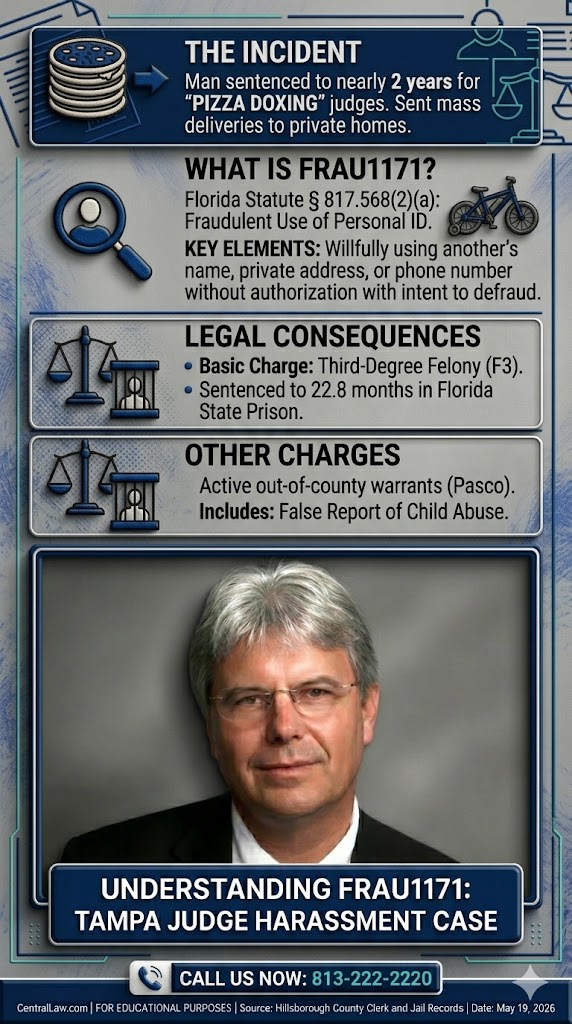
In a fraud case that underscores the rising tide of harassment and threats targeting the American judiciary, a 50-year-old Zephyrhills man has been sentenced to nearly two years in prison for a targeted “pizza doxing” campaign against two Hillsborough County judges. Full disclosure, this was not a case of mine.
Jonathan Mark Miller admitted to weaponizing unwanted food deliveries as a form of harassment and intimidation, sending dozens of cash-on-delivery pizza orders to the private residences of the judges overseeing or linked to his legal matters. The targeted judges were forced to deal with an influx of delivery drivers at their homes, a tactic increasingly recognized by law enforcement as a modern mechanism for harassment and a veiled threat to public officials.
New Details From Hillsborough County Jail Records
While the state and federal interest in the case highlights national concerns over judicial safety, newly reviewed local booking records from the Hillsborough County Sheriff’s Office (HCSO) reveal that Miller’s legal troubles extend far beyond the “pizza doxing” incident alone.
Miller was processed into the Falkenburg Road Jail on May 18, 2026, following court proceedings at the George Edgecomb Courthouse. The booking ledger outlines a strict sentence structure alongside substantial pending legal liabilities in neighboring jurisdictions:
Table of Charges and Immediate Consequences
| Charge # | Charge Description & Code | Class / Type | Case Number | Bond / Custody Status | Dispositions & Remarks |
| 1 | Criminal Use of Personal Identification Information (ADMIN021) | NN / Out of County Warrant | 2026CF001829CFAXWS | $15,000.00 | Hold for Pasco County |
| 2 | Criminal Use of Personal Identification Information (ADMIN021) | NN / Out of County Warrant | 2026CF001829CFAXWS | $15,000.00 | Hold for Pasco County |
| 3 | Criminal Use of Personal Identification Information (ADMIN021) | NN / Out of County Warrant | 2026CF001829CFAXWS | $15,000.00 | Hold for Pasco County |
| 4 | Criminal Use of Personal Identification Information (ADMIN021) | NN / Out of County Warrant | 2026CF001829CFAXWS | $15,000.00 | Hold for Pasco County |
| 5 | Fraudulent Use of Personal Information (FRAU1171) | F3 (3rd Degree Felony) / Court Order | 25-CF-004286-A | $0.00 (Sentenced) | Sentenced to Florida State Prison (FSP) for 22.8 Months with credit for time served. |
| 6 | Fraudulent Use of Personal Information (FRAU1171) | F3 (3rd Degree Felony) / Court Order | 25-CF-004286-A | $0.00 (Sentenced) | Sentenced to Florida State Prison (FSP) for 22.8 Months (Concurrent per Judge instructions). |
| 7 | False Report of Child Abuse (ADMIN021) | NN / Out of County Warrant | 2026CF002213CFAXWS | $100,000.00 | Hold for Pasco County |
Key Jail Record Takeaways:
- Active State Prison Commitment: Charges #5 and #6 represent the finalized local sentences stemming from the “pizza doxing” incident. The judge has ordered a specific sentence of 22.8 months in the Florida State Prison (FSP) system.
- The Pasco County Warrants: Totaling $160,000 in active bonds, Miller faces an entirely separate legal battle in neighboring Pasco County. This includes four identity theft charges and an exceptionally serious charge for False Report of Child Abuse, which carries a standalone $100,000 bond.
- Logistical Status: His status is marked as “Ready for Transfer, State Prison.” Because of the active “Hold for Pasco Co,” the Department of Corrections and local sheriffs will coordinate whether he is transported to state prison first or if he will be court-ordered to Pasco County to resolve those pending felony warrants first.
10 expert-focused Q&A on FRAU1171 and doxing offenses.

A: Florida treats the fraudulent use of personal identification information, often coded as FRAU1171, as a serious felony with severe consequences. As a Board-Certified Criminal Trial Lawyer, I have the verified expertise to challenge the complex digital evidence and cross-county warrants often involved in these cases. Less than 1% of Florida attorneys hold this certification, meaning you get an acknowledged specialist fighting for your freedom.
A: Doxing involves intentionally publishing or using someone’s private identifying information without their consent to cause harm, harassment, or financial loss. While “doxing” is a modern term, prosecutors frequently charge this behavior under Florida Statute § 817.568 as the fraudulent use of personal information. I scrutinize the state’s cyber-evidence to ensure they can actually prove intent and lack of authorization beyond a reasonable doubt.
A: Having served as a prosecutor, I understand exactly how the State builds a case from digital footprints, device tracking, and financial records. I can anticipate their strategies and identify the weak links in their forensic evidence before we ever step into the courtroom. This dual perspective allows me to build a highly aggressive, proactive defense against complex fraud allegations.
A: Yes, if the state proves you willfully used someone’s personal information without authorization to harass or defraud them, you can be convicted of a Third-Degree Felony. I recently monitored a Tampa case where “pizza doxing” local judges resulted in a 22.8-month sentence in Florida State Prison. I take these charges seriously and prepare every defense to protect you from harsh statutory penalties and scoresheet escalations.
A: You should politely decline to answer any questions, refuse to unlock your devices, and immediately state that you want to speak with your attorney. Detectives investigating cybercrimes are highly trained to extract statements that can be used to establish your intent to defraud. Contact my office right away so I can step in, handle the communication, and protect your constitutional rights.
A: These cases often involve intricate digital forensics, multi-jurisdictional warrants, and complex sentencing scoresheets that can rapidly increase potential prison time. The state must prove not just that data was used, but that you were the specific individual behind the keyboard acting with willful intent. I rely on my decades of trial experience to dismantle the prosecution’s technical narrative and expose reasonable doubt.
A: Yes, under Florida law, charges for fraudulent use of personal information can escalate to higher-degree felonies with mandatory minimum prison sentences depending on the victim’s status and the financial impact. Targeting law enforcement, judges, or other public servants significantly raises the stakes of the prosecution. I fight aggressively to challenge these enhancements and protect my clients from disproportionate sentencing.
A: Not every case goes to trial; many are resolved through strategic negotiations, motions to suppress illegally obtained digital evidence, or outright dismissals. However, I prepare every single case I take on as if it is going before a jury. This relentless preparation often forces the prosecution to offer better resolutions because they know we are ready for a courtroom battle.
A: Time is absolutely critical, as digital evidence, server logs, and tracking data can be lost or misinterpreted if not immediately challenged. Early intervention can sometimes prevent charges from being formally filed or stop cross-county warrants from complicating your release. If you or a loved one are facing FRAU1171 charges, call my office at 813-222-2220 right now.
A: The first step is a thorough, confidential consultation where we review the exact allegations and the evidence the state claims to possess. I will evaluate the police reports, analyze the search warrants for your devices, and give you a no-nonsense assessment of your legal standing. You can schedule this initial evaluation right now by visiting https://www.centrallaw.com/contact-us/.

Deep Dive: Understanding Florida Charge Code FRAU1171
In Florida’s criminal justice system, the internal booking code FRAU1171 corresponds to the statutory Fraud offense of Fraudulent Use of Personal Information under Florida Statute § 817.568(2). This charge is commonly referred to as criminal identity theft.
Legal Definition and Elements of the Offense
To secure a conviction for this offense, the State must prove beyond a reasonable doubt that a person willfully and without authorization fraudulently used, or possessed with intent to fraudulently use, the “personal identification information” (PII) of another individual.
Under Florida law, PII includes names, addresses, telephone numbers, or digital identifiers. In the context of cyber-harassment or “doxing” campaigns, utilizing a target’s name, private home address, and telephone number to fraudulently initiate financial transactions—such as ordering cash-on-delivery services without their consent—directly fulfills the statutory elements of unauthorized, fraudulent use of PII.
Sentencing Guidelines and Penalties
As noted in the HCSO booking records, the basic form of this offense is classified as a Third-Degree Felony (indicated by the F3 class designation). Under the Florida Criminal Punishment Code, a Third-Degree Felony carries statutory maximum penalties of up to 5 years in Florida State Prison and a fine of up to $5,000 per count.
While a base conviction has no mandatory minimum prison sentence, Florida law imposes strict statutory enhancements based on the specific roles held by the victims. In the case of Miller, the judge utilized the sentencing guidelines to impose a precise sentence of 22.8 months in state prison, reflecting the court’s view of the structured and targeted nature of the identity deployment against judicial officers.
For a deeper look into the tactics used and the broader national implications for judicial security, read the full article on the Tampa Bay Times.
Excerpt from Original Article Text
After ‘pizza doxing’ Tampa judges, man gets nearly 2 years in prison
The George Edgecomb Courthouse in downtown Tampa is the headquarters for Florida’s 13th Judicial Circuit. Jonathan Mark Miller admitted sending pizza orders to the homes of two judges. The case is seen as part of a rise in threats against the judiciary.
Sources:
https://www.tampabay.com/news/crime/2026/05/19/hillsborough-judge-pizza-doxing-sentencing/
webapps.hcso.tampa.fl.us