- Free Consultation: (813) 222-2220 Tap Here to Call Us


Cell Phone Tower Defense Lawyer Attacks Evidence in Criminal Cases – How it Really Works


By Ben Levitan
Cell phone tower evidence defense lawyer in Tampa notes that Cell phone tracking data has become a cornerstone of modern criminal cases, but its presentation in court is often flawed and misleading. We cut through the confusion surrounding Call Data Records (CDRs), cell tower coverage, and the “widely accepted methodologies” that can lead to wrongful conclusions. If your case involves cell phone evidence, understanding the vast difference between an accurate, scientific exhibit and a biased, “wedge”-shaped depiction is critical to your defense. Don’t let flawed technology send you to jail—contact experienced attorney W. F. “Casey” Ebsary Jr. today for a free consultation to review your cell phone tracking evidence and build a rigorous defense. Call us at (813) 222-2220 or visit our Contact Page.
Ben Levitan is a distinguished Wireless Cellular Telecommunications Expert with over 30 years of experience, having worked for industry giants like Verizon, Sprint, and Alcatel, and holding several patents in cellular technology. He currently serves as a highly sought-after expert witness who helps Cell Phone Tower Defense Lawyers and specializes in disproving flawed location testimony often presented by law enforcement, asserting that while raw cell phone data is reliable, the “widely accepted methodologies” used to interpret it are scientifically inaccurate. Mr. Levitan is certified to testify in Federal and State courts and regularly assists legal counsel in complex criminal and civil matters, providing invaluable defense strategies and technical tutorials; you can learn more about his expertise at www.BenLevitan.com.
Cell Phone Records
Cell phone records have become a key part of trials since about 2001. And since 2001, incorrect and unscientific testimony from non-experts has resulted in wrongful convictions. And AI promises to make this worse.
Every time you make a call, receive a call, send or receive a text message, or open and use a data application, the phone company creates a records. These are the records the prosecutors will try to use against you. This record contains:
- Type of Activity (Usually, Voice Call, Data User, or Text Message)
- Start and stop time of the activity
- Cell Tower(s) Used.
This records is used by phone companies for billing. We use this to bill you for your call or amount of data you used. We used these often to pay the cell tower provider. Many cell towers are privately owned, and we pay to use them.
These records are for billing but contain enough technical information that they can be used as evidence in court, IF the presenter has specialized knowledge of the records.
Cell Phone Tracking Case Study
Take the case of an incident at a restaurant, in Ybor City, Florida at 12:00 PM on a specific date. The state’s “expert” presents this exhibit:
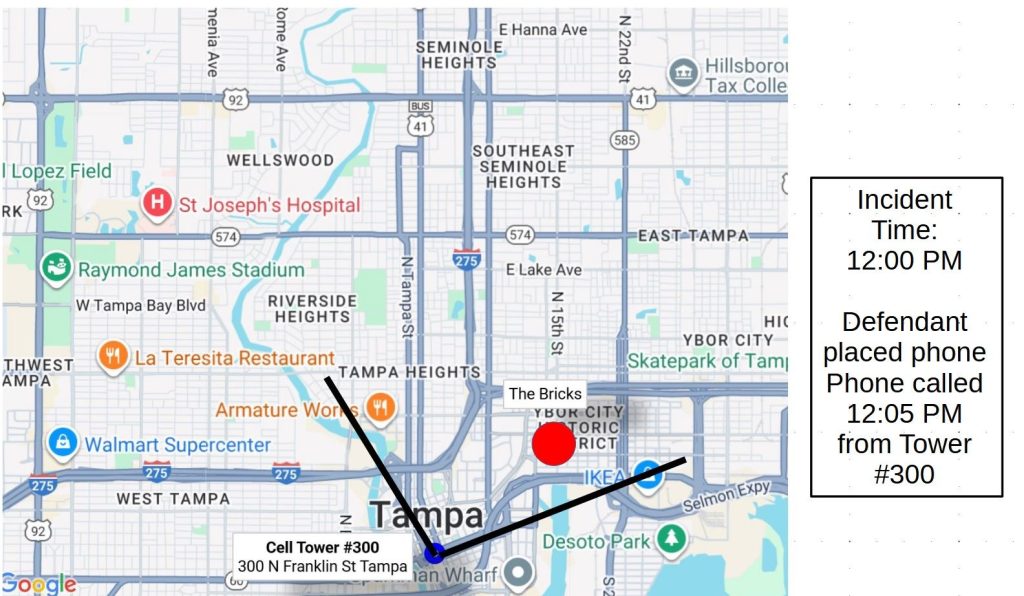
A cell phone record for the defendant’s phone shows that at 12:05 PM he placed a called to his girlfriend. The record also shows that at the time he placed this call his phone was connected to the cell tower located at 300 N. Franklin Street in Tampa. That cell tower is the tower your phone would connected to, if you were at the location of the incident. The cell phone records are highly reliable. As a juror, what would you conclude? It seems that the defendant was in the area of the incident.
Cell Phone Expert Opinion
Where are the flaws in the “expert’s” opinion?
1. The “Wedge” is always your first clue. Radio, broadcast as a circle, and it’s broadcast area is always shown as a circle. This wedge can only be accomplished by a garden hose, not a radio signal. The area should be shown as a circular area.
2. The “Coverage Area” has no limit. How far out does this coverage area go? As an open jaw, this implies that if the defendant’s phone was anywhere within these arms at any distance from the tower, the state would say he was at the scene of the incident. Remember, when you leave the area of one cell tower, you have to hand off to the next area. Where is the boundaries here?
3. The “Scale” is deceptive. The location of the incident is a restaurant in Tampa. But looking at the expert’s exhibit you’ll see that the restaurant covers about four square blocks. Wow, that must be some place. This is prejudicial, as it unfairly changes the scale of the restaurant and makes it more certain to a juror that the defendant was at or near the incident scene.
Coverage of a cell tower is circular
What would an accurate exhibit look like?
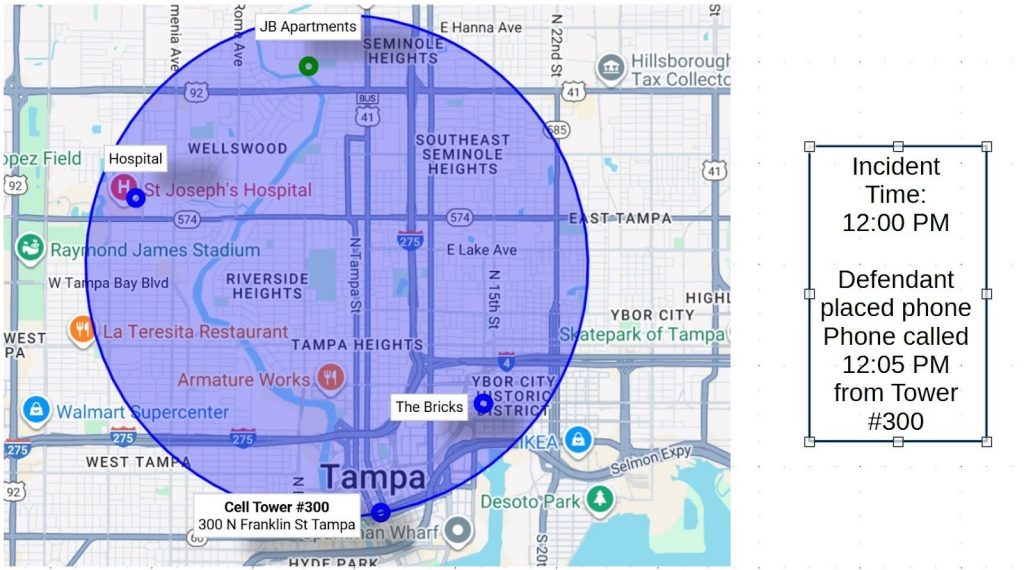
This depiction is scientifically sound:
1. The coverage of a cell tower is circular. This is how are radio signal broadcasts.
2. A cell tower’s broadcast area will typically be five miles wide. Cell towers are very expensive so cell phone companies want to cover the maximum area they can, with the fewest possible cell towers. Cell towers are laid out in a very specific pattern that minimizes the number of cell towers a phone company needs.
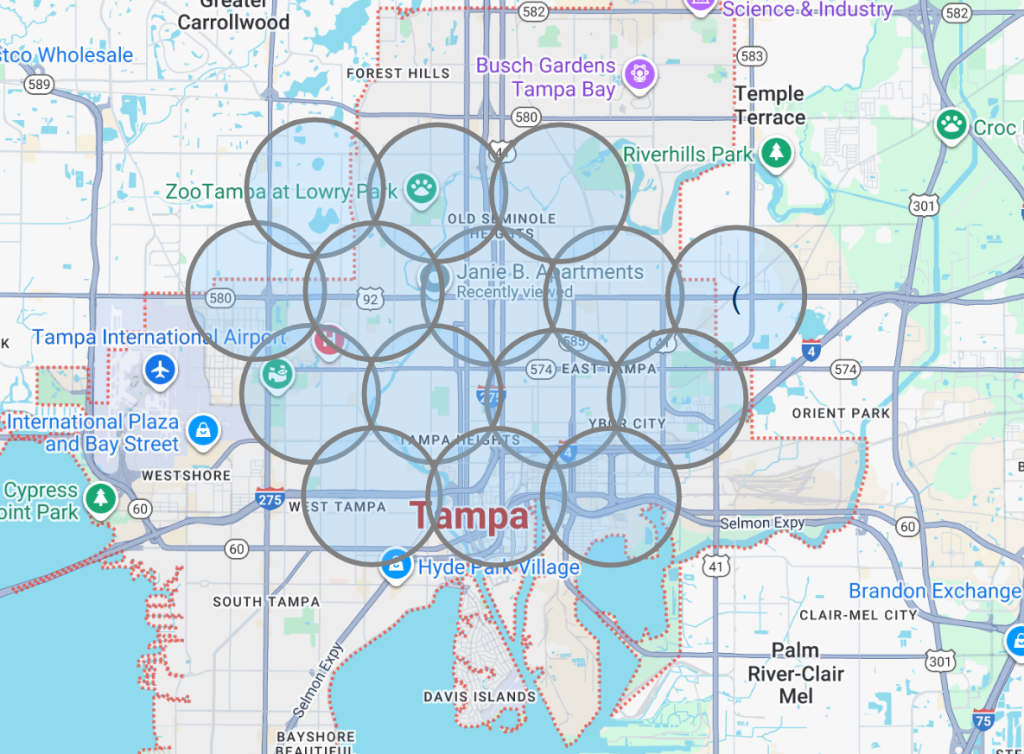
3. Cell phone records cannot pinpoint your location. They simply indicate which cell tower coverage area you were located when you used your phone. That being said, this defendant’s cellphone was in the coverage area of the cell tower that you would use if you were at the incident location. But can the expert claim you were at the incident location or near it?
4. Let’s look again at the coverage area of this cell tower. What does this tell a juror?
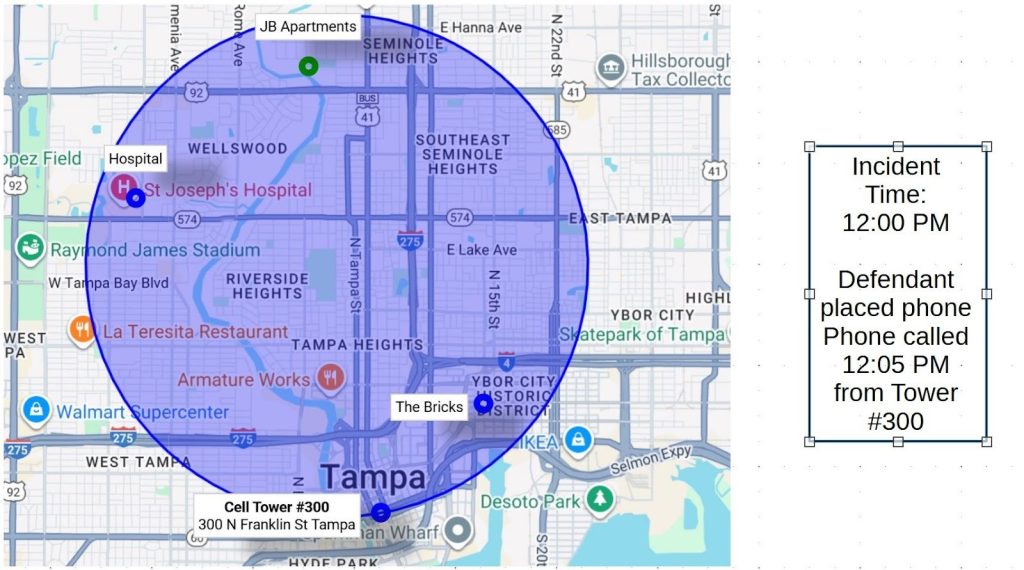
- The defendant’s phone was in the coverage area of the cell tower at 300 N. Franklin Street in Tampa. A phone being used at the incident would also use the cell tower at 300 N. Franklin Street.
- This cell tower covers a circular area that is five miles across. How big an area is this? The area of this circle (remember Algebra? Pie R Squared?) is 19 square miles.
- 19 square miles is the same area as 9,503 NFL football fields.
- The only fact an expert can state is that the defendant’s phone was in an area that is the size of 9,503 NFL Football fields.
- Certainly, that is not evidence that the defendant was at the scene of the crime, “beyond a reasonable doubt.”
The prosecutor’s expert made it seem that the defendant being connected to this cell tower placed him in close vicinity to the incident location. Now, what do the juror think? Likely, that they can’t excluded him from being there, but there is no proof yet that he was there.
5. In this specific case, the Cell Phone Tower Defense Lawyer and defendant claimed he was at work at St. Joseph’s Hospital, (shown inside the coverage area to the upper left) and left work, called his girlfriend and told her he was headed home. Home was the JB Apartments, also within the coverage area of the Franklin Street tower as well, and is shown inside the top of the coverage area. His alibi is consistent with the facts presented by the cell phone evidence.
Cell phone records in criminal cases are very important and very scientific, however it is important that these records be explained accurately to assure that a fair picture is shown. Always be sure that if cell phone evidence is being presented in a criminal case, that it is being done correctly.
10 Q&A on Cell Phone Tracking Evidence

Questions and Answers
Cell phone tracking identifies a phone’s location using three primary methods: GPS tracking, cell tower triangulation, and analysis of Call Data Records (CDRs). GPS uses satellite signals to provide highly accurate, real-time location data, which is typically the most precise method. Cell tower triangulation approximates a phone’s location by measuring signal strength from multiple nearby towers, offering valuable but less specific information. CDRs contain metadata like the time, duration, and cell towers utilized during a call, which helps determine a phone’s general location over a period of time.
Experienced technology experts, such as Ben Levitan, often assert that the underlying cell phone data itself is highly reliable and accurately recorded by service providers. However, the contradiction arises because these same experts argue that the “widely accepted methodologies” used by law enforcement to interpret and report that data in court are fundamentally flawed. Therefore, the core legal dispute used by Cell Phone Tower Defense Lawyers often centers not on the data’s existence, but on the specific techniques used to draw conclusions about a tracked location.
Yes, courts generally accept cell phone tracking data as admissible evidence in legal proceedings, provided that it meets specific reliability standards established by case law. Precedents like United States v. Morgan have helped solidify the admissibility of this evidence, affirming its use in forensic investigations. The key requirement is that the party presenting the evidence must adequately demonstrate that the technology and the analysis used are reliable for the court.
The key reliability issue, according to seasoned experts, lies in the interpretation and presentation of the raw data, not the underlying carrier records themselves. Experts contend that the conventional investigative methods for reporting a phone’s movement are often accepted by non-experts, making the resulting testimony susceptible to error or misrepresentation. This emphasizes the critical defense strategy of challenging the expert’s specific methodology rather than the foundational cellular technology.
GPS tracking is highly precise because it utilizes satellite signals to pinpoint the device’s exact location, offering real-time, highly accurate data that can be critical in court. In contrast, cell tower triangulation approximates a location by analyzing signal strength from multiple cell towers, which only provides a general coverage area. This difference is crucial for the defense, as a lawyer can successfully argue a lack of specificity when the evidence relies on the less-accurate triangulation to place a defendant in an exact location.
Courts have consistently ruled that experts do not need in-depth knowledge of all the underlying algorithms or proprietary software to provide reliable testimony. As highlighted in United States v. Morgan, it is generally not practical for an investigator to have expertise in the inner workings of every mathematical formula used by their tools. Instead, the expert must simply demonstrate proficiency in using the relevant technology and be able to reliably testify about the outputs and data collected during their analysis.
A crucial defense is by Cell Phone Tower Defense Lawyers is to challenge the expert’s qualifications or the specific methodology used to interpret the data, even if the raw cell phone records are considered reliable. This involves scrutinizing how the analyst processed the records, questioning the techniques used for mapping and visualization, or highlighting any potential errors in the data collection process. By targeting the “widely accepted methodologies,” a defense attorney can argue that the conclusion drawn from the data is flawed, even if the data itself is accurate.
The chain of custody is vital because it guarantees the integrity and authenticity of the cell phone tracking evidence presented in court. It requires meticulous documentation of everyone who handled the data, what changes were made, and when those actions occurred from the moment of collection until trial. Any break, inconsistency, or undocumented transfer in the chain of custody can severely compromise the evidence’s reliability and potentially lead to its exclusion from the case.
A Call Data Record (CDR) is metadata retained by cell phone carriers that documents critical details about calls made and received by a specific device. CDRs include essential information such as the time, duration, and, most importantly, the specific cell towers that handled the connection for each call. By analyzing the sequence of towers utilized over a time, law enforcement can determine a phone’s general trajectory and location throughout a given investigative period.
When evidence relies on cell tower triangulation rather than precise GPS data, a lawyer can argue that the evidence lacks the specificity required to prove guilt beyond a reasonable doubt. This defense emphasizes that triangulation can only place a phone within a general coverage area, which may span several square miles. The attorney can highlight this inherent margin of error to undermine the prosecution’s claim that the client was at a very exact crime scene location.
About the Author
| Name: Ben Levitan |
| Email: BenLev@aol.com |
| Phone: 9194200924 |
| The fact (about cell phone reliability of testimony based on cell phone tracking) is that cell phone data is highly reliable; however, the “widely accepted methodologies” for reporting a phones location and movement are non-sense accepted by non-experts. I’ve spent 30 year working for Verizon, Sprint, and Alcatel and now act as an expert witness in cell phone technology. Please call if you need help. Ben Levitan. BenLev@AOL.com is the fastest. I regularly testify against the FBI and show that they don’t know what they are talking about. |
10 More Cell Phone Evidence Q&A

When a phone performs an activity—such as making or receiving a call, sending a text, or using a data application—the phone company creates a record. This record primarily contains the Type of Activity (e.g., Voice Call, Data Use), the start and stop time of the activity, and the specific Cell Tower(s) Used during that connection. Although these records are primarily generated for billing purposes, they contain the technical data necessary to be presented as location evidence in court.
The most significant flaw and “first clue” is the depiction of a cell tower’s coverage as a “Wedge” shape rather than a circular area. A radio signal, which cell towers broadcast, naturally radiates outward in a circle, so depicting coverage as a narrow wedge is physically inaccurate. This distortion is often used to deceptively narrow the perceived location of the defendant, making it seem more precise than the underlying science allows.
The accurate coverage area of a typical cell tower is a circular area up to five miles wide, which translates to a massive area of about 19 square miles. Therefore, the only fact an expert can scientifically state is that the phone was within this vast area. Claiming the defendant was at or near a specific incident location within an area the size of 9,503 NFL football fields is not evidence “beyond a reasonable doubt.”
An expert may present an exhibit where the scale is deceptively magnified, making the crime scene (like a restaurant) appear to cover a disproportionately large area, such as “four square blocks.” This is prejudicial because it unfairly changes the perception of the incident location’s size. By broadening the visual representation of the scene, it makes the cell tower connection appear more likely to place the defendant directly at or very near the crime.
The records are generated for business purposes—to bill customers for calls and data usage and to pay owners of privately owned cell towers. While they are highly reliable in logging connectivity, their original purpose reinforces the scientific limitation that they only indicate the cell tower’s coverage area used, not a precise location. They were never intended to pinpoint a user’s exact coordinates.
Ben Levitan, a veteran in wireless technology, stresses that the raw cell phone data itself is highly reliable because it is accurately recorded by the carriers. The unreliability, however, stems from the “widely accepted methodologies” used to interpret and report this data in court. He argues that these methods are often “non-sense accepted by non-experts,” leading to incorrect and unscientific testimony.
If the defendant’s alibi—such as being at work at St. Joseph’s Hospital or driving home to the JB Apartments—is consistent with being inside the five-mile circular coverage area, the cell phone evidence actually supports their defense. In this scenario, the cell phone record can no longer be used to exclude the defendant’s alibi; it simply confirms they were somewhere within that 19-square-mile circle, failing to prove they were at the specific crime scene.
The most critical missing piece is a clear indication of the boundaries or limits of the cell tower’s signal. By depicting the coverage area with open, unending “arms,” the exhibit falsely implies that a phone could be anywhere within that range, at any distance. A scientifically sound exhibit must show a clear circular boundary to define where the signal is handed off to the next cell tower.
It is crucial because the misuse of cell phone evidence, particularly through incorrect and unscientific testimony, has historically resulted in wrongful convictions. Presenting the evidence with misleading visuals and inaccurate conclusions prevents a fair picture from being shown to the jury. Therefore, attorneys must ensure the records are explained correctly, emphasizing that the records only indicate a phone was in a wide coverage area and not at a precise location.
Since cell phone records became prevalent in trials around 2001, a major issue has been the presentation of incorrect and unscientific testimony from non-experts, directly leading to wrongful convictions. The article warns that the introduction of AI promises to make this problem worse, likely by creating more sophisticated, yet potentially flawed or misleading, analytical interpretations that non-expert witnesses may rely upon and present to the court.