- Free Consultation: (813) 222-2220 Tap Here to Call Us


316.1935 Cracks Down on Fleeing and Eluding


Florida 316.1935 Cracks Down on Fleeing and Eluding — HB 113 Turns Hesitation Into a Felony
Attorney W.F. “Casey” Ebsary Jr., a Board-Certified Criminal Trial Lawyer in Florida, is already defending clients charged under Florida’s expanded fleeing and eluding law 316.1935. HB 113 (House Bill 113 jargon for new law in Florida), effective in 2025, significantly increases penalties for anyone who fails to stop when directed by law enforcement. These changes affect everything from slow-speed evasions to high-speed chases, including motorcycles, ATVs, golf carts, and other off-road vehicles.
Whether a driver panicked, misunderstood police instructions, or made a split-second judgment call, HB 113 now elevates nearly all attempts to flee law enforcement into serious felony offenses with harsher prison exposure.
Attorney Casey Ebsary has long represented individuals charged under Florida Statute §316.1935 — Fleeing or Attempting to Elude a Law Enforcement Officer — and his experience positions him to navigate the new complexities introduced by HB 113.
What HB 113 Means for Florida Drivers
HB 113 enhances penalties and expands the scope of Florida’s fleeing and eluding statute. Key takeaways include:
- Increased penalties at all levels of fleeing or eluding, not only high-speed chases.
- Expanded definitions of “fleeing,” including delayed compliance or slow-speed evasion.
- Encouragement for prosecutors to seek jail or prison time rather than probation.
- Potential expansion of vehicle forfeiture authority in intentional fleeing cases.
Even first-time offenders now face longer prison terms and reduced chances for probation or withhold of adjudication.
Florida Statute §316.1935 — Fleeing or Attempting to Elude
Reference: Florida Statute §316.1935 on Justia
| Fleeing Level | Current Charge | Maximum Penalty (Pre-HB 113) |
|---|---|---|
| Failure to Stop (Lights/Siren On) | 3rd Degree Felony | Up to 5 Years |
| Fleeing with High-Speed or Reckless Driving | 2nd Degree Felony | Up to 15 Years |
| Fleeing Resulting in Serious Injury or Death | 1st Degree Felony | Up to 30 Years |
HB 113 changes the enforcement landscape by pushing prosecutors and judges toward mandatory incarceration, even in cases where no injury occurs.
Updated Penalty Structure Under HB 113
| Offense Type | Old Law (Pre-HB 113) | New Law (Post-HB 113) |
|---|---|---|
| Slow-Speed Fleeing / Failure to Stop Immediately | 3rd Degree Felony — Often Probation-Eligible | 3rd Degree Felony — More Likely to Involve Jail Time |
| High-Speed Fleeing Without Injury | 2nd Degree Felony — Up to 15 Years | 2nd Degree Felony — Judges Encouraged to Impose Prison Terms |
| Fleeing Resulting in Injury or Death | 1st Degree Felony — Up to 30 Years | 1st Degree Felony — Greater Likelihood of Maximum Sentencing |
| Motorcycles / ATVs / Golf Carts / Off-Road Vehicles | Sometimes Treated with Leniency | Now Clearly Covered Under HB 113’s Expansion |
Bottom line: Even brief hesitation or delayed stopping can trigger serious felony exposure.
316.1935 Infographic – Florida Fleeing & Attempting to Elude Law Enforcement
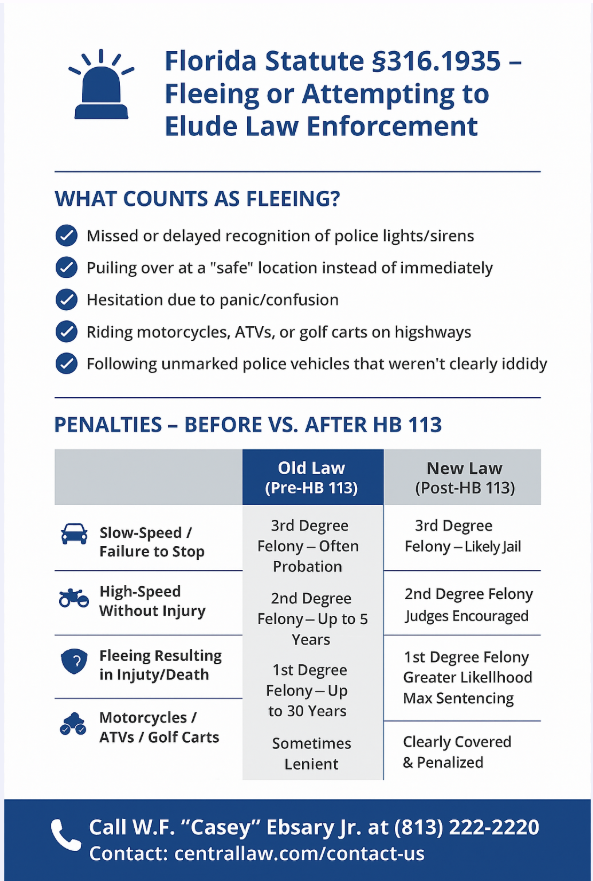
What Counts as “Fleeing”
- Missed police lights or delayed recognition
- Pulling over at a “safe” location instead of immediately
- Panic or uncertainty while driving
- Motorcycle or ATV hesitation on highway
- Unmarked vehicle confusion
Top Defense Strategies
- No clear signal to stop
- Stopping safely ≠ evasion
- Unmarked vehicles create reasonable doubt
- Medical or mechanical emergencies
Call Attorney W.F. “Casey” Ebsary Jr. at (813) 222-2220 — Protect your freedom, driving record, and reputation today.
What Counts as Fleeing Under HB 113?
Many drivers are surprised by how broadly Florida now defines “fleeing”:
- You do not need to be in a high-speed chase.
- Delayed compliance or slow-speed evasion may be treated as felony conduct.
- HB 113 applies to all vehicles, including motorcycles, golf carts, and off-road ATVs.
Intent matters less than actual behavior: a few seconds of hesitation can lead to a criminal charge.
Top 5 Defense Strategies for 316.1935 Cases
Attorney Ebsary emphasizes that every fleeing charge must be proven beyond a reasonable doubt. Potential defense approaches include:
- No Clear Signal to Stop – Lights or sirens may not have been visible or audible.
- Stopping in a Safe Location – Delayed compliance can be framed as safety-conscious, not evasion.
- Unmarked Vehicle Confusion – Following unmarked or poorly identified vehicles can create reasonable doubt.
- Medical or Mechanical Emergency – Emergencies can negate criminal intent.
- Minimal Speed or Traffic Constraints – Low-speed delays due to traffic or road conditions can impact the case.
Quick Q&A — Florida 316.1935 HB 113 & Fleeing/Eluding Law
Yes. Prosecutors may pursue charges if you did not comply immediately. HB 113 explicitly penalizes hesitation or delayed stopping.
HB 113 treats all fleeing more harshly. Even low-speed attempts to evade police may result in felony charges and jail exposure.
Absolutely. Prosecutors frequently stack charges, for example, DUI plus fleeing, under HB 113 to increase penalties.
Fear or confusion may be a defense, but only with proper legal representation. Without counsel, prosecutors typically assume intent.
Yes. The law explicitly expands to include all motor vehicles, even recreational and off-road vehicles, removing prior leniency.
Intentional fleeing could trigger vehicle forfeiture under HB 113, especially if the conduct is severe or results in harm.
Not significantly. HB 113 increases felony exposure and encourages judges to impose incarceration, even for first-time offenses.
Defense strategies focus on proving delayed compliance was reasonable, signals were unclear, unmarked vehicles caused confusion, or emergencies justified actions.
Up to 30 years in prison if fleeing results in serious injury or death — HB 113 increases the likelihood of maximum sentencing in such cases.
While HB 113 applies statewide, prosecutorial discretion and judicial practices may slightly differ by county. Attorney Ebsary routinely navigates local practices in Hillsborough, Pinellas, Pasco, Polk, and Hernando counties.
Yes. Fleeing charges carry serious long-term consequences. Early legal intervention improves the chances of negotiating reduced charges or alternative sentencing.
Why Choose Attorney W.F. “Casey” Ebsary Jr.
Attorney Casey Ebsary is a Board-Certified Criminal Trial Lawyer with extensive experience defending fleeing and eluding cases in Florida. His practice spans Hillsborough, Pinellas, Pasco, Polk, Hernando, and Central Florida. He combines courtroom experience, technology expertise, and a nuanced understanding of Florida’s evolving statutes to protect his clients’ freedom, driving records, and reputations.
Learn more about Attorney Ebsary: Bio Page
Final Call to Action
Florida HB 113 creates broad criminal exposure for drivers who hesitate, panic, or delay compliance when interacting with law enforcement. Good people can make split-second errors — but under the new law, these mistakes carry long-lasting felony consequences.
Protect yourself now. Contact a skilled attorney who understands the law inside and out.
📞 Call Attorney W.F. “Casey” Ebsary Jr. at (813) 222-2220
🔗 Contact Page: https://www.centrallaw.com/contact-us/
🔗 About Attorney Ebsary: https://www.centrallaw.com/lawyers/w-f-casey-ebsary-jr/
Attorney Ebsary fights to reduce or dismiss fleeing charges, negotiate withholds of adjudication, and safeguard your driving record, freedom, and reputation.
Extended Q&A — Florida HB 113 & Fleeing/Eluding Law

Yes. Under HB 113, the focus is on immediate compliance, not whether you eventually stopped. If law enforcement determines that you delayed stopping or hesitated in response to lights or sirens, they can charge you with a felony. Even a few seconds of hesitation can trigger criminal liability. An experienced attorney can argue that delayed compliance was reasonable based on traffic, visibility, or safety concerns.
HB 113 expands the statute to treat all fleeing more harshly, regardless of speed. Previously, slower evasions sometimes resulted in probation or lesser penalties. Now, even slow-speed or low-risk attempts to evade can result in felony charges and jail exposure. Defense attorneys often highlight that the situation posed minimal danger to the public to mitigate penalties.
Absolutely. Prosecutors frequently stack charges under HB 113 to increase overall penalties. For example, a DUI and fleeing offense can be prosecuted simultaneously, increasing felony exposure. Attorney Ebsary reviews all associated charges to craft a coordinated defense strategy that challenges the fleeing allegation while addressing the underlying DUI or drug charge.
Fear, confusion, or misunderstanding can impact the case, but only if presented effectively. Courts primarily look at your actions, not your thoughts. A skilled attorney can argue that your reaction was reasonable given road conditions, the presence of unmarked vehicles, or other situational factors. Without counsel, prosecutors may assume criminal intent regardless of your state of mind.
Yes. HB 113 explicitly expands the statute to cover all types of motor vehicles, including motorcycles, ATVs, off-road vehicles, and golf carts. Previously, some drivers of non-traditional vehicles received leniency. Now, any attempt to evade law enforcement with these vehicles can result in felony charges. Attorneys can use technicalities regarding vehicle type and traffic laws to mount a defense in certain situations.
Potentially, yes. HB 113 provides prosecutors with expanded authority to pursue vehicle forfeiture in intentional fleeing cases. This typically occurs when the fleeing incident involved recklessness, repeated violations, or serious injury. An attorney can challenge forfeiture by demonstrating lack of intent or that the vehicle was used out of necessity, protecting clients from losing their property unnecessarily.
Not significantly under HB 113. Even first-time offenders now face longer prison terms, higher felony classifications, and a reduced likelihood of probation. Judges are encouraged to impose incarceration, making early legal intervention critical. A knowledgeable attorney can advocate for alternatives or negotiate favorable outcomes to minimize long-term consequences.
Defense strategies include showing that police signals were unclear, delayed stopping was reasonable, or emergencies justified actions. Evidence such as dashcam video, witness statements, or GPS data can create reasonable doubt. Attorneys also scrutinize law enforcement procedures for errors in pursuit or documentation that might invalidate the charge. Properly presented defenses can reduce or even dismiss fleeing allegations.
A first-degree fleeing felony can carry up to 30 years in prison if the incident results in serious injury or death. HB 113 increases the likelihood that judges will impose maximum or near-maximum sentences in severe cases. Even if no injury occurred, the felony classification alone can create long-term repercussions, including restrictions on professional licenses, voting rights, and firearm ownership. Legal representation is essential to mitigate these lifelong consequences.
While HB 113 applies statewide, local prosecutorial practices and judicial discretion can affect outcomes. Some counties may push for mandatory incarceration more aggressively, while others may consider alternative sentencing. An attorney familiar with the region, like Former Hillsborough County Assistant State Attorney Ebsary in Hillsborough, Pinellas, Pasco, Polk, and Hernando counties, can navigate local trends to negotiate the best possible result for clients.
Yes. Fleeing charges carry serious long-term consequences, and early intervention increases the likelihood of reduced charges or alternative sentencing. An attorney can preserve evidence, interview witnesses promptly, and challenge procedural missteps. Acting quickly also allows for a strategic defense that considers all aspects of HB 113’s expanded penalties.
The full statute is available online at Florida Statute §316.1935 on Justia. Attorney Ebsary uses his deep knowledge of the statute to analyze how recent legislative changes affect each case. Understanding the law is critical, but professional guidance ensures you don’t face the enhanced penalties alone. Legal counsel can clarify your rights and options before engaging with law enforcement or the court system.