- Free Consultation: (813) 222-2220 Tap Here to Call Us


Social Media Injury Lawyer Tampa | Youth Addiction Claims


Social Media Adolescent Injury Litigation: Master Complaint Analysis & Legal Guide
As a Tampa personal injury attorney advocating for Florida families, I have seen firsthand the devastating emotional and physical toll that predatory social media platforms take on our children. At the Law Office of W.F. “Casey” Ebsary Jr., we are actively reviewing claims on behalf of parents across Hillsborough County and Central Florida whose children have suffered catastrophic mental health crises due to defective platform algorithms. To learn more about my background, firm experience, and commitment to client advocacy, you can visit my Attorney W.F. “Casey” Ebsary Jr. profile page or review our dedicated Tampa Social Media Injury Lawyer hub.
The nationwide litigation against tech conglomerates has been consolidated into a central federal proceeding titled In re: Social Media Adolescent Addiction/Personal Injury Products Liability Litigation, MDL No. 3047, pending in the United States District Court for the Northern District of California before Chief Judge Yvonne Gonzalez Rogers. This landing page provides an in-depth, verified analysis of the foundational legal document in this litigation: Plaintiffs’ Amended Master Complaint (Personal Injury).

Video Overview: Attorney Casey Ebsary on Social Media Youth Injury Claims
Video Briefing: Fighting for Florida Families Against Big Tech
Summary of Video Presentation by Attorney W.F. “Casey” Ebsary Jr.In this video briefing, I discuss how multi-billion-dollar social media corporations purposefully designed software features to exploit adolescent neurobiology for corporate revenue. I explain how our Tampa law firm works directly with parents to preserve critical smart-device evidence, document psychiatric treatment records, and navigate the complex federal multidistrict litigation process. Families seeking immediate, confidential legal assistance can watch our full video library or directly contact our office for a free legal evaluation.
Executive Summary: Plaintiffs’ Amended Master Complaint (MDL No. 3047)
In my review of Plaintiffs’ Amended Master Complaint in In re: Social Media Adolescent Addiction/Personal Injury Products Liability Litigation (MDL No. 3047, N.D. Cal., Case No. 4:22-md-03047-YGR), I find a comprehensive evidentiary framework detailing how Big Tech corporations systematically harmed American youth. Filed on April 14, 2023, this 288-page master pleading serves as the administrative umbrella for individual personal injury actions brought by injured minors and their families across the nation. My firm utilizes this master complaint to establish liability against corporate defendants—including Meta Platforms, Inc. (Facebook and Instagram), Snap Inc. (Snapchat), ByteDance Ltd. (TikTok), and Alphabet Inc./Google LLC (YouTube)—for engineering defective social media applications that induce compulsive, harmful use among adolescents.
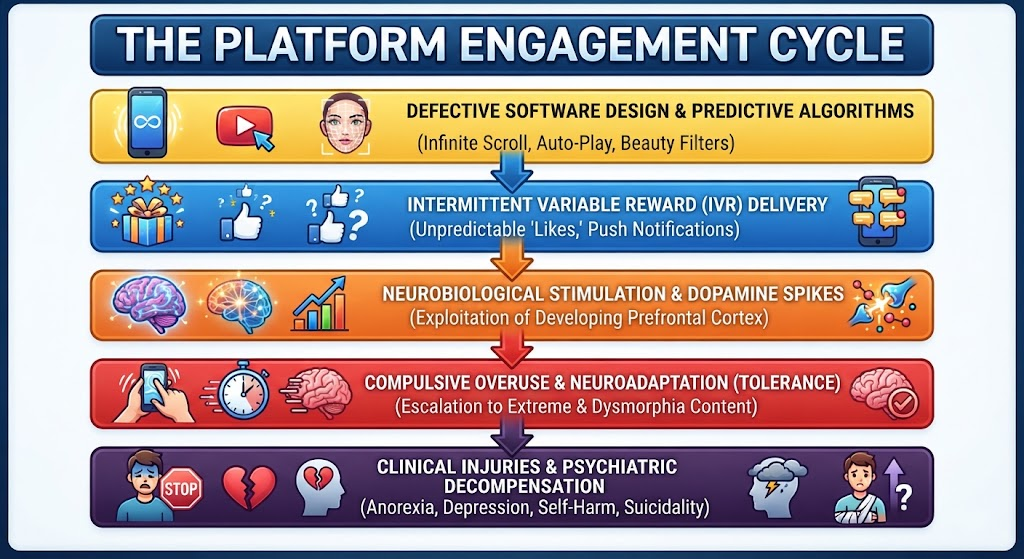
The complaint sets forth how defendants targeted children and teenagers as a core pipeline for business expansion and advertising revenue. Because youth are in a critical developmental stage characterized by incomplete prefrontal cortex maturity, they lack the emotional resiliency and impulse control of adults. Defendants consciously exploited these neurobiological vulnerabilities by embedding features designed to manipulate dopamine release and create a hypnotic “flow state”. The primary design defects identified across platforms include engagement-based recommendation algorithms, infinite scrolling, visual “Like” metrics, appearance-altering beauty filters, intermittent variable reward notifications, auto-playing video feeds, and disappearing content. Additionally, defendants failed to implement effective age-verification mechanisms or meaningful parental controls, knowingly allowing millions of preteens to access platforms without parental consent.
Crucially, the complaint demonstrates that defendants possessed actual knowledge of the severe mental health risks associated with their platforms. Internal company research leaked by whistleblowers revealed that Meta executives knew Instagram worsened body image issues for one in three teenage girls and directly contributed to suicidal thoughts and eating disorders. Rather than altering their algorithms or warning parents, defendants actively concealed these findings to protect user retention and ad sales. This corporate negligence coincided with a nationwide youth mental health crisis highlighted by the U.S. Surgeon General and the CDC, including a 57% increase in youth suicide rates between 2007 and 2019.
The physical and psychiatric injuries detailed throughout the master complaint are severe, permanent, and sometimes fatal. Minor plaintiffs have suffered clinical diagnoses of major depressive disorder, anorexia nervosa, bulimia, severe anxiety, cutting, self-harm, viral challenge injuries, suicidal ideation, and death by suicide. The master complaint asserts 18 legal counts, encompassing strict product liability for design defect and failure to warn, common law negligence, fraudulent concealment, consumer protection violations, statutory child exploitation claims, wrongful death, and loss of consortium.
As a Tampa personal injury attorney representing injured youth and families throughout Hillsborough County and Florida, I view this master complaint as a vital legal instrument. Through consolidated multidistrict proceedings, we are holding corporate developers accountable for prioritizing corporate profits over child safety. To evaluate your family’s legal options or learn more about our ongoing advocacy, you can visit my Attorney W.F. “Casey” Ebsary Jr. profile, explore our Tampa Social Media Injury Lawyer page, or directly contact our office for a free legal evaluation.
Serving Injured Youth Across Tampa Bay & Central Florida
Algorithmic addiction and adolescent mental health injuries affect youth across every community in our region. Our legal practice advocates for minor children, teenagers, and parents throughout the greater Tampa metropolitan area, encompassing:
- Hillsborough County: Tampa, Brandon, Riverview, Plant City, Carrollwood, Westchase, and Temple Terrace.
- Pinellas County: St. Petersburg, Clearwater, Largo, Palm Harbor, and Pinellas Park.
- Pasco & Hernando Counties: Land O’ Lakes, Wesley Chapel, New Port Richey, and Spring Hill.
- Manatee & Sarasota Counties: Bradenton, Lakewood Ranch, and Sarasota.
Whether an initial action belongs before the Hillsborough County Circuit Court, the Pinellas County 6th Judicial Circuit, or the federal Middle District bench in Tampa, we ensure all local procedural, evidentiary, and statutory tolling prerequisites are firmly established.
Question & Answer Guide: Understanding the Master Complaint (MDL No. 3047)
What is Plaintiffs’ Amended Master Complaint in MDL No. 3047?
Plaintiffs’ Amended Master Complaint serves as an administrative pleading setting forth the common facts, scientific evidence, and legal causes of action brought by injured children and their guardians against major tech companies. Filed on April 14, 2023, in Case No. 4:22-md-03047-YGR, the Master Complaint streamlines multidistrict litigation by allowing individual plaintiffs nationwide to adopt its core allegations through a Short Form Complaint. It alleges that social media platforms are defectively designed consumer products engineered to induce compulsive use and severe mental health harm in minors. Families across Florida can leverage this Master Complaint to establish liability for catastrophic psychiatric injuries suffered by youth.
Which social media companies and platforms are named as corporate defendants?
The Master Complaint names four major tech conglomerates and their operating subsidiaries as primary corporate defendants. These include Meta Platforms, Inc. along with Instagram, LLC and Facebook entities; Snap Inc., the owner and operator of Snapchat; ByteDance Ltd., ByteDance Inc., TikTok Ltd., and TikTok, Inc., which operate TikTok; and Google LLC, YouTube, LLC, and Alphabet Inc., which operate YouTube. The lawsuits allege that each of these corporate entities deployed tailored product features designed to capture and monetize minor users. I can confirm that these specific entities form the primary focus of active federal litigation.
How do algorithmic design defects and neurobiological manipulation harm children?
The complaint details how tech developers engineered specific software features to manipulate dopamine pathways in developing adolescent brains. By utilizing Intermittent Variable Rewards (IVR)—a psychological mechanism borrowed from slot machines—platforms withhold and release social feedback, such as “Likes” and notifications, on unpredictable schedules to maximize compulsive engagement. Additionally, features such as infinite scrolling, endless video auto-play, read receipts, appearance-altering beauty filters, and push notifications induce a hypnotic “flow state” that deprives children of sleep and self-regulation. These features exploit youth vulnerabilities during critical phases of brain development, leading directly to addiction and mental health decay.
How do the allegations address COPPA and age-verification failures?
Under the Children’s Online Privacy Protection Act, operators of commercial websites directed to children under 13 cannot lawfully collect personal data without verifiable parental consent. The Master Complaint alleges that defendants implemented illusory age-verification systems relying on unverified self-reporting, allowing millions of preteen children to establish accounts. Although defendants possessed sophisticated age-estimation algorithms used for targeted advertising, they deliberately failed to apply these tools to restrict underage access. Official guidance from the Federal Trade Commission COPPA Guidance details mandatory compliance mechanisms that defendants allegedly ignored to protect corporate profit margins.
How do courts differentiate product design defect claims from Section 230 protections?
Section 230 of the Communications Decency Act traditionally protects interactive computer services from civil liability when acting as third-party publishers of user content. However, the federal court overseeing MDL No. 3047 established a critical legal distinction between third-party speech and proprietary, non-speech product features. The Master Complaint focuses strictly on defective software architectures, such as predictive recommendation algorithms, continuous auto-play loops, deceptive notification timing, and absent parental controls. Because these claims challenge the safety and mechanical design of the application software itself rather than third-party text or images, courts have held that Section 230 does not grant blanket civil immunity.
What clinical mental health injuries are recognized under this litigation?
To maintain a viable product liability action, a minor must have suffered formally diagnosed, severe psychological or physical injuries resulting from platform addiction. Recognized clinical diagnoses in the Master Complaint include Major Depressive Disorder, severe anxiety disorders, obsessive-compulsive disorders, and dangerous eating disorders such as anorexia nervosa and bulimia. The litigation also encompasses documented incidents of non-suicidal self-harm, severe sleep deprivation leading to psychological decompensation, suicidal ideation, suicide attempts, and wrongful death. I evaluate every potential claim against strict medical documentation standards to confirm actionable harm.
What legal causes of action are asserted against Meta, Snap, ByteDance, and Google?
The Master Complaint asserts eighteen distinct legal counts grounded in tort law, consumer protection statutes, and federal civil rights codes. Core counts asserted against all defendants include Strict Liability Design Defect (Count 1), Strict Liability Failure to Warn (Count 2), Negligence in Product Design (Count 3), Negligent Failure to Warn (Count 4), General Negligence (Count 5), and Violation of Unfair Trade Practices and Consumer Protection Laws (Count 7). Additional claims against all defendants include Negligence Per Se (Count 10), federal statutory claims under 18 U.S.C. §§ 1595, 2255, and 2252 regarding child exploitation (Counts 11–15), Wrongful Death (Count 16), Survival Actions (Count 17), and Loss of Consortium (Count 18). Meta is specifically charged with Fraudulent and Negligent Concealment (Counts 8–9).
What official findings have federal public health authorities issued regarding social media safety?
In December 2021, the U.S. Department of Health and Human Services published the landmark U.S. Surgeon General’s Advisory on Protecting Youth Mental Health, warning that digital platforms create tension between corporate revenue and adolescent health. Official research published in the CDC Youth Risk Behavior Surveillance Data indicates that youth suicide rates increased by 57% between 2007 and 2019, while emergency room visits for youth anxiety disorders rose 117%. Furthermore, public health surveys demonstrate that adolescents spending more than three hours daily on social media face double the risk of internalizing mental health problems. The Surgeon General explicitly concluded that there is insufficient evidence proving social media platforms are safe for children.
Table 1: Defendant Platforms & Engineered Product Defects (MDL No. 3047)
| Defendant Conglomerate | Named Platform(s) | Primary Engineered Features Challenged | Associated Clinical Injuries Pled |
| Meta Platforms, Inc. | Instagram, Facebook, Messenger Kids | Intermittent variable reward notifications, infinite scroll, appearance-altering beauty filters, “People You May Know” adult connections | Anorexia, bulimia, severe depression, body dysmorphia, self-harm, suicidal ideation |
| Snap Inc. | Snapchat | Disappearing “Snaps,” “Snap Streaks” mechanics, “Snap Map” geolocational pressure, “Quick Add” | Extreme anxiety, compulsive checking, severe sleep disruption, peer validation compulsions |
| ByteDance Ltd. / Inc. | TikTok | “For You” feed predictive algorithms, continuous auto-play, time-limited reward loops, viral challenge amplification | Dopamine addiction, self-harm challenge injuries, severe depression, eating disorders |
| Alphabet Inc. / Google LLC | YouTube | “Watch time” maximization algorithms, continuous auto-play, behavioral recommendation feeds | Compulsive overuse, social isolation, major depressive disorder, sleep deprivation |
Table 2: Core Legal Causes of Action in Master Complaint
| Count | Legal Theory / Cause of Action | Target Defendants | Primary Legal Basis |
| Count 1 | Strict Liability – Design Defect | All Defendants | Software features engineered in a manner unreasonably dangerous to youth |
| Count 2 | Strict Liability – Failure to Warn | All Defendants | Failure to notify parents and minor users of known addiction risks |
| Count 3 | Negligence – Design | All Defendants | Breach of duty of care in software development and feature deployment |
| Count 4 | Negligence – Failure to Warn | All Defendants | Negligent omission of safety instructions and mental health warnings |
| Counts 8–9 | Fraudulent & Negligent Concealment | Meta Platforms | Active concealment of internal research showing adolescent harm |
| Counts 16–18 | Wrongful Death & Consortium Claims | All Defendants | Statutory survivor and estate damages resulting from fatal injuries |
The Software-Driven Neurobiological Feedback Loop
Florida Law, Jurisdiction & Statutory Cutoffs
How do Florida statutes of limitations affect social media injury lawsuits?
Under Florida civil practice, strict statutory deadlines govern product liability and negligence claims against corporate defendants. You can examine the governing statutory framework directly via Florida Statutes Section 95.11 on Justia, which outlines filing deadlines for personal injury actions. In Florida, general negligence actions are governed by a two-year filing period, whereas product liability claims historically operated under a four-year framework depending on accrual rules and statutory amendments. Determining the precise accrual date for a minor involving delayed discovery of psychological harm requires detailed legal scrutiny, making immediate consultation essential to prevent claims from becoming permanently barred.
Where are social media lawsuits filed and how does the MDL process work for Tampa families?
While nationwide proceedings are centralized in California, local lawsuits originate right here in Central Florida. For families in Hillsborough County, federal filings initiate in the U.S. District Court for the Middle District of Florida (Tampa Division), located at the Sam M. Gibbons United States Courthouse (801 N Florida Ave, Tampa, FL 33602). In state-court actions, claims are filed in the 13th Judicial Circuit Court of Florida at the George E. Edgecomb Courthouse in downtown Tampa.
Once filed, individual federal personal injury actions are transferred and coordinated under Chief Judge Yvonne Gonzalez Rogers in the Northern District of California (In re: Social Media Adolescent Addiction/Personal Injury Products Liability Litigation, MDL No. 3047). As your social media injury lawyer in Tampa, I evaluate claims locally, preserve electronic evidence under Florida statutory standards, prepare and file your Short Form Complaint directly into MDL No. 3047, and guide Tampa Bay families through every stage of pretrial coordination and bellwether proceedings. This structure provides our local clients with hands-on, neighborhood legal counsel backed by the leverage of consolidated nationwide discovery.
What criteria do we evaluate when reviewing a potential social media injury claim?
When reviewing a potential claim, I look for three primary elements to establish legal liability and causation. First, we verify that intensive, compulsive platform usage began while the child was a minor, typically between the ages of 10 and 17. Second, we establish a clear chronological link between platform overuse and subsequent psychological or physical deterioration. Third, the claim must be corroborated by formal medical or psychiatric treatment records, such as emergency room admissions, residential treatment stays, or clinical therapy logs.
What evidence must families preserve when preparing a social media addiction lawsuit?
Parents should immediately preserve all smart devices, mobile phones, tablets, and computers used by the child, taking care not to alter account settings or wipe local device data. You should save account usernames, record screenshots of harmful algorithmic feeds or direct messages, and export available platform account data files where feasible. Additionally, gather all medical evaluations, psychiatric admission summaries, therapy invoices, and academic records reflecting sudden performance drops or attendance issues. Preserving this physical and electronic evidence is vital to proving product causation in court.
Frequently Asked Questions (FAQs)
Can parents file a lawsuit if their child has recently reached the age of 18?
Yes, young adults who suffered severe injuries as minors may still maintain viable legal claims under applicable tolling doctrines. Although the injury and compulsive platform usage must have originated during their minority, state legal rules frequently extend filing deadlines based on minority status or delayed discovery of product defects. My firm conducts detailed chronological evaluations of first account creation, primary psychiatric intervention, and current age to confirm whether statutory extensions apply.
What financial compensation can families seek in a social media injury lawsuit?
Plaintiffs in MDL No. 3047 seek full compensatory damages for past and future economic losses, including emergency medical care, inpatient psychiatric hospitalizations, and long-term residential treatment costs. Compensation is also sought for non-economic damages, including severe emotional distress, pain and suffering, physical impairment, and loss of educational attainment. In catastrophic cases involving fatal self-harm, surviving family members can pursue wrongful death damages and survivor actions under applicable state laws.
How do multidistrict litigation bellwether trials function?
Bellwether trials are representative sample cases selected by the court and litigants to be tried before juries prior to broader resolution. These initial trials test legal theories, evaluate scientific expert testimony, and measure jury responses to corporate conduct. While bellwether verdicts do not automatically settle every pending action, their outcomes provide crucial benchmarks that drive global settlement negotiations.
How can Florida families get started with a confidential case evaluation?
Families in Tampa and throughout Florida can reach out directly to my office to discuss their circumstances in complete confidence. We review medical records, evaluate platform usage history, and explain your legal rights under Florida law without any upfront cost. You can contact my team directly by calling our office or submitting an inquiry online through our secure portal.
Take Action: Contact a Social Media Injury Lawyer in Tampa Today
If your child or teenager has experienced severe clinical depression, body dysmorphia, an eating disorder, self-harm, or suicidal ideation resulting from predatory platform algorithms, you do not have to take on Big Tech alone. As an experienced trial attorney advocating for families throughout the Greater Tampa Bay area, I provide personalized legal guidance to hold corporate tech developers accountable under Florida product liability law and federal MDL frameworks.
To discuss your circumstances in complete confidence and explore your family’s legal options, schedule a free case evaluation today:
Law Office of W.F. “Casey” Ebsary Jr.
2102 W Cleveland St
Tampa, FL 33606
Direct Telephone: (813) 222-2220
Secondary / Inquiries: (813) 933-6807
Office Hours: Monday – Friday, 8:00 AM – 5:00 PM (24/7 Telephone Intake Available)
Visit our secure contact our office page or call our Tampa office directly at (813) 222-2220 to speak with a dedicated legal advocate.