

Fighting for You, a Friend, or a Loved One



Florida Weapons Jury Instructions
Florida Weapons Jury Instructions Explained by a Board Certified Criminal Trial Lawyer
Facing a Florida weapons charge? Understanding the Florida Standard Jury Instructions can help you understand what the prosecution must prove if your case goes to trial. As a Board Certified Criminal Trial Lawyer, former prosecutor, and criminal defense attorney, I have spent decades preparing cases by carefully analyzing the same jury instructions judges read to juries before deliberations. If you would like to learn more about my background, please visit my attorney bio at https://www.centrallaw.com/lawyers/w-f-casey-ebsary-jr/. If you need legal representation, contact my office at https://www.centrallaw.com/contact-us/ to schedule a confidential consultation.
Why Florida Jury Instructions Matter
Many people believe a criminal case is decided by the police report or by what the attorneys argue in court. In reality, jurors are instructed by the judge using the Florida Standard Jury Instructions before they begin deliberations. Those instructions identify the legal elements that the State must prove beyond a reasonable doubt. Throughout my career, I have viewed these instructions as the roadmap for trial preparation because they define the issues the jury must ultimately decide.
This page is designed to explain, in plain English, how the Florida Standard Jury Instructions apply to several commonly charged weapons offenses. It is intended as an educational resource and should not be considered legal advice.
How I Prepare Weapons Cases
When I prepare a criminal trial, I begin with the jury instructions rather than assumptions about the case. Every witness, photograph, exhibit, recording, and piece of testimony is evaluated against the specific elements the jury will be instructed to consider. That disciplined approach has guided my work as both a former prosecutor and a Board Certified Criminal Trial Lawyer.
Understanding the jury instructions also helps my clients appreciate why certain facts may become important during trial. The focus is always on whether the admissible evidence supports each required element identified in the applicable instruction.
Five Common Florida Weapons Jury Instructions
| Jury Instruction | What the Jury Is Asked to Decide |
| Carrying a Concealed Weapon or Firearm | Whether the State proved each required element of concealment and possession. |
| Armed While Committing a Criminal Offense | Whether the defendant displayed, used, threatened to use, attempted to use, or carried a weapon or firearm during the alleged offense. |
| Improper Exhibition of a Weapon or Firearm | Whether the alleged conduct satisfied the elements contained in the instruction. |
| Discharging a Firearm | Whether the State proved the required conduct described in the applicable instruction. |
| Shooting Into a Building or Vehicle | Whether the evidence established each required element beyond a reasonable doubt. |
Carrying a Concealed Weapon or Firearm
One of the most frequently charged weapons offenses involves allegations that a weapon or firearm was carried in a concealed manner. The jury instruction identifies the elements that must be proven before a conviction may be returned. As a trial lawyer, I focus on whether the admissible evidence supports every required element rather than relying on assumptions or conclusions contained in an arrest report.
Armed While Committing a Criminal Offense
Florida’s jury instructions also address situations in which the State alleges that a defendant was armed during the commission of another offense. Depending upon the allegations, jurors may be instructed to determine whether a weapon or firearm was displayed, used, threatened to be used, attempted to be used, or carried during the commission of the alleged crime. My trial preparation centers on the specific language the court will ultimately provide to the jury.
Improper Exhibition of a Weapon or Firearm
Cases involving the alleged improper exhibition of a weapon often depend upon the precise facts presented at trial. The jury instruction identifies the issues jurors must evaluate before reaching a verdict. Careful review of witness testimony, photographs, videos, and other admissible evidence is often an important part of preparing these cases for trial.
Discharging a Firearm
The Florida Standard Jury Instructions include separate instructions addressing offenses involving the discharge of a firearm. Every criminal trial is unique, and the specific instruction used depends upon the charge filed and the evidence presented. My role is to carefully compare the evidence with each required element identified in the instruction.
Shooting Into a Building or Vehicle
The jury instructions also address allegations involving shooting or throwing a missile, stone, hard substance, or firearm into or at specified structures or vehicles. These instructions contain multiple elements and definitions that may vary depending upon the allegations in the charging document. Understanding those distinctions is an important part of trial preparation.
Criminal Trial Process
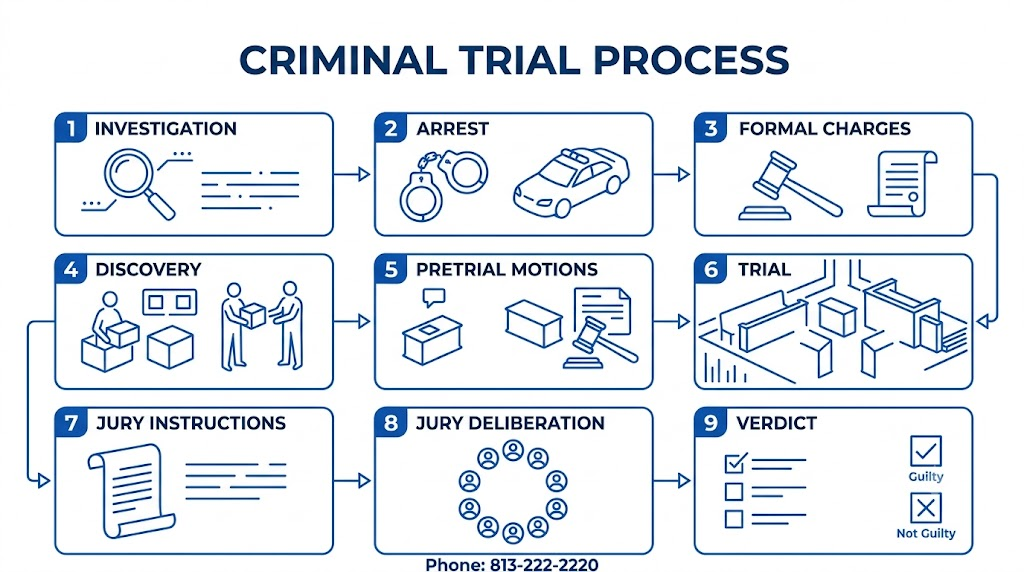
A criminal case begins with a thorough investigation, often leading to an official arrest. Prosecutors then file formal charges. During discovery, both sides share evidence before arguing pretrial motions. Next, the trial occurs. Afterward, the judge reads Florida Standard Jury Instructions, guiding the jury through deliberation to a final verdict.
Why Experience Matters
As a Board Certified Criminal Trial Lawyer, I have devoted my practice to courtroom advocacy. Jury instructions are not simply legal documents—they are the framework through which jurors evaluate the evidence. My preparation is always guided by the instructions the judge will ultimately read before deliberations begin.
If you are facing a Florida weapons charge, I encourage you to learn more about my experience on my attorney biography page and contact my office if you would like to discuss your case.
Frequently Asked Questions

What are Florida Standard Jury Instructions?
Florida Standard Jury Instructions are the model instructions judges use to explain the law to jurors before deliberations. They identify the elements the jury must consider when deciding whether the State has proven the charged offense beyond a reasonable doubt.
Why are jury instructions important?
The instructions provide the legal framework for jury deliberations. They explain the issues jurors are expected to resolve based upon the evidence admitted during trial.
Does every criminal trial use jury instructions?
Jury trials generally conclude with the judge instructing the jurors on the law that applies to the charges being considered. The specific instructions depend on the offenses and the evidence presented.
Can jury instructions differ from one case to another?
Yes. Some instructions contain optional language or definitions that are included only when supported by the allegations or evidence in a particular case.
Why do defense lawyers study jury instructions?
The instructions identify the elements that the prosecution must establish. I use them as the foundation for preparing witnesses, evaluating evidence, and developing trial strategy.
Do jury instructions define important legal terms?
Many instructions include definitions of words or phrases used in the charged offense. Those definitions help jurors apply the law to the evidence presented during trial.
Are jury instructions available to the public?
Yes. The Florida Standard Jury Instructions are publicly available and are regularly updated to reflect changes approved by the courts.
Are jury instructions the same as criminal statutes?
No. Criminal statutes define offenses enacted by the Legislature, while jury instructions explain how jurors should apply the law during deliberations.
Should I read the jury instructions if I have been charged?
Reading the applicable jury instructions may help you better understand the issues involved in your case. They should be considered together with advice from your attorney.
Why choose a Board Certified Criminal Trial Lawyer?
Board Certification recognizes substantial experience, professionalism, and tested expertise in criminal trial practice. When preparing a case for trial, I rely on decades of courtroom experience together with the Florida Standard Jury Instructions that govern jury deliberations.
Official Florida Weapons Jury Instructions
The complete Florida Standard Jury Instructions for Weapons Offenses referenced on this page appear below as a public reference. The explanatory material above is intended to help readers better understand how these instructions function during a criminal jury trial. Please consult the most current official version when reviewing any specific instruction.
Speak With an Experienced Florida Criminal Trial Lawyer
If you have been charged with a weapons offense anywhere in Tampa, Hillsborough County, Clearwater, St. Petersburg, or the surrounding communities, I would be honored to discuss your case. Learn more about my experience at https://www.centrallaw.com/lawyers/w-f-casey-ebsary-jr/ or contact my office today at https://www.centrallaw.com/contact-us/ to schedule a confidential consultation.
Official Florida Weapons Jury Instructions
10.1 CARRYING A CONCEALED [FIREARM] [WEAPON] [ELECTRIC WEAPON OR DEVICE]
§ 790.01, Fla. Stat.
To prove the crime of Carrying a Concealed [Firearm] [Weapon] [Electric Weapon or Device], the State must prove the following three* elements beyond a reasonable doubt:
1. (Defendant) knowingly carried on or about [his] [her] person [a firearm] [a concealed weapon] [an electric weapon or device].
2. The [firearm] [concealed weapon] [electric weapon or device] was concealed from the ordinary sight of another person.
3. *At that time,
a. [he] [she] was not licensed by the Department of Agriculture and Consumer Services** to carry a[n] concealed [firearm] [weapon] [electrical weapon or device];
and
b. was ineligible to receive and maintain such a license because of (insert reason defendant cannot get a license because he or she does not meet the criteria in § 790.06(2)(a)-(f) and (i)-(n), (3), and (10), Fla. Stat).
Ensor v. State, 403 So. 2d 349 (Fla. 1981); Dorelus v. State, 747 So. 2d 368 (Fla. 1999).
The term “on or about [his] [her] person” means physically on the person or readily accessible to [him] [her].
The term “ordinary sight of another person” means the casual and ordinary observation of another in the normal associations of life. A [firearm] [concealed weapon] [electric weapon or device] need not be completely hidden for you to find that it was concealed. However, a[n] [firearm] [concealed weapon] [electric weapon or device] is not concealed if, although not fully exposed, its status as a[n[ [firearm] [concealed weapon] [electric weapon or device] is detectable by ordinary observation.
Give only the applicable paragraphs.
A “firearm” means any weapon [including a starter gun] which will, is designed to, or may readily be converted to expel a projectile by the action of an explosive; [the frame or receiver of any such weapon;] [any firearm muffler or firearm silencer;] [any destructive device;] [any machine gun]. [The term “firearm” does not include an antique firearm unless the antique firearm is used in the commission of another crime. An antique firearm is (insert definition in 790.001, Fla. Stat.)]. [A destructive device is (insert definition in § 790.001, Fla. Stat.)].
A “concealed weapon” means any dirk, metallic knuckles, billie, tear gas gun, chemical weapon or device, or other deadly weapon carried on or about a person in such manner as to conceal the weapon from the ordinary sight of another person.
A “deadly weapon” is any object that will likely cause death or great bodily harm if used in the ordinary and usual manner contemplated by its design and construction.
An object not designed to inflict bodily harm may nonetheless be a “deadly weapon” if it was intended to be used [or threatened to be used] in a manner likely to cause death or great bodily harm.
“Great bodily harm” means great as distinguished from slight, trivial, minor, or moderate harm.
“Electric weapon or device” means any device which, through the application or use of electrical current, is designed, redesigned, used, or intended to be used for offensive or defensive purposes, the destruction of life, or the infliction of injury.
“Tear gas gun” and “chemical weapon or device” are defined in § 790.001, Fla. Stat.
§ 790.01(5)(b), Fla. Stat. The statute and case law are silent as to: (1) which party bears the burden of persuasion of the affirmative defense, and (2) the standard for the burden of persuasion. Under the common law, defendants had both the burden of production and the burden of persuasion on affirmative defenses by a preponderance of the evidence. The Florida Supreme Court has often decided, however, that once a defendant meets the burden of production on an affirmative defense, the burden of persuasion is on the State to disprove the affirmative defense beyond a reasonable doubt (e.g., self-defense and consent to enter in a burglary prosecution). In the absence of case law, trial judges must resolve the issue via a special instruction. See the opinion in Dixon v. United States, 548 U.S. 1 (2006), for further guidance.
It is a defense for a person who carries for purposes of lawful self-defense, in a manner concealed from the ordinary sight of another person:
1. A self-defense chemical spray.
2. A nonlethal stun gun or dart-firing stun gun or other nonlethal electric weapon or device that is designed solely for defensive purposes.
Lesser Included Offenses
CARRYING A CONCEALED [FIREARM] [WEAPON] [ELECTRIC WEAPON OR DEVICE] — 790.01
| CATEGORY ONE | CATEGORY TWO | FLA. STAT. | INS. NO. |
|---|---|---|---|
| None | |||
| Attempt | 777.04(1) | 5.1 |
Comments
A special instruction will be necessary in cases where the deadly weapon was an animal or a substance or something that is not commonly referred to as an “object.”
*As of November 2024, it was unclear whether element #3 is required when the concealed item at issue is not listed in § 790.06(1)(a), Fla. Stat. For example, metallic knuckles are listed as a concealed weapon in § 790.001, Fla. Stat., but metallic knuckles are not an item for which someone can obtain a license to carry in a concealed manner. In the absence of appellate case law that interprets the interaction between § 790.01, Fla. Stat., and § 790.06(1)(a), Fla. Stat., trial judges will need to determine whether to instruct on element #3 in certain circumstances.
**§ 790.015, Fla. Stat. allows a resident of the United States but a nonresident of Florida to carry a concealed weapon/firearm if the nonresident is 21 years of age or older, and either satisfies certain criteria to have a concealed weapon/firearm license in Florida or has a valid concealed weapon/firearm license in his or her immediate possession that had been issued to him or her in his or her state of residence. A special jury instruction will be necessary if those circumstances are relevant.
Pursuant to § 790.25, Fla. Stat., a person 18 years of age or older who was in lawful possession of a handgun or other weapon may possess it within the interior of a private conveyance if the handgun or weapon was securely encased or otherwise not readily accessible for immediate use.
This instruction was adopted in 1981 and was amended in 1989 [543 So. 2d 1205], 2013 [131 So. 3d 720], 2018 [253 So. 3d 1040], on April 3, 2020, on January 29, 2021, December 15, 2023, and on December 6, 2024.
10.2 [OPEN CARRYING OF A HANDGUN] [OR][CARRYING A CONCEALED WEAPON OR FIREARM] IN A PROHIBITED PLACE
§ 790.06(12), Fla. Stat.
To prove the crime of [Open Carrying of a Handgun] [or] [Carrying a Concealed Weapon or Firearm] in a Prohibited Place, the State must prove the following element beyond a reasonable doubt:
1. (Defendant) knowingly and willfully [openly carried a handgun] [or] [carried a concealed firearm or weapon] in
Give as applicable.
a place of nuisance.
a police, sheriff, or highway patrol station.
a detention facility, prison, or jail.
a courthouse.
a courtroom.
a polling place.
a meeting of the governing body of a county, public school district, municipality, or special district.
a meeting of the Legislature or a committee thereof.
a school, college, or professional athletic event not related to firearms.
an elementary or secondary school facility or administration building.
a career center.
any portion of an establishment licensed to dispense alcoholic beverages for consumption on the premises, which portion of the establishment is primarily devoted to such purpose.
a college or university facility.
the inside of the passenger terminal and sterile area of any airport, provided that no person shall be prohibited from carrying any legal firearm into the terminal, which firearm is encased for shipment for purposes of checking such firearm as baggage to be lawfully transported on any aircraft.
a place where the carrying of firearms is prohibited by federal law.
“Willfully” means intentionally and purposely.
Use the definitions below if Open Carrying of a Handgun in a Prohibited Place is charged. § 790.001, Fla. Stat.
“Handgun” means a firearm capable of being carried and used by one hand, such as a pistol or revolver.
“Firearm” means any weapon [including a starter gun] which will, is designed to, or may readily be converted to expel a projectile by the action of an explosive [or] [the frame or receiver of any such weapon] [any firearm muffler or firearm silencer] [any destructive device] [any machine gun]. “Machine gun” and “destructive device” are defined in § 790.001, Fla. Stat.
Use the definitions below if Carrying a Concealed Weapon or Firearm in a Prohibited Place is charged. § 790.06(1), Fla. Stat.
“Concealed weapon or firearm” means a handgun, electric weapon or device, tear gas gun, knife, or billie, but does not include a machine gun. “Electric weapon or device” and “tear gas gun” are defined in § 790.001, Fla. Stat.
“Concealed” means the weapon or firearm was carried on or about a person in such a manner such that it could not be seen from the ordinary sight of another person. The term “on or about [his] [her] person” means physically on the person or readily accessible to [him] [her]. The term “ordinary sight of another person” means the casual and ordinary observation of another in the normal associations of life.
Lesser Included Offense
[OPEN CARRYING OF A HANDGUN] [OR] [CARRYING A CONCEALED WEAPON OR FIREARM] IN A PROHIBITED PLACE —790.06(12)
| CATEGORY ONE | CATEGORY TWO | FLA. STAT. | INS. NO. |
|---|---|---|---|
| Attempt | 777.04(1) | 5.1 |
Comments
As of October 2025, it was not clear that § 790.06(12)(a), Fla. Stat., creates a crime because the statute merely states that a license issued under Chapter 790 does not authorize a person to openly carry a handgun or carry a concealed weapon or concealed firearm into certain places. The statute does not say “It is unlawful for a person to openly carry a handgun or carry a concealed weapon or concealed firearm into …” nor does it say “A person who openly carries a handgun or carries a concealed weapon or concealed firearm into …. is guilty of a second degree misdemeanor. The Committee on Standard Jury Instructions in Criminal Cases drafted this instruction for the benefit of judges who believe the scheme in § 790.06(12)(a) and (12)(d), Fla. Stat., creates a crime.
If a “place of nuisance” is alleged, the court should adopt a definition from
§ 823.05, Fla. Stat. Additional definitions might be appropriate depending on the prohibited place that is alleged.
As of October 2025, it was unclear whether the exceptions for concealed weapons/firearms in courtrooms (§ 790.06(12)(a)5., Fla. Stat.) and college/university facilities (§ 790.06(12)(a)13., Fla. Stat.) are affirmative defenses. A special instruction will be needed if an exception is at issue.
This instruction was adopted on April 3, 2020, and amended on December 15, 2023, and on November 13, 2025.
10.3 PERSONS ENGAGED IN CRIMINAL OFFENSE HAVING [WEAPON] [ELECTRIC WEAPON OR DEVICE] [CONCEALED WEAPON] [FIREARM] [CONCEALED FIREARM]
§§ 790.07(1) and (2), Fla. Stat.
To prove the crime of (crime charged), the State must prove the following two elements beyond a reasonable doubt:
Give 1a or 1b or both as applicable.
1. (Defendant)
a. [displayed] [used] [threatened to use] [attempted to use]
[a weapon].
[a firearm].
[an electric weapon or device].
b. carried a [weapon] [firearm], that was concealed from the ordinary sight of another person.
2. [He] [She] did so while [committing or attempting to commit a[n] (felony alleged)] [under indictment].
1. Define the felony alleged. The felony cannot be antitrust violations, unfair trade practices, restraints of trade, nonsupport of dependents, bigamy, or other similar offenses. See § 790.07(3), Fla. Stat.
2. Define “attempt” if applicable (see instruction 5.1).
Give if firearm is applicable. § 790.001, Fla. Stat.
A “firearm” means any weapon [including a starter gun] which will, is designed to, or may readily be converted to expel a projectile by the action of an explosive; [the frame or receiver of any such weapon;] [any firearm muffler or firearm silencer;] [any destructive device;] [any machine gun]. [The term “firearm” does not include an antique firearm unless the antique firearm is used in the commission of another crime. An antique firearm is (insert definition in § 790.001, Fla. Stat.)]. [A destructive device is (insert definition in § 790.001, Fla. Stat.)].
Give if weapon in element #1a is applicable. § 790.001, Fla. Stat. Slungshot is defined in § 790.001, Fla. Stat.
A “weapon” is any dirk, knife, metallic knuckles, slungshot, billie, tear gas gun, chemical weapon or device, or other deadly weapon except a firearm or a common pocketknife, plastic knife, or blunt-bladed table knife.
A “deadly weapon” is any object other than a firearm that will likely cause death or great bodily harm if used in the ordinary and usual manner contemplated by its design and construction.
An object not designed to inflict bodily harm may nonetheless be a “deadly weapon” if it was [used] [or] [threatened to be used] [or] [intended to be used] [or] [attempted to be used] in a manner likely to cause death or great bodily harm.
“Great bodily harm” means great as distinguished from slight, trivial, minor, or moderate harm, and as such does not include mere bruises.
There is a conflict within the district courts about whether an open common pocketknife is a weapon:
Give if applicable. Porter v. State, 798 So. 2d 855 (Fla. 5th DCA 2001); J.R.P. v. State, 979 So. 2d 1178 (Fla. 3d DCA 2008).
However, an open pocketknife could constitute a weapon.
Give if applicable. G.R.N. v. State, 220 So. 3d 1267 (Fla. 4th DCA 2017).
If a common pocketknife is open, it is still considered to be a common pocketknife.
Give if electric weapon or device in element #1a is applicable. § 790.001, Fla. Stat.
“Electric weapon or device” means any device which, through the application or use of electrical current, is designed, redesigned, used, or intended to be used for offensive or defensive purposes, the destruction of life, or the infliction of injury.
Give if element #1b is applicable.
The term “ordinary sight of another person” means the casual and ordinary observation of another in the normal associations of life. A [firearm] [weapon] need not be completely hidden for you to find that it was concealed. However, a [firearm] [weapon] is not concealed if, although not fully exposed, its status as a [firearm] [weapon] is detectable by ordinary observation.
Give if concealed weapon in element #1b is applicable. § 790.001, Fla. Stat.
A “concealed weapon” means any dirk, metallic knuckles, billie, tear gas gun, chemical weapon or device, or other deadly weapon carried on or about a person in such manner as to conceal the weapon from the ordinary sight of another person.
A “deadly weapon” is any object that will likely cause death or great bodily harm if used in the ordinary and usual manner contemplated by its design and construction.
An object not designed to inflict bodily harm may nonetheless be a “deadly weapon” if it was intended to be used in a manner likely to cause death or great bodily harm.
“Great bodily harm” means great as distinguished from slight, trivial, minor, or moderate harm, and as such does not include mere bruises.
Lesser Included Offenses
PERSONS ENGAGED IN CRIMINAL OFFENSE, HAVING [WEAPON] [ELECTRIC WEAPON OR DEVICE] [CONCEALED WEAPON] [FIREARM] [CONCEALED FIREARM] — 790.07
| CATEGORY ONE | CATEGORY TWO | FLA. STAT. | INS. NO. |
|---|---|---|---|
| None | |||
| Attempt (may be applicable when concealed weapon is charged) | 777.04(1) | 5.1 | |
| Carrying concealed firearm | 790.01 | 10.1 | |
| Carrying concealed weapon | 790.01 | 10.1 | |
| Improper exhibition of dangerous weapon | 790.10 | 10.5 |
Comments
The crimes in § 790.07(1), Florida Statutes, and § 790.07(2), Florida Statutes, are bumped up to a first-degree felony if a defendant has previously been convicted of subsection (1) or (2). See § 790.07(4), Fla. Stat. As of November 2019, it is unclear whether the existence of a prior conviction will be treated as an element of the crime that must be found by the jury in a bifurcated proceeding or whether a prior violation can be proven to the judge at sentencing. It is also unclear whether a conviction includes a withhold of adjudication.
A special instruction will be necessary in cases where the deadly weapon was an animal or a substance or something that is not commonly referred to as an “object.”
This instruction was adopted in 1981, and amended in 1989, 1992, and on April 3, 2020.
10.5 IMPROPER EXHIBITION OF A [WEAPON] [FIREARM]
§ 790.10, Fla. Stat.
To prove the crime of Improper Exhibition of a [Weapon] [Firearm], the State must prove the following three elements beyond a reasonable doubt:
1. (Defendant) had or carried [a weapon] [a firearm] [a dirk] [a sword] [a sword cane] [an electric weapon or device].
2. (Defendant) exhibited the [weapon] [firearm] [dirk] [sword] [sword cane] [electric weapon or device] in a [rude] [careless] [angry] [or] [threatening] manner.
3. [He] [She] did so in the presence of one or more persons.
Give only applicable paragraphs.
§ 790.001, Fla. Stat. Slungshot is defined in § 790.001, Fla. Stat.
A “weapon” is any dirk, knife, metallic knuckles, slungshot, billie, tear gas gun, chemical weapon or device, or other deadly weapon except a firearm or a common pocketknife, plastic knife, or blunt-bladed table knife.
There is a conflict within the district courts about whether an open common pocketknife is a weapon:
Porter v. State, 798 So. 2d 855 (Fla. 5th DCA 2001); J.R.P. v. State, 979 So. 2d 1178 (Fla. 3d DCA 2008).
However, an open pocketknife could constitute a weapon.
G.R.N. v. State, 220 So. 3d 1267 (Fla. 4th DCA 2017).
If a common pocketknife is open, it is still considered to be a common pocketknife.
A “deadly weapon” is any object other than a firearm that will likely cause death or great bodily harm if used in the ordinary and usual manner contemplated by its design and construction.
Give if applicable.
An object not designed to inflict bodily harm may nonetheless be a “deadly weapon” if it was used, threatened to be used, or intended to be used in a manner likely to cause death or great bodily harm.
“Great bodily harm” means harm that is more than slight, trivial, minor, or moderate.
§ 790.001, Fla. Stat.
“Electric weapon or device” means any device which, through the application or use of electrical current, is designed, redesigned, used, or intended to be used for offensive or defensive purposes, the destruction of life, or the infliction of injury.
§ 790.001, Fla. Stat.
A “firearm” means any weapon [including a starter gun] which will, is designed to, or may readily be converted to expel a projectile by the action of an explosive; [the frame or receiver of any such weapon;] [any firearm muffler or firearm silencer;] [any destructive device;] [any machine gun]. [The term “firearm” does not include an antique firearm unless the antique firearm is used in the commission of another crime. An antique firearm is (insert definition in
§ 790.001, Fla. Stat.)]. [A destructive device is (insert definition in § 790.001, Fla. Stat.)].
Lesser Included Offenses
IMPROPER EXHIBITION OF A WEAPON OR FIREARM — 790.10
| CATEGORY ONE | CATEGORY TWO | FLA. STAT. | INS. NO. |
|---|---|---|---|
| None | |||
| Attempt | 777.04(1) | 5.1 | |
| Assault | 784.011 | 8.1 |
Comments
Read instructions 3.6(f) or 3.6(g) as applicable, if the defendant is claiming self-defense, defense of others, or defense of property.
A special instruction will be necessary in cases where the weapon was an animal or a substance or something that is not commonly referred to as an “object.”
This instruction was adopted in 1981 and amended in 2013 [131 So. 3d 720], 2016 [195 So. 3d 356], 2018 [253 So. 3d 1040], on April 3, 2020, and on June 12, 2026.
10.6 DISCHARGING A FIREARM [IN PUBLIC] [ON RESIDENTIAL PROPERTY]
§ 790.15, Fla. Stat.
To prove the crime of Discharging a Firearm [in Public] [on Residential Property], the State must prove the following element beyond a reasonable doubt:
Give a, b, c, and/or d as applicable.
a. (Defendant) knowingly discharged a firearm in a public place.
b. (Defendant) knowingly discharged a firearm [on] [over] the right of way of a paved public road, highway, or street.
c. (Defendant) knowingly discharged a firearm over an occupied premises.
d. (Defendant) [recklessly] [negligently] discharged a firearm outdoors on property [used primarily as the site of a dwelling] [zoned exclusively for residential use].
Definitions.
“Knowingly” means with full knowledge and intentionally.
“Recklessly” means with a conscious and intentional indifference to consequences.
“Negligently” means failing to use reasonable care under the circumstances.
Optional Definition.
A “public place” is any place intended or designed to be frequented or resorted to by the public.
§ 810.011(2), Fla. Stat.
“Dwelling” means a building or conveyance of any kind, including any attached porch, whether the building or conveyance is temporary or permanent, mobile or immobile, which has a roof over it, including a tent, and is designed to be occupied by people lodging therein at night.
§ 790.001, Fla. Stat.
A “firearm” is any weapon (including a starter gun) which will, is designed to, or may readily be converted to expel a projectile by the action of an explosive [including any machine gun or any destructive device]. [The term “firearm” does not include an antique firearm unless the antique firearm is used in the commission of a crime.]
§ 790.001, Fla. Stat.
[“Antique firearm” means any firearm manufactured in or before 1918 (including any matchlock, flintlock, percussion cap, or similar early type of ignition system) or replica thereof, whether actually manufactured before or after the year 1918, and also any firearm using fixed ammunition manufactured in or before 1918, for which ammunition is no longer manufactured in the United States and is not readily available in the ordinary channels of commercial trade.]
§ 790.001, Fla. Stat.
[“Destructive device” means any bomb, grenade, mine, rocket, missile, pipebomb, or similar device containing an explosive, incendiary, or poison gas and includes any frangible container filled with an explosive, incendiary, explosive gas, or expanding gas, which is designed or so constructed as to explode by such filler and is capable of causing bodily harm or property damage; any combination of parts either designed or intended for use in converting any device into a destructive device and from which a destructive device may be readily assembled; any device declared a destructive device by the Bureau of Alcohol, Tobacco, and Firearms; any type of weapon which will, is designed to, or may readily be converted to expel a projectile by the action of any explosive and which has a barrel with a bore of one-half inch or more in diameter; and ammunition for such destructive devices, but not including shotgun shells or any other ammunition designed for use in a firearm other than a destructive device.
“Destructive device” does not include:
a. a device which is not designed, redesigned, used, or intended for use as a weapon;
b. Any device, although originally designed as a weapon, which is redesigned so that it may be used solely as a signaling, line-throwing, safety, or similar device;
c. Any shotgun other than a short-barreled shotgun; or
d. Any nonautomatic rifle (other than a short-barreled rifle) generally recognized or particularly suitable for use for the hunting of big game.]
Affirmative Defense. See § 790.15(1), Fla. Stat.
The statute and case law (with the exception of self-defense, defense of others, and defense of property case law) are silent as to 1) which party bears the burden of persuasion of the affirmative defense and 2) the standard for the burden of persuasion. Under the common law, defendants had both the burden of production and the burden of persuasion on an affirmative defense by a preponderance of the evidence.
The Florida Supreme Court has often decided, however, that once a defendant meets the burden of production on an affirmative defense, the burden of persuasion is on the State to disprove the affirmative defense beyond a reasonable doubt (e.g., self-defense and consent to enter in a burglary prosecution). In the absence of case law, trial judges must resolve the issue via a special instruction. See the opinions in Dixon v. United States, 548 U.S. 1 (2006), for further guidance.
It is a defense to the crime of Discharging a Firearm [in Public] [on Residential Property] if the defendant was [lawfully defending life or property] [performing official duties requiring the discharge of a firearm] [discharging a firearm on public roads or property expressly approved for hunting by the Fish and Wildlife Conservation Commission or Division of Forestry].
If burden of persuasion is on the defendant:
If you find that defendant proved (insert appropriate burden of persuasion) that [he] [she] was [performing official duties requiring the discharge of a firearm] [discharging a firearm on public roads or property expressly approved for hunting by the Fish and Wildlife Conservation Commission or Division of Forestry], you should find [him] [her] not guilty. If the defendant did not prove (insert appropriate burden of persuasion) that [he] [she] was [performing official duties requiring the discharge of a firearm] [discharging a firearm on public roads or property expressly approved for hunting by the Fish and Wildlife Conservation Commission or Division of Forestry], you should find [him] [her] guilty, if all the elements of the charge have been proven beyond a reasonable doubt.
If burden of persuasion is on the State:
If you find that the State proved (insert appropriate burden of persuasion) that the defendant was not [lawfully defending life or property] [performing official duties requiring the discharge of a firearm] [discharging a firearm on public roads or property expressly approved for hunting by the Fish and Wildlife Conservation Commission or Division of Forestry], you should find [him] [her] guilty, if all of the elements of the charge have been proven beyond a reasonable doubt. However, if the State failed to prove (insert appropriate burden of persuasion) that the defendant was not [lawfully defending life or property] [performing official duties requiring the discharge of a firearm] [discharging a firearm on public roads or property expressly approved for hunting by the Fish and Wildlife Conservation Commission or Division of Forestry], you should find [him] [her] not guilty.
Lesser Included Offenses
DISCHARGING A FIREARM [IN PUBLIC] [ON RESIDENTIAL PROPERTY] — 790.15
| CATEGORY ONE | CATEGORY TWO | FLA. STAT. | INS. NO. |
|---|---|---|---|
| None | |||
| Attempt | 777.04(1) | 5.1 |
Comments
As of October 2020, the term “in a public place” has not been defined for purposes of this statute by the Florida Supreme Court or a District Court of Appeal. Similarly, neither the Florida Supreme Court nor any District Court of Appeal have determined whether cells or common areas inside of a jail or a prison are “in a public place.” The term “public place” has been interpreted to include the inside of a vehicle that is located in a public parking lot and the inside of a stall in a public restroom if freely visible from a public area. See State v. Folks, 723 So. 2d 369 (Fla. 4th DCA 1998) and Ward v. State, 636 So. 2d 68 (Fla. 5th DCA 1994). When crafting a special instruction for unique circumstances, trial judges may also want to consider § 876.11, Fla. Stat., which provides a definition of “public place” that includes all walks, alleys, streets, boulevards, avenues, lanes, roads, highways or other ways or thoroughfares dedicated to public use or owned or maintained by public authority, and all grounds and buildings owned, leased by, operated, or maintained by public authority.
This instruction was adopted in 1981 and was amended in 1989 [543 So. 2d 1205], 2013 [131 So. 3d 755], 2016 [190 So. 3d 614], and on November 20, 2020.
10.6(a) DISCHARGING A FIREARM FROM A VEHICLE WITHIN 1,000 FEET OF A PERSON
§ 790.15(2), Fla. Stat.
To prove the crime of Discharging a Firearm from a Vehicle Within 1,000 Feet of a Person, the State must prove the following two elements beyond a reasonable doubt:
1. (Defendant) was an occupant of a vehicle.
2. (Defendant) knowingly and willfully discharged a firearm from that vehicle within 1,000 feet of any person.
§ 790.001, Fla. Stat.
A “firearm” is legally defined as any weapon, including a starter gun, which will, is designed to, or may readily be converted to expel a projectile by the action of an explosive; the frame or receiver of any such weapon; any firearm muffler or firearm silencer; any destructive device; or any machine gun. [The term “firearm” does not include an antique firearm unless the antique firearm is used in the commission of a crime.] See §790.001, Fla. Stat., for the definitions of antique firearm and destructive device.
“Knowingly” means with full knowledge and intentionally.
“Willfully” means intentionally and purposely.
Lesser Included Offenses
No lesser included offenses have been identified for this offense.
10.6(b) DRIVER OR OWNER OF A VEHICLE KNOWINGLY DIRECTING ANOTHER TO DISCHARGE A FIREARM FROM THE VEHICLE
§ 790.15(3), Fla. Stat.
To prove the crime of Driver or Owner of a Vehicle Knowingly Directing Another to Discharge a Firearm from the Vehicle, the State must prove the following two elements beyond a reasonable doubt:
1. (Defendant) was the driver or owner of a vehicle.
2. (Defendant) knowingly directed [another] [(person alleged)] to discharge a firearm from that vehicle.
Give if applicable.
It is not necessary for the State to prove that the owner of the vehicle occupied the vehicle at the time of discharge.
Definitions.
§ 790.001, Fla. Stat.
A “firearm” is legally defined as any weapon, including a starter gun, which will, is designed to, or may readily be converted to expel a projectile by the action of an explosive; the frame or receiver of any such weapon; any firearm muffler or firearm silencer; any destructive device; or any machine gun. [The term “firearm” does not include an antique firearm unless the antique firearm is used in the commission of another crime.] See §790.001, Fla. Stat., for the definitions of antique firearm and destructive device.
Optional Definitions. Shaw v. State, 510 So. 2d 349 (Fla. 2d DCA 1987).
“Knowingly” means with actual knowledge and understanding of the facts or the truth.
“Knowingly” means an act done voluntarily and intentionally and not because of mistake or accident or other innocent reason.
Lesser Included Offense
DRIVER OR OWNER OF A VEHICLE KNOWINGLY DIRECTING ANOTHER TO DISCHARGE A FIREARM FROM THE VEHICLE—790.15(3)
| CATEGORY ONE | CATEGORY TWO | FLA. STAT. | INS. NO. |
|---|---|---|---|
| None | |||
| Attempt | 777.04(1) | 5.1 |
Comments
As of February 2018, it was undecided whether the courts would use the definitions of “driver” and “vehicle” in § 316.003, Florida Statutes, for this crime.
This instruction was adopted in 2018.
10.7(a) POSSESSING, THROWING, MAKING, PLACING, PROJECTING, OR DISCHARGING A DESTRUCTIVE DEVICE
§ 790.161(1), Fla. Stat.
To prove the crime of (crime charged), the State must prove the following element beyond a reasonable doubt:
(Defendant) willfully and unlawfully
[made]
[possessed]
[threw]
[placed]
[projected]
[discharged]
[attempted to [make] [possess] [throw] [place] [project]
[discharge]]
a destructive device.
A “destructive device” is defined as (adapt from § 790.001, Fla. Stat., as required by the allegations).
“Willfully” means intentionally, knowingly, and purposely.
Possession. Give if applicable.
To prove (defendant) “possessed a destructive device,” the State must prove beyond a reasonable doubt that [he] [she] a) knew of the existence of the destructive device, and b) intentionally exercised control over that destructive device.
Give if applicable.
Control can be exercised over a destructive device whether the destructive device is carried on a person, near a person, or in a completely separate location. Mere proximity to a destructive device does not establish that the person intentionally exercised control over the destructive device in the absence of additional evidence. Control can be established by proof that (defendant) had direct personal power to control the destructive device or the present ability to direct its control by another.
Joint possession. Give if applicable.
Possession of a destructive device may be sole or joint, that is, two or more persons may possess a destructive device.
Lesser Included Offenses
No lesser included offenses have been identified for this offense.
Comment
This instruction was adopted in 1981 and was amended in 1989, 1992, and 2019.
10.7(b) POSSESSING, THROWING, MAKING, PLACING, PROJECTING, OR DISCHARGING A DESTRUCTIVE DEVICE [WITH INTENT TO DO [BODILY HARM] [PROPERTY DAMAGE]] [RESULTING IN DISRUPTION OF [GOVERNMENTAL OPERATIONS] [COMMERCE] [THE PRIVATE AFFAIRS OF ANOTHER PERSON]]
§ 790.161(2), Fla. Stat.
To prove the crime of (crime charged), the State must prove the following two elements beyond a reasonable doubt:
1. (Defendant) willfully and unlawfully
[made]
[possessed]
[threw]
[placed]
[projected]
[discharged]
[attempted to [make] [possess] [throw] [place] [project] [discharge]]
a destructive device.
Give those parts of element 2 as applicable.
2. a. (Defendant’s) act was committed with the intent to
[do bodily harm to another person].
[do property damage].
b. (Defendant’s) act resulted in
[a disruption of governmental operations].
[a disruption of commerce].
[a disruption of the private affairs of another
person].
A “destructive device” is defined as (adapt from § 790.001, Fla. Stat., as required by the allegations).
“Willfully” means intentionally, knowingly, and purposely.
Possession. Give if applicable.
To prove (defendant) “possessed a destructive device,” the State must prove beyond a reasonable doubt that [he] [she] a) knew of the existence of the destructive device, and b) intentionally exercised control over that destructive device.
Give if applicable.
Control can be exercised over a destructive device whether the destructive device is carried on a person, near a person, or in a completely separate location. Mere proximity to a destructive device does not establish that the person intentionally exercised control over the destructive device in the absence of additional evidence. Control can be established by proof that (defendant) had direct personal power to control the destructive device or the present ability to direct its control by another.
Joint possession. Give if applicable.
Possession of a destructive device may be sole or joint, that is, two or more persons may possess a destructive device.
Lesser Included Offenses
POSSESSING, THROWING, MAKING, PLACING, PROJECTING, OR DISCHARGING DESTRUCTIVE DEVICE, ETC. — 790.161(2)
| CATEGORY ONE | CATEGORY TWO | FLA. STAT. | INS. NO. |
|---|---|---|---|
| Possessing, throwing, making placing, projecting, or discharging destructive device | 790.161(1) | 10.7(a) | |
| Aggravated assault | 784.021 | 8.2 | |
| Assault | 784.011 | 8.1 |
Comment
This instruction was adopted in 1992 and amended in 2019.
10.7(b) POSSESSING, THROWING, MAKING, PLACING, PROJECTING, OR DISCHARGING A DESTRUCTIVE DEVICE [WITH INTENT TO DO [BODILY HARM] [PROPERTY DAMAGE]] [RESULTING IN DISRUPTION OF [GOVERNMENTAL OPERATIONS] [COMMERCE] [THE PRIVATE AFFAIRS OF ANOTHER PERSON]]
§ 790.161(2), Fla. Stat.
To prove the crime of (crime charged), the State must prove the following two elements beyond a reasonable doubt:
1. (Defendant) willfully and unlawfully
[made]
[possessed]
[threw]
[placed]
[projected]
[discharged]
[attempted to [make] [possess] [throw] [place] [project] [discharge]]
a destructive device.
Give those parts of element 2 as applicable.
2. a. (Defendant’s) act was committed with the intent to
[do bodily harm to another person].
[do property damage].
b. (Defendant’s) act resulted in
[a disruption of governmental operations].
[a disruption of commerce].
[a disruption of the private affairs of another
person].
A “destructive device” is defined as (adapt from § 790.001, Fla. Stat., as required by the allegations).
“Willfully” means intentionally, knowingly, and purposely.
Possession. Give if applicable.
To prove (defendant) “possessed a destructive device,” the State must prove beyond a reasonable doubt that [he] [she] a) knew of the existence of the destructive device, and b) intentionally exercised control over that destructive device.
Give if applicable.
Control can be exercised over a destructive device whether the destructive device is carried on a person, near a person, or in a completely separate location. Mere proximity to a destructive device does not establish that the person intentionally exercised control over the destructive device in the absence of additional evidence. Control can be established by proof that (defendant) had direct personal power to control the destructive device or the present ability to direct its control by another.
Joint possession. Give if applicable.
Possession of a destructive device may be sole or joint, that is, two or more persons may possess a destructive device.
Lesser Included Offenses
POSSESSING, THROWING, MAKING, PLACING, PROJECTING, OR DISCHARGING DESTRUCTIVE DEVICE, ETC. — 790.161(2)
| CATEGORY ONE | CATEGORY TWO | FLA. STAT. | INS. NO. |
|---|---|---|---|
| Possessing, throwing, making placing, projecting, or discharging destructive device | 790.161(1) | 10.7(a) | |
| Aggravated assault | 784.021 | 8.2 | |
| Assault | 784.011 | 8.1 |
Comment
This instruction was adopted in 1992 and amended in 2019.
10.7(d) POSSESSING, THROWING, MAKING, PLACING, PROJECTING, OR DISCHARGING A DESTRUCTIVE DEVICE RESULTING IN DEATH
§ 790.161(4), Fla. Stat.
In the absence of an express concession that the homicide was not excusable or justified, the trial judge must also read Instruction 7.1, Introduction to Homicide.
To prove the crime of (crime charged), the State must prove the following two elements beyond a reasonable doubt:
1. (Defendant) willfully and unlawfully
[made]
[possessed]
[threw]
[placed]
[projected]
[discharged]
[attempted to [make] [possess] [throw] [place] [project] [discharge]]
a destructive device.
2. The act resulted in the death of another person.
A “destructive device” is defined as (adapt from § 790.001, Fla. Stat., as required by the allegations).
“Willfully” means intentionally, knowingly, and purposely.
Possession. Give if applicable.
To prove (defendant) “possessed a destructive device,” the State must prove beyond a reasonable doubt that [he] [she] a) knew of the existence of the destructive device and b) intentionally exercised control over that destructive device.
Give if applicable.
Control can be exercised over a destructive device whether the destructive device is carried on a person, near a person, or in a completely separate location. Mere proximity to a destructive device does not establish that the person intentionally exercised control over the destructive device in the absence of additional evidence. Control can be established by proof that (defendant) had direct personal power to control the destructive device or the present ability to direct its control by another.
Joint possession. Give if applicable.
Possession of a destructive device may be sole or joint, that is, two or more persons may possess a destructive device.
Lesser Included Offenses
POSSESSING, THROWING, MAKING, PLACING, PROJECTING, OR DISCHARGING DESTRUCTIVE DEVICE — 790.161(4)
| CATEGORY ONE | CATEGORY TWO | FLA. STAT. | INS. NO. |
|---|---|---|---|
| Possessing, throwing, making, placing, projecting, or discharging destructive device resulting in bodily harm | 790.161(3) | 10.7(c) | |
| Possessing, throwing, making, placing, projecting, or discharging destructive device | 790.161(1) | 10.7(a) | |
| Possessing, throwing, making, placing, projecting, or discharging destructive device, etc. | 790.161(2) | 10.7(b) | |
| Aggravated assault | 784.021 | 8.2 | |
| Assault | 784.011 | 8.1 |
Comment
This instruction was adopted in 1992 and amended in 2018.
10.8 THREAT TO THROW, PLACE, PROJECT, OR DISCHARGE ANY DESTRUCTIVE DEVICE
§ 790.162, Fla. Stat.
To prove the crime of Threat to [Throw] [Place] [Project] [Discharge] Any Destructive Device, the State must prove the following two elements beyond a reasonable doubt:
1. (Defendant) threatened to [throw] [place] [project] [discharge] a destructive device.
2. The threat conveyed an intent to do [bodily harm to] [damage to the property of] any person.
Give if requested. Valdes v. State, 443 So. 2d 221 (Fla. 1st DCA 1983); Reid v. State, 405 So. 2d 500 (Fla. 2d DCA 1981).
It is not necessary for the State to prove the defendant had the actual intent to cause [harm] [or] [damage], or that [he] [she] had the ability to carry out the threat, or that there was an actual destructive device.
Definition. Adapt as appropriate. § 790.001, Fla. Stat.
A “destructive device” means any bomb, grenade, mine, rocket, missile, pipebomb, or similar device containing an explosive, incendiary, or poison gas and includes any frangible container filled with an explosive, incendiary, explosive gas, or expanding gas, which is designed or so constructed as to explode by such filler and is capable of causing bodily harm or property damage; any combination of parts either designed or intended for use in converting any device into a destructive device and from which a destructive device may be readily assembled; any device declared a destructive device by the Bureau of Alcohol, Tobacco, and Firearms; any type of weapon which will, is designed to, or may readily be converted to expel a projectile by the action of any explosive and which has a barrel with a bore of one-half inch or more in diameter; and ammunition for such destructive devices, but not including shotgun shells or any other ammunition designed for use in a firearm other than a destructive device.
“Destructive device” does not include:
a. A device which is not designed, redesigned, used, or intended for use as a weapon;
b. Any device, although originally designed as a weapon, which is redesigned so that it may be used solely as a signaling, line-throwing, safety, or similar device;
c. Any shotgun other than a short-barreled shotgun; or
d. Any nonautomatic rifle (other than a short-barreled rifle) generally recognized or particularly suitable for use for the hunting of big game.
Lesser Included Offenses
THREAT TO THROW, PROJECT, PLACE, OR DISCHARGE ANY DESTRUCTIVE DEVICE — 790.162
| CATEGORY ONE | CATEGORY TWO | FLA. STAT. | INS. NO. |
|---|---|---|---|
| None | |||
| Attempt | 777.04(1) | 5.1 | |
| Aggravated Assault | 784.021 | 8.2 | |
| Assault | 784.011 | 8.1 |
Comment
This instruction was adopted in 1981 and was amended in 1989 and 2017.
10.9 FALSE REPORT CONCERNING THE [PLACING OR PLANTING OF A BOMB, DYNAMITE, OTHER DEADLY EXPLOSIVE, OR A WEAPON OF MASS DESTRUCTION] [USE OF FIREARMS IN A VIOLENT MANNER AGAINST A PERSON]
§ 790.163(1), Fla. Stat.
To prove the crime of False Report Concerning the [Placing or Planting of a Bomb, Dynamite, Other Deadly Explosive, or a Weapon of Mass Destruction] [Use of Firearms in a Violent Manner Against a Person], the State must prove the following three elements beyond a reasonable doubt:
1. (Defendant) made a false report to any person concerning [the placing or planting of a bomb, dynamite, other deadly explosive, or a weapon of mass destruction] [the use of firearms in a violent manner against a person].
2. (Defendant) knew the report was false.
3. The report was made with intent to deceive, mislead, or otherwise misinform any person.
§ 790.163(3), Fla. Stat.
You may infer that a person who knowingly made a false report had the intent to deceive, mislead, or otherwise misinform any person.
Definitions. Give if applicable.
§ 790.166(1)(a), Fla. Stat.
“Weapon of mass destruction” means:
1. Any device or object that is designed or intended to cause death or serious bodily injury to any human or animal, or severe emotional or mental harm to any human, through the release, dissemination, or impact of toxic or poisonous chemicals, or their precursors;
2. Any device or object involving a biological agent;
3. Any device or object that is designed or intended to release radiation or radioactivity at a level dangerous to human or animal life; or
4. Any biological agent, toxin, vector, or delivery system.
Lesser Included Offenses
No lesser included offenses have been identified for this offense.
Comments
There are no definitions for “bomb,” “dynamite,” or “deadly explosive” in the statutes or case law, although there is a definition of “explosive” in § 790.001, Fla. Stat.
A special instruction may be necessary in cases where there is a dispute about whether the report pertained to a present threat or a threat of future action. A threat of future action is not covered by § 790.163(1), Fla. Stat. See J.A.W. v. State, 283 So. 3d 896 (Fla. 1st DCA 2019).
This instruction was adopted in 1981 and was amended in 1985, 2017 [217 So. 3d 965], and on July 9, 2021.
10.10 FALSE REPORT CONCERNING [THE PLACING OR PLANTING OF A BOMB, DYNAMITE, OTHER DEADLY EXPLOSIVE, OR A WEAPON OF MASS DESTRUCTION] [AN ACT OF ARSON OR OTHER VIOLENCE] TO PROPERTY OWNED BY THE STATE [OR ANY POLITICAL SUBDIVISION]
§ 790.164(1), Fla. Stat.
To prove the crime of False Report Concerning [the Placing or Planting of a Bomb, Dynamite, Other Deadly Explosive or a Weapon of Mass Destruction] [an Act of Arson or Other Violence] to Property Owned by the State [or any Political Subdivision], the State must prove the following four elements beyond a reasonable doubt:
1. (Defendant) made a false report to any person concerning [the placing or planting of a bomb, dynamite, other deadly explosive, or a weapon of mass destruction] [an act of arson or other violence] to property.
2. The property was owned by the State [or any political subdivision].
3. (Defendant) knew the report was false.
4. The report was made with the intent to deceive, mislead, or otherwise misinform any person.
§ 790.164(3), Fla. Stat.
You may infer that a person who knowingly made a false report had the intent to deceive, mislead, or otherwise misinform any person.
Definitions. Give if applicable.
§ 790.166(1)(a), Fla. Stat.
“Weapon of mass destruction” means:
1. Any device or object that is designed or intended to cause death or serious bodily injury to any human or animal, or severe emotional or mental harm to any human, through the release, dissemination, or impact of toxic or poisonous chemicals, or their precursors;
2. Any device or object involving a biological agent;
3. Any device or object that is designed or intended to release radiation or radioactivity at a level dangerous to human or animal life; or
4. Any biological agent, toxin, vector, or delivery system.
§ 1.01(8), Fla. Stat.
“Political subdivision” means counties, cities, towns, villages, special tax school districts, special road and bridge districts, bridge districts, and all other districts in this state.
Lesser Included Offenses
FALSE REPORT CONCERNING THE [PLACING OR PLANTING OF A BOMB, DYNAMITE, OTHER DEADLY EXPLOSIVE, OR A WEAPON OF MASS DESTRUCTION] [AN ACT OF ARSON OR OTHER VIOLENCE] TO PROPERTY OWNED BY THE STATE [OR ANY POLITICAL SUBDIVISION] — 790.164(1)
| CATEGORY ONE | CATEGORY TWO | FLA. STAT. | INS. NO. |
|---|---|---|---|
| False report concerning the placing or planting of a bomb, dynamite, other deadly explosive, or a weapon of mass destruction (if charged) | 790.163(1) | 10.9 | |
| Attempt | 777.04(1) | 5.1 | |
| False report concerning the use of firearms in a violent manner against a person* | 790.163(1)* | 10.9* |
Comments
*Although the crime set forth in § 790.164(1), Fla. Stat., includes language covering a false report concerning the use of firearms in a violent manner against a person, that part of the statute does not pertain to a threat against property owned by the state or a political subdivision. For an allegation involving a false report concerning the use of firearms in a violent manner against a person, the trial judge should refer to Instruction 10.9
There are no definitions for “bomb,” “dynamite,” or “deadly explosive” in the statutes or case law, although there is a definition of “explosive” in § 790.001, Fla. Stat.
A special instruction may be necessary is cases where there is a dispute about whether the report pertained to a present threat or a threat of future action. A threat of future action is not covered by § 790.164(1), Fla. Stat. See J.A.W. v. State, 283 So. 3d 896 (Fla. 1st DCA 2019).
This instruction was adopted in 1981 and was amended in 1985, 2017 [217 So. 3d 965], and on July 9, 2021.
10.11 FURNISHING [FIREARM] [WEAPON] TO MINOR [OR] [FURNISHING DANGEROUS WEAPON TO PERSON OF UNSOUND MIND]
§ 790.17, Fla. Stat.
To prove the crime of (name of crime), the State must prove the following two elements beyond a reasonable doubt:
Give as applicable.
1. a. (Defendant) [sold] [hired] [bartered] [lent] [transferred] [gave] (name of minor) a [weapon] [dirk] [electric weapon or device] without the permission of the [parent] [guardian] of (name of minor).
b. (Defendant) [sold] [hired] [bartered] [lent] [transferred] [gave] [an electric weapon or device] [a dangerous weapon] to (name of person of unsound mind).
c. (Defendant) knowingly or willfully transferred a firearm to (name of minor) without the permission of the [parent] [guardian] of (name of minor).
d. (Defendant) knowingly or willfully sold a firearm to (name of minor).
Give as applicable.
2. a. (Minor alleged) was at the time under 18 years of age.
b. (Person of unsound mind) was at the time a person of unsound mind.
Definitions. Give only those paragraphs that are applicable.
§ 790.001, Fla. Stat. Slungshot is defined in § 790.001, Fla. Stat.
A “weapon” is any dirk, knife, metallic knuckles, slungshot, billie, tear gas gun, chemical weapon or device, or other deadly weapon except a firearm or a common pocketknife, plastic knife, or blunt-bladed table knife.
A “deadly weapon” is any object other than a firearm that will likely cause death or great bodily harm if used in the ordinary and usual manner contemplated by its design and construction.
An object not designed to inflict bodily harm may nonetheless be a “deadly weapon” if the defendant knew that the object would be used or threatened to be used in a manner likely to cause death or great bodily harm.
The following two paragraphs are applicable only if element #1b is charged.
A “dangerous weapon” is any object [other than an ordinary pocketknife] that is readily capable of inflicting death or great bodily harm if used in the ordinary manner contemplated by its design and construction.
An object not designed to inflict bodily harm [other than an ordinary pocketknife] may nonetheless be a “dangerous weapon” if the defendant knew that the object would be used or threatened to be used in a manner likely to inflict death or great bodily harm.
“Great bodily harm” means great as distinguished from slight, trivial, minor, or moderate harm, and as such does not include mere bruises.
§ 790.001, Fla. Stat.
“Electric weapon or device” means any device which, through the application or use of electrical current, is designed, redesigned, used, or intended to be used for offensive or defensive purposes, the destruction of life, or the infliction of injury.
§ 790.001, Fla. Stat.
A “firearm” means any weapon [including a starter gun] which will, is designed to, or may readily be converted to expel a projectile by the action of an explosive; [the frame or receiver of any such weapon;] [any firearm muffler or firearm silencer;] [any destructive device;] [any machine gun]. [The term “firearm” does not include an antique firearm unless the antique firearm is used in the commission of another crime. An antique firearm is (insert definition in § 790.001, Fla. Stat.)]. [A destructive device is (insert definition in § 790.001, Fla. Stat.)].
“Willfully” means intentionally and purposely.
Lesser Included Offense
FURNISHING [FIREARM] [WEAPON] TO MINOR UNDER 18 YEARS OF AGE, ETC. — 790.17
| CATEGORY ONE | CATEGORY TWO | FLA. STAT. | INS. NO. |
|---|---|---|---|
| None | |||
| Attempt | 777.04(1) | 5.1 |
Comments
A special instruction will be necessary in cases where the weapon was an animal or a substance or something that is not commonly referred to as an “object.”
It is unclear whether a person may lawfully sell a firearm to a minor under 18 years of age if the parent or guardian has given permission.
This instruction was adopted in 1981 and amended on April 3, 2020.
10.12 DEALER SELLING ARMS TO MINORS
§ 790.18, Fla. Stat.
To prove the crime of a Dealer Selling Arms to a Minor, the State must prove the following three elements beyond a reasonable doubt:
1. (Defendant) was engaged in the business of dealing in arms as a source of revenue.
2. In the course of that business (defendant) sold to (minor alleged) the (weapon alleged).
3. (Minor alleged) was at the time under the age of 18 years.
Definitions
A “dealer in arms” is a person who buys and sells weapons or firearms.
A “(weapon or firearm alleged)” is legally defined as (adapt from § 790.001, Fla. Stat., as required by the allegations).
Lesser Included Offenses
SELLING ARMS TO MINORS BY DEALERS — 790.18
| CATEGORY ONE | CATEGORY TWO | FLA. STAT. | INS. NO. |
|---|---|---|---|
| None | |||
| Attempt | 777.04(1) | 5.1 |
Comment
This instruction was adopted in 1981 and was amended in 1992.
10.13 SHOOTING OR THROWING A [MISSILE] [STONE] [HARD SUBSTANCE] [AT] [WITHIN] [INTO] [IN] A[N] [BUILDING] [VEHICLE] [VESSEL] [AIRCRAFT]
§ 790.19, Fla. Stat.
To prove the crime of (crime charged), the State must prove the following three elements beyond a reasonable doubt:
Give 1a–1c as applicable.
1. (Defendant)
a. [shot] [or] [threw] a missile that would produce death or great bodily harm.
b. hurled or projected a stone or other hard substance that would produce death or great bodily harm.
c. *shot a firearm that would produce death or great bodily harm.
Give 2a–2f as applicable.
2. [He] [She] did so [at] [within] [into] [in]
a. a public or private building, occupied or unoccupied.
b. a public or private bus, that was being used or occupied by any person.
c. a train, locomotive, railway car, caboose, cable railway car, street railway car, or monorail car that was being used or occupied by any person.
d. a vehicle of any kind that was being used or occupied by any person.
e. a boat, vessel, ship, or barge lying in or plying the waters of this state.
f. an aircraft flying through the air space of this state.
3. The defendant’s act was done wantonly or maliciously.
State v. Kettell, 980 So. 2d 1061 (Fla. 2008).
“Wantonly” means consciously and intentionally, with reckless indifference to consequences and with the knowledge that damage is likely to be done to some person.
State v. Kettell, 980 So. 2d 1061 (Fla. 2008).
“Maliciously” means wrongfully, intentionally, without legal justification or excuse, and with the knowledge that injury or damage will or may be caused to another person or the property of another person.
Give if applicable. § 790.001, Fla. Stat.
A “firearm” means any weapon [including a starter gun] which will, is designed to, or may readily be converted to expel a projectile by the action of an explosive; [the frame or receiver of any such weapon;] [any firearm muffler or firearm silencer;] [any destructive device;] [any machine gun]. [The term “firearm” does not include an antique firearm unless the antique firearm is used in the commission of another crime. An “antique firearm” is (insert definition in 790.001, Fla. Stat.)]. Destructive device is defined in § 790.001, Fla. Stat.
Wheeler v. State, 203 So. 3d 1007 (Fla. 4th DCA 2016).
“Great bodily harm” means great as distinguished from slight, trivial, minor, or moderate harm, and as such does not include mere bruises.
Give if applicable. Polite v. State, 454 So. 2d 769 (Fla. 1st DCA 1984).
It is not necessary for the State to prove a defendant acted with malevolence toward a vehicle or structure itself if the State proved [he] [she] acted with a wanton or malicious attitude directed toward an individual within or near the vehicle or structure.
Lesser Included Offenses
SHOOTING OR THROWING A [MISSILE] [STONE] [HARD SUBSTANCE [[AT] [WITHIN] [INTO] [IN] A[N] [BUILDING] [VEHICLE] [VESSEL] [AIRCRAFT] — 790.19
| CATEGORY ONE | CATEGORY TWO | FLA. STAT. | INS. NO. |
|---|---|---|---|
| None | |||
| Attempt | 777.04(1) | 5.1 | |
| Criminal Mischief | 806.13 | 12.4 | |
| Discharging firearm in public | 790.15 | 10.6 |
Comments
*According to the Fourth District Court of Appeal, § 790.19, Fla. Stat., cannot be reclassified pursuant to § 775.087(1), Fla. Stat., because the use of a weapon or a firearm is an essential element of the crime. Jefferson v. State, 927 So. 2d 1037 (Fla. 4th DCA 2006). However, in Robertson v. State, 807 So. 2d 708 (Fla. 4th DCA 2002), the Fourth District also held it was proper to add 18 firearm points on the scoresheet because possession of a firearm is not an essential element of the crime. The First District Court of Appeal held in Horn v. State, 677 So. 2d 320 (Fla. 1st DCA 1996), that the use of a firearm was a necessary element of shooting at an occupied vehicle in violation of § 790.19, Fla. Stat. The Third District Court of Appeal has also held that the use of a firearm is a necessary element of shooting into an occupied vehicle. Jones v. Singletary, 621 So. 2d 760 (Fla. 3d DCA 1993). Trial judges should therefore consider whether to instruct on element #1c based on the charging document and the evidence.
This instruction was adopted in 1981 and amended in 2018 [253 So. 3d 1024] and 2019.
10.14 POSSESSION OF A [SHORT-BARRELED RIFLE] [SHORT-BARRELED SHOTGUN] [MACHINE GUN]
§ 790.221, Fla. Stat.
To prove the crime of Possession of a [Short-Barreled Rifle] [Short-Barreled Shotgun] [Machine Gun], the State must prove the following two elements beyond a reasonable doubt:
1. (Defendant) knowingly owned or knowingly had in [his] [her] care, custody, possession, or control a [short-barreled rifle] [short-barreled shotgun] [machine gun].
2. The [short-barreled rifle] [short-barreled shotgun] [machine gun] was one that was, or could readily be made, operable.
Definitions. Give as applicable.
“Care” and “custody” mean immediate charge and control exercised by a person over the named object. The terms care, custody, and control may be used interchangeably.
Possession.
To prove (defendant) “possessed” a [short-barreled rifle] [short-barreled shotgun] [machine gun], the State must prove beyond a reasonable doubt that [he] [she] a) knew of the existence of the [short-barreled rifle] [short-barreled shotgun] [machine gun] and b) intentionally exercised control over it.
Give if applicable.
Control can be exercised over a [short-barreled rifle] [short-barreled shotgun] [machine gun] whether it is carried on a person, near a person, or in a completely separate location. Mere proximity to a [short-barreled rifle] [short-barreled shotgun] [machine gun] does not establish that the person intentionally exercised control over it in the absence of additional evidence. Control can be established by proof that (defendant) had direct personal power to control the [short-barreled rifle] [short-barreled shotgun] [machine gun] or the present ability to direct its control by another.
Joint possession.
Possession of a [short-barreled rifle] [short-barreled shotgun] [machine gun] may be sole or joint, that is, two or more persons may possess it.
§ 790.001, Fla. Stat. Give as applicable.
A “machine gun” means any firearm which shoots, or is designed to shoot, automatically more than one shot, without manually reloading, by a single function of the trigger. A “firearm” means any weapon which will, is designed to, or may readily be converted to expel a projectile by the action of an explosive; the frame or receiver of any such weapon; any firearm muffler or firearm silencer.
A “short-barreled shotgun” means a shotgun having one or more barrels less than 18 inches in length and any weapon made from a shotgun (whether by alteration, modification, or otherwise) if such weapon as modified has an overall length of less than 26 inches.
A “short-barreled rifle” means a rifle having one or more barrels less than 16 inches in length and any weapon made from a rifle (whether by alteration, modification, or otherwise) if such weapon as modified has an overall length of less than 26 inches.
Antique Firearm Affirmative Defense. Give if applicable.
§ 790.221, Fla. Stat.; § 790.001, Fla. Stat.
The statute and case law are silent as to (1) which party bears the burden of persuasion of the defense and (2) the standard for the burden of persuasion. Under the common law, defendants had both the burden of production and the burden of persuasion on affirmative defenses by a preponderance of the evidence. The Florida Supreme Court has often decided, however, that once a defendant meets the burden of production on an affirmative defense, the burden of persuasion is on the State to disprove the affirmative defense beyond a reasonable doubt (e.g., self-defense and consent to enter in a burglary prosecution). In the absence of case law, trial judges must resolve the issue via a special instruction. See the opinion in Dixon v. United States, 548 U.S. 1 (2006), for further guidance.
It is a defense if the [short-barreled rifle] [short-barreled shotgun] [machine gun] is an antique firearm. An “antique firearm” means any firearm manufactured in or before 1918 (including any matchlock, flintlock, percussion cap, or similar early type of ignition system) or replica thereof, whether actually manufactured before or after the year 1918, and also any firearm using fixed ammunition manufactured in or before 1918, for which ammunition is no longer manufactured in the United States and is not readily available in the ordinary channels of commercial trade.
If burden of persuasion is on the defendant:
If you find that defendant proved (insert appropriate burden of persuasion) that the [short-barreled rifle] [short-barreled shotgun] [machine gun] is an antique firearm, you should find [him] [her] not guilty.
If burden of persuasion is on the State:
If you find that the State proved (insert appropriate burden of persuasion) that the [short-barreled rifle] [short-barreled shotgun] [machine gun] is not an antique firearm, you should find [him] [her] guilty, if all the elements of the charge have been proven beyond a reasonable doubt.
Lesser Included Offense
POSSESSION OF A [SHORT-BARRELED RIFLE] [SHORT-BARRELED SHOTGUN] [MACHINE GUN] — 790.221
| CATEGORY ONE | CATEGORY TWO | FLA. STAT. | INS. NO. |
|---|---|---|---|
| None | |||
| Attempt | 777.04(1) | 5.1 |
Comments
Pursuant to § 790.221(3), Fla. Stat., firearms that are lawfully owned and possessed under provisions of federal law are excepted from the statute. A special instruction will be required in cases where the defendant claims federal law allows the ownership and possession of those firearms.
This instruction was adopted in 1981 and was amended in 1989 [540 So. 2d 1205], 2018 [253 So. 3d 1024], and on February 21, 2025.
10.15 CONVICTED FELON CARRYING A CONCEALED WEAPON OR CONVICTED FELON POSSESSING [A FIREARM] [AMMUNITION] [AN ELECTRIC WEAPON OR DEVICE]
§ 790.23, Fla. Stat.
To prove the crime of (crime charged), the State must prove the following two elements beyond a reasonable doubt:
1. (Defendant) had been convicted of a felony.
Give 2a or 2b or both as applicable.
2. After the conviction, (defendant) knowingly
a. owned or had in [his] [her] care, custody, possession, or control [a firearm] [an electric weapon or device] [ammunition].
b. carried a concealed weapon.
Give if applicable. § 790.23(1)(a), (1)(c), or (1)(e), Fla. Stat.
The court instructs you that (name of felony) was a felony under [Florida state] [federal] [(insert the name of the state, territory, or country) law and was punishable by imprisonment for a term exceeding 1 year] on (insert relevant date).
For purposes of § 790.23(1)(a), Fla. Stat., a withhold of adjudication does not qualify as a “conviction.” State v. Menuto, 912 So. 2d 603 (Fla. 2d DCA 2005).
“Convicted” means that a judgment has been entered in a criminal proceeding by a court pronouncing the accused guilty.
Give as appropriate. § 790.001, Fla. Stat.
A “firearm” means any weapon [including a starter gun] which will, is designed to, or may readily be converted to expel a projectile by the action of an explosive; [the frame or receiver of any such weapon;] [any firearm muffler or firearm silencer;] [any destructive device;] [any machine gun]. [The term “firearm” does not include an antique firearm unless the antique firearm is used in the commission of another crime. An antique firearm is (insert definition in § 790.001, Fla. Stat.]. [A destructive device is (insert definition in § 790.001, Fla. Stat.].
An “electric weapon or device” means any device which, through the application or use of electrical current, is designed, redesigned, used, or intended to be used for offensive or defensive purposes, the destruction of life, or the infliction of injury.
“Ammunition” means an object consisting of all of the following:
a. A fixed metallic or nonmetallic hull or casing containing a primer.
b. One or more projectiles, one or more bullets, or shot.
c. Gunpowder.
Give only if defendant is charged with Convicted Felon Carrying a Concealed Weapon. See § 790.001, Fla. Stat.
A “concealed weapon” means any dirk, metallic knuckles, billie, tear gas gun, chemical weapon or device, or other deadly weapon carried on or about a person in such manner as to conceal the weapon from the ordinary sight of another person.
Give the following paragraph only if applicable.
A “deadly weapon” is any object that will likely cause death or great bodily harm if used in the ordinary and usual manner contemplated by its design and construction.
Give the following paragraph only if applicable.
An object not designed to inflict bodily harm may nonetheless be a “deadly weapon” if it was intended [or threatened] to be used in a manner likely to cause death or great bodily harm.
Give the following paragraph only if applicable.
“Great bodily harm” means great as distinguished from slight, trivial, minor, or moderate harm, and as such does not include mere bruises.
The explanations of “on or about a person” and “ordinary sight of another person” apply only when convicted felon carried a concealed weapon is alleged.
The term “on or about a person” means physically on the person or readily accessible to [him] [her].
The term “ordinary sight of another person” means the casual and ordinary observation of another in the normal associations of life. A weapon need not be completely hidden for you to find that it was concealed. However, a weapon is not concealed if, although not fully exposed, its status as a weapon is detectable by ordinary observation.
Give only if element 2a alleged.
“Care” and “custody” mean immediate charge and control exercised by a person over the named object. The terms care, custody, and control may be used interchangeably.
Possession. Give only if element 2a alleged.
To prove (defendant) “possessed” [a firearm] [an electric weapon or device] [ammunition], the State must prove beyond a reasonable doubt that [he] [she] a) knew of the existence of the [firearm] [electric weapon or device] [ammunition] and b) intentionally exercised control over it.
Give if applicable and only if element 2a alleged.
Control can be exercised over [a firearm] [an electric weapon or device] [ammunition] whether it is carried on a person, near a person, or in a completely separate location. Mere proximity to [a firearm] [an electric weapon or device] [ammunition] does not establish that the person intentionally exercised control over it in the absence of additional evidence. Control can be established by proof that (defendant) had direct personal power to control the [firearm] [electric weapon or device] [ammunition] or the present ability to direct its control by another.
Joint possession. Give if applicable and only if element 2a alleged.
Possession of [a firearm] [an electric weapon or device] [ammunition] may be sole or joint, that is, two or more persons may possess it.
Optional Definitions. Shaw v. State, 510 So. 2d 349 (Fla. 2d DCA 1987).
“Knowingly” means with actual knowledge and understanding of the facts or the truth.
“Knowingly” means an act done voluntarily and intentionally and not because of mistake or accident or other innocent reason.
Lesser Included Offenses
CONVICTED FELON CARRYING A CONCEALED WEAPON OR CONVICTED FELON POSSESSING [A FIREARM] [AMMUNITION] [AN ELECTRIC WEAPON OR DEVICE]—790.23
| CATEGORY ONE | CATEGORY TWO | FLA. STAT. | INS. NO. |
|---|---|---|---|
| Carrying a Concealed Weapon if Carrying a Concealed Weapon by a Convicted Felon is charged | 790.01(1) | 10.1 | |
| Attempt | 777.04(1) | 5.1 | |
| Carrying concealed firearm | 790.01(2) | 10.1 |
Comments
A special instruction will be necessary in cases where the concealed weapon was an animal or a substance or something that is not commonly referred to as an “object.”
The term “possession” in what is commonly referred to as the “10-20-life” statute is defined in § 775.087(4), Fla. Stat. Because the definition of “actual possession” for purposes of § 775.087(2), Fla. Stat., differs from the definition of “actual possession” in the opinions that explain the difference between actual and constructive possession, judges should consider using instruction 3.3(d) for “10-20-life” cases.
This instruction was adopted in 1981 and amended in 1989 [543 So. 2d 1205], 1992 [603 So. 2d 1175], 2007 [953 So. 2d 495], 2013 [131 So. 3d 720], 2018 [253 So. 3d 1024], on April 3, 2020, on July 9, 2021, and April 1, 2022.
10.15(a) [POSSESSION OF [A FIREARM] [AN ELECTRIC WEAPON OR DEVICE] [AMMUNITION]] [OR] [CARRYING A CONCEALED WEAPON] BY A PERSON UNDER THE AGE OF 24 WHO HAS BEEN FOUND DELINQUENT OF AN OFFENSE THAT WOULD BE A FELONY IF COMMITTED BY AN ADULT
§ 790.23(1)(b) or (1)(d), Fla. Stat.
To prove the crime of (crime charged), the State must prove the following three elements beyond a reasonable doubt:
1. (Defendant) had been found by [a court of this state] [a court of another [state] [territory] [country]] to have committed a delinquent act that would be a felony if committed by an adult [and which was punishable by imprisonment for a term exceeding 1 year].
Give 2a or 2b or both as applicable.
2. After being found to have committed that delinquent act, (defendant) knowingly
a. owned or had in [his] [her] care, custody, possession, or control [a firearm] [an electric weapon or device] [ammunition].
b. carried a concealed weapon.
3. (Defendant) was under 24 years of age at the time [he] [she] [owned or had in [his] [her] care, custody, possession, or control, [the firearm] [the electric weapon or device] [the ammunition]] [or] [carried the concealed weapon].
“Found” refers to a finding of fact by a court of competent jurisdiction and does not require an adjudication of guilt. State v. Menuto, 912 So. 2d 603 (Fla. 2d DCA 2005).
Give if applicable. § 790.23(1)(b) or (1)(d), Fla. Stat.
The court instructs you that (name of felony) was a felony under [Florida state law] [(insert the name of the state, territory, or country where the delinquent act occurred) law and was punishable by imprisonment for a term exceeding 1 year] on (insert relevant date).
§ 985.03(9), Fla. Stat.
“Delinquent act” is a violation of law found by a court to have been committed by any married or unmarried child under 18 years of age.
Give as appropriate. § 790.001, Fla. Stat.
A “firearm” means any weapon (including a starter gun) which will, is designed to, or may readily be converted to expel a projectile by the action of an explosive; the frame or receiver of such weapon; any firearm muffler or firearm silencer; any destructive device; or any machine gun. [The term “firearm” does not include an antique firearm unless the antique firearm is used in the commission of another crime. An antique firearm is (insert definition in § 790.001, Fla. Stat.)]. [A destructive device is (insert definition in § 790.001, Fla. Stat.)].
“Ammunition” means an object consisting of all of the following:
a. A fixed metallic or nonmetal hull or casing containing a primer.
b. One or more projectiles, one or more bullets, or shot.
c. Gunpowder.
An “electric weapon or device” means any device which, through the application or use of electrical current, is designed, redesigned, used, or intended to be used for offensive or defensive purposes, the destruction of life, or the infliction of injury.
Give only if element 2b alleged.
A “concealed weapon” means any dirk, metallic knuckles, billie, tear gas gun, chemical weapon or device, or other deadly weapon carried on or about a person in such a manner as to conceal the weapon from the ordinary sight of another person.
Give the following paragraph only if applicable.
A “deadly weapon” is any object that will likely cause death or great bodily harm if used in the ordinary and usual manner contemplated by its design and construction.
Give the following paragraph only if applicable.
An object not designed to inflict bodily harm may nonetheless be a “deadly weapon” if it was intended [or threatened] to be used in a manner likely to cause death or great bodily harm. “Great bodily harm” means great as distinguished from slight, trivial, minor, or moderate harm, and as such does not include mere bruises.
The term “on or about a person” means physically on the person or readily accessible to [him] [her].
The term “ordinary sight of another person” means the casual and ordinary observation of another in the normal associations of life. Absolute invisibility is not a necessary element to a finding of concealment.
Give only if element 2a alleged.
“Care” and “custody” mean immediate charge and control exercised by a person over the named object. The terms care, custody, and control may be used interchangeably.
Possession. Give only if element 2a alleged.
To prove (defendant) “possessed” [a firearm] [an electric weapon or device] [ammunition], the State must prove beyond a reasonable doubt that [he] [she] a) knew of the existence of the [firearm] [electric weapon or device] [ammunition] and b) intentionally exercised control over it.
Give if applicable and only if element 2a alleged.
Control can be exercised over [a firearm] [an electric weapon or device] [ammunition] whether it is carried on a person, near a person, or in a completely separate location. Mere proximity to [a firearm] [an electric weapon or device] [ammunition] does not establish that the person intentionally exercised control over it in the absence of additional evidence. Control can be established by proof that (defendant) had direct personal power to control the [firearm] [electric weapon or device] [ammunition] or the present ability to direct its control by another.
Joint possession. Give if applicable and only if element 2a alleged.
Possession of [a firearm] [an electric weapon or device] [ammunition] may be sole or joint, that is, two or more persons may possess it.
Optional Definitions. Shaw v. State, 510 So. 2d 349 (Fla. 2d DCA 1987).
“Knowingly” means with actual knowledge and understanding of the facts or the truth.
“Knowingly” means an act done voluntarily and intentionally and not because of mistake or accident or other innocent reason.
Lesser Included Offenses
CARRYING A CONCEALED WEAPON OR POSSESSING FIREARM/AMMUNITION/ELECTRIC WEAPON OR DEVICE BY A PERSON UNDER THE AGE OF 24 WHO HAS BEEN FOUND DELINQUENT OF AN OFFENSE THAT WOULD BE A FELONY IF COMMITTED BY AN ADULT– 790.23(1)(b) or (d)
| CATEGORY ONE | CATEGORY TWO | FLA. STAT. | INS. NO. |
|---|---|---|---|
| Carrying a Concealed Weapon if Carrying a Concealed Weapon is charged | 790.01(1) | 10.1 | |
| Attempt | 777.04(1) | 5.1 | |
| Carrying concealed firearm | 790.01(2) | 10.1 |
Comments
The 3-year minimum mandatory sentence for actual possession of a firearm does not apply because this crime is not listed in § 775.087(2), Fla. Stat. Potter v. State, 997 So. 2d 1215 (Fla. 1st DCA 2008).
A special instruction will be necessary in cases where the weapon was an animal or a substance or something that is not commonly referred to as an “object.”
This instruction was adopted in 2012 [95 So. 3d 868] and amended in 2018 [253 So. 3d 1024], on April 3, 2020, and on April 1, 2022.
10.15(b) [POSSESSION OF [A FIREARM] [AMMUNITION] [AN ELECTRIC WEAPON OR DEVICE]] [OR] [CARRYING A CONCEALED WEAPON] BY A PERSON WHO MET THE CRITERIA IN § 775.084(1)(d) AND § 790.235(2) FLA. STATS.
§ 790.235, Fla. Stat.
To prove the crime of (crime charged), the State must prove the following two elements beyond a reasonable doubt:
Give 1a or 1b or both as applicable.
1. (Defendant) knowingly
a. owned or had in [his] [her] care, custody, possession, or control [a firearm] [an electric weapon or device] [ammunition].
b. carried a concealed weapon.
2. Before that time, [he] [she] met the criteria in § 775.084(1)(d) and § 790.235(2), Florida Statutes.
In some cases, there is a stipulation that the defendant qualified as a violent career criminal. In those cases, trial judges should read instruction #2.3 instead of the following paragraphs.
There are six elements the State must prove beyond a reasonable doubt for you to find the defendant met the criteria in § 775.084(1)(d) and § 790.235(2), Florida Statutes. They are as follows:
Give only the crimes for which evidence was presented.
1. The defendant was convicted as an adult [or was adjudicated delinquent] three or more times for a crime in this state [or other qualified offense], specifically:
a. (List forcible felony from s. 776.08);
b. Aggravated stalking, as described in s. 784.048(3) and (4);
c. Aggravated child abuse, as described in s. 827.03(2)(a);
d. Aggravated abuse of [an elderly person] [disabled adult], as described in s. 825.102(2);
e. [Lewd or lascivious battery] [Lewd or lascivious molestation] [Lewd or lascivious conduct, [Lewd or lascivious exhibition] as described in s. 800.04 or s. 847.0135(5);
f. Escape, as described in s. 944.40; or
g. (List felony violation of chapter 790 involving the use or possession of a firearm).
2. The defendant has been incarcerated in a state prison or a federal prison.
3. The crime [in Count x] for which you are now rendering a verdict was committed on or after October 1, 1995, and:
a. while the defendant was serving a prison sentence or other sentence, or court-ordered or lawfully imposed supervision that was imposed as a result of a prior conviction [or adjudication of delinquency] for a crime found in #1 above;
or
b. within 5 years after the conviction of the last crime found in #1 above, or within 5 years after the defendant’s release from a prison sentence, probation, community control, control release, conditional release, parole, or court-ordered or lawfully imposed supervision or other sentence that was imposed as a result of a prior conviction for a crime found in #1 above, whichever was later.
4. The defendant has not received a pardon for any crime found in #1.*
5. None of the defendant’s convictions [or adjudications of delinquency] for the crimes found in #1 have been set aside in any postconviction proceeding.*
6. The crimes [or adjudications of delinquency] found in #1 were all sentenced in separate proceedings.
Give if applicable. § 775.084, Fla. Stat.
“Qualified offense” means any offense, substantially similar in elements and penalties to an offense in this state, which is in violation of a law of any other jurisdiction, whether that of another state, the District of Columbia, the United States or any possession or territory thereof, or any foreign jurisdiction, that was punishable under the law of such jurisdiction at the time of its commission by the defendant by death or imprisonment exceeding 1 year.
§ 775.084, Fla. Stat.
A withhold of adjudication for a person placed on probation or community control qualifies as a prior conviction.
Give as appropriate. § 790.001, Fla. Stat.
A “firearm” means any weapon [including a starter gun] which will, is designed to, or may readily be converted to expel a projectile by the action of an explosive; [the frame or receiver of any such weapon;] [any firearm muffler or firearm silencer;] [any destructive device;] [any machine gun]. [The term “firearm” does not include an antique firearm unless the antique firearm is used in the commission of another crime. An antique firearm is (insert definition in
§ 790.001, Fla. Stat.]. [A destructive device is (insert definition in § 790.001, Fla. Stat.].
An “electric weapon or device” means any device which, through the application or use of electrical current, is designed, redesigned, used, or intended to be used for offensive or defensive purposes, the destruction of life, or the infliction of injury.
“Ammunition” means an object consisting of all of the following:
a. A fixed metallic or nonmetallic hull or casing containing a primer.
b. One or more projectiles, one or more bullets, or shot.
c. Gunpowder.
Give only if defendant is charged with the alternative of carrying a concealed weapon. See § 790.001, Fla. Stat.
A “concealed weapon” means any dirk, metallic knuckles, billie, tear gas gun, chemical weapon or device, or other deadly weapon carried on or about a person in such manner as to conceal the weapon from the ordinary sight of another person.
Give the following paragraph only if applicable.
A “deadly weapon” is any object that will likely cause death or great bodily harm if used in the ordinary and usual manner contemplated by its design and construction.
Give the following paragraph only if applicable.
An object not designed to inflict bodily harm may nonetheless be a “deadly weapon” if it was intended [or threatened] to be used in a manner likely to cause death or great bodily harm. “Great bodily harm” means great as distinguished from slight, trivial, minor, or moderate harm, and as such does not include mere bruises.
The explanations of “on or about a person” and “ordinary sight of another person” apply only in cases involving an allegation that the defendant carried a concealed weapon.
The term “on or about a person” means physically on the person or readily accessible to [him] [her].
The term “ordinary sight of another person” means the casual and ordinary observation of another in the normal associations of life. A weapon need not be completely hidden for you to find that it was concealed. However, a weapon is not concealed if, although not fully exposed, its status as a weapon is detectable by ordinary observation.
Give only if element 2a alleged.
“Care” and “custody” mean immediate charge and control exercised by a person over the named object. The terms care, custody, and control may be used interchangeably.
Possession. Give only if element 2a alleged.
To prove (defendant) “possessed” [a firearm] [an electric weapon or device] [ammunition], the State must prove beyond a reasonable doubt that [he] [she] a) knew of the existence of the [firearm] [electric weapon or device] [ammunition] and b) intentionally exercised control over it.
Give if applicable and only if element 2a alleged.
Control can be exercised over [a firearm] [an electric weapon or device] [ammunition] whether it is carried on a person, near a person, or in a completely separate location. Mere proximity to [a firearm] [an electric weapon or device] [ammunition] does not establish that the person intentionally exercised control over it in the absence of additional evidence. Control can be established by proof that (defendant) had direct personal power to control the [firearm] [electric weapon or device] [ammunition] or the present ability to direct its control by another.
Joint possession. Give if applicable and only if element 2a alleged.
Possession of [a firearm] [an electric weapon or device] [ammunition] may be sole or joint, that is, two or more persons may possess it.
Optional Definitions. Shaw v. State, 510 So. 2d 349 (Fla. 2d DCA 1987).
“Knowingly” means with actual knowledge and understanding of the facts or the truth.
“Knowingly” means an act done voluntarily and intentionally and not because of mistake or accident or other innocent reason.
Affirmative defense. § 790.235(3), Fla. Stat. The defendant has the burden of producing evidence that his or her civil rights and firearm authority had been restored. As of February 2026, the statute and case law are silent as to (1) which party bears the burden of persuasion of the affirmative defense and (2) the level of proof for that burden of persuasion. Trial judges will need to decide whether the defendant must prove his or her civil rights and firearm authority had been restored, or the State must prove the defendant’s civil rights and firearm authority had not been restored. No matter which party has the burden of persuasion, judges will also need to decide the level of proof for that burden. Under the common law, defendants had the burden of proving an affirmative defense by a preponderance of the evidence. However, the Florida Supreme Court has often allocated the burden to the State to disprove an affirmative defense under the beyond a reasonable doubt standard (e.g., self-defense).
It is a defense to the crime of (crime charged) if the defendant’s civil rights and firearm authority had been restored. (Instruct on appropriate burden.)
Lesser Included Offenses
POSSESSION OF [A FIREARM] [AMMUNITION] [AN ELECTRIC WEAPON OR DEVICE] [OR] [CARRYING A CONCEALED WEAPON] BY A PERSON WHO MET THE CRITERIA IN § 775.084(1)(d) AND §790.235(2), FLA. STATS. — 790.235
| CATEGORY ONE | CATEGORY TWO | FLA. STAT. | INS. NO. |
|---|---|---|---|
| Carrying a Concealed Weapon or Possessing a Firearm, Ammunition, or Electric Weapon or Device by a Convicted Felon | 790.23 | 10.15 | |
| Carrying a Concealed Weapon if Carrying a Concealed Weapon by a Convicted Felon is charged | 790.01(1) | 10.1 | |
| Attempt | 777.04(1) | 5.1 | |
| Carrying concealed firearm | 790.01(2) | 10.1 |
Comments
A special instruction will be necessary in cases where the concealed weapon was an animal or a substance or something that is not commonly referred to as an “object.”
Trial judges do not depart from the essential requirements of law by prohibiting the State, at jury trial, from using the term “violent career criminal.” State v. Emmund, 698 So. 2d 1318 (Fla. 3d DCA 1997).
*For sentencing as a violent career criminal, it is an affirmative defense that the defendant was pardoned for a prior felony or other qualified offense or that a prior conviction had been set aside in a postconviction proceeding. See State v. Rucker, 613 So. 2d 460 (Fla. 1993). Because, as of February 2026, there is no appellate court that has addressed whether a pardon or set aside is also an affirmative defense for purposes of § 790.235, Fla. Stat., the Committee on Standard Jury Instructions in Criminal Cases, in an abundance of caution, included pardons and set asides as elements #4 and #5.
This instruction was adopted on May 5, 2023, and amended on September 5, 2025, and on March 20, 2026.
10.16 USING A FIREARM WHILE UNDER THE INFLUENCE
§ 790.151, Fla. Stat.
To prove the crime of Using a Firearm While Under the Influence, the State must prove the following two elements beyond a reasonable doubt:
1. (Defendant) used a firearm.
2. (Defendant) was under the influence of [an alcoholic beverage] [any chemical substance] [any controlled substance] when affected to the extent that [his] [her] normal faculties were impaired, when using the firearm.
§ 790.001, Fla. Stat.
“Firearm” means any weapon (including a starter gun) which will, is designed to, or may readily be converted to expel a projectile by the action of an explosive; the frame or receiver of any such weapon; any firearm muffler or firearm silencer; any destructive device; or any machine gun. The term “firearm” does not include an antique firearm unless the antique firearm is used in the commission of a crime.
“Use a firearm” means to discharge a firearm or to have a firearm readily accessible for immediate discharge.
“Readily accessible for immediate discharge” means loaded and in a person’s hand.
Give if applicable.
“Alcoholic beverages” are considered to be substances of any kind and description which contain alcohol.
§ 877.111, Fla. Stat.
(Chemical substance) is a chemical substance under Florida law.
Ch. 893, Fla. Stat.
(Controlled substance) is a controlled substance under Florida law.
Lesser Included Offenses
No lesser included offenses have been identified for this offense.
Comment
This instruction was adopted in 2007.
10.18 [ALTERING OR REMOVING FIREARM SERIAL NUMBER WITH INTENT TO DISGUISE TRUE IDENTITY] [POSSESSION OR SALE OR DELIVERY OF FIREARM WITH SERIAL NUMBER ALTERED OR REMOVED]
§ 790.27, Fla. Stat.
To prove the crime of (name of crime), the State must prove the following [two] [three] elements beyond a reasonable doubt:
Give only if § 790.27(1)(a), Fla. Stat. is charged.
1. (Defendant) knowingly [altered] [removed] the [manufacturer’s]
[importer’s] serial number from a firearm.
2. (Defendant) did so with the intent to disguise the true identity of the firearm.
Give only if § 790.27(2)(a), Fla. Stat. is charged.
1. (Defendant) knowingly [sold] [delivered] [possessed] a firearm.
2. The [manufacturer’s] [importer’s] serial number had been unlawfully [altered] [removed].
3. (Defendant) knew the serial number had been [altered] [removed].
§ 790.001, Fla. Stat.
A “firearm” means any weapon (including a starter gun) which will, is designed to, or may readily be converted to expel a projectile by the action of an explosive[; the frame or receiver of any such weapon;] [any firearm muffler or firearm silencer;] [any destructive device;] [or] [any machine gun].
Give if possession charged.
To prove (defendant) “possessed a firearm,” the State must prove beyond a reasonable doubt that [he] [she]: a) knew of the existence of the firearm; and b) intentionally exercised control over the firearm.
Give if applicable.
Control can be exercised over a firearm whether the firearm is carried on a person, near a person, or in a completely separate location. Mere proximity to a firearm does not establish that the person intentionally exercised control over the firearm in the absence of additional evidence. Control can be established by proof that (defendant) had direct personal power to control the firearm or the present ability to direct its control by another.
Joint possession. Give if applicable.
Possession of a firearm may be sole or joint, that is, two or more persons may possess a firearm.
Lesser Included Offense
[ALTERING OR REMOVING FIREARM SERIAL NUMBER WITH INTENT TO DISGUISE TRUE IDENTITY] [POSSESSION OR SALE OR DELIVERY OF FIREARM WITH SERIAL NUMBER ALTERED OR REMOVED]—790.27
| CATEGORY ONE | CATEGORY TWO | FLA. STAT. | INS. NO. |
|---|---|---|---|
| None | |||
| Attempt | 777.04(1) | 5.1 |
Comment
This instruction was adopted in 2009 [6 So. 3d 574] and amended in 2019.
10.19 USE OF A SELF-DEFENSE WEAPON
§ 790.054, Fla. Stat.
To prove the crime of Using a Self-Defense Weapon against a law enforcement officer, the State must prove the following four elements beyond a reasonable doubt:
1. (Defendant) intentionally used a [self-defense chemical spray] [nonlethal stun gun] [nonlethal electric weapon] [dart firing stun gun] against (victim).
2. (Victim) was at the time a law enforcement officer.
3. (Defendant) knew (victim) was a law enforcement officer.
4. At the time of the incident, (victim) was engaged in the lawful performance of [his] [her] duties.
The court now instructs you that (name of official position of victim designated in charge) is a law enforcement officer. Do not read the name of the victim in this part of the instruction.
Lesser Included Offenses
USE OF A SELF-DEFENSE WEAPON — § 790.054
| CATEGORY ONE | CATEGORY TWO | FLA. STAT. | INS. NO. |
|---|---|---|---|
| None | |||
| Battery | 784.03(1)(a) | 8.3 |
Comment
This instruction is based on section 790.054, Florida Statutes (1997). In giving this instruction, do not refer to the victim by name in the last sentence of the instruction. That sentence must state the class of officers to which the victim belongs, e.g., probation officer, correctional officer. See Wright v. State, 586 So. 2d 1025 (Fla. 1991).
This instruction was adopted in 2000 [765 So. 2d 692] and amended in 2008.
10.20 [CARE] [CUSTODY] [POSSESSION] [CONTROL] OF [A FIREARM] [AMMUNITION] WHILE A FINAL INJUNCTION FOR [DOMESTIC VIOLENCE] [STALKING] [CYBERSTALKING] IS IN EFFECT
§ 790.233(1), Fla. Stat.
To prove the crime of (crime charged), the State must prove the following three elements beyond a reasonable doubt:
1. A judge issued a final injunction for protection against [domestic violence] [stalking] [cyberstalking] against (defendant).
2. The final injunction had been served upon (defendant) or (defendant) had acknowledged receipt.
3. While the final injunction was in force and effect, (defendant) had [ammunition] [a firearm] in [his] [her] care, custody, possession, or control.
Give as applicable. § 790.001, Fla. Stat.
“Firearm” means any weapon (including a starter gun) which will, is designed to, or may readily be converted to expel a projectile by the action of an explosive; the frame or receiver of any such weapon, any firearm muffler or firearm silencer; any destructive device; any machine gun. [The term “firearm” does not include an antique firearm unless the antique firearm is used in the commission of another crime.] See § 790.001, Fla. Stat. for the definition of antique firearm.
“Destructive device” means any bomb, grenade, mine, rocket, missile, pipebomb, or similar device containing an explosive, incendiary, or poison gas and includes any frangible container filled with an explosive, incendiary, explosive gas, or expanding gas, which is designed or so constructed as to explode by such filler and is capable of causing bodily harm or property damage; any combination of parts either designed or intended for use in converting any device into a destructive device and from which a destructive device may be readily assembled; any device declared a destructive device by the Bureau of Alcohol, Tobacco, and Firearms; any type of weapon which will, is designed to, or may readily be converted to expel a projectile by the action of any explosive and which has a barrel with a bore of one-half inch or more in diameter; and ammunition for such destructive devices, but not including shotgun shells or any other ammunition designed for use in a firearm other than a destructive device.
“Destructive device” does not include:
a. A device which is not designed, redesigned, used, or intended for use as a weapon;
b. Any device, although originally designed as a weapon, which is redesigned so that it may be used solely as a signaling, line-throwing, safety, or similar device;
c. Any shotgun other than a short-barreled shotgun; or
d. Any nonautomatic rifle (other than a short-barreled rifle) generally recognized or particularly suitable for use for the hunting of big game.
“Ammunition” means an object consisting of all of the following:
a. A fixed metallic or nonmetallic hull or casing containing a primer;
b. One or more projectiles, one or more bullets, or shot;
c. Gunpowder.
“Care” and “custody” mean immediate charge and control exercised by a person over the named item. The terms care, custody, and control may be used interchangeably.
Possession.
To prove (defendant) “possessed” [a firearm] [ammunition], the State must prove beyond a reasonable doubt that [he] [she] a) knew of the existence of the [firearm] [ammunition]; and b) intentionally exercised control over it.
Give if applicable.
Control can be exercised over [a firearm] [ammunition] whether it is carried on a person, near a person, or in a completely separate location. Mere proximity to [a firearm] [ammunition] does not establish that the person intentionally exercised control over it in the absence of additional evidence. Control can be established by proof that (defendant) had direct personal power to control the [firearm] [ammunition] or the present ability to direct its control by another.
Joint possession.
Possession of [a firearm] [ammunition] may be sole or joint, that is, two or more persons may possess it.
Lesser Included Offense
[CARE] [CUSTODY] [POSSESSION] [CONTROL] OF [A FIREARM] [AMMUNITION] WHILE A FINAL INJUNCTION FOR [DOMESTIC VIOLENCE] [STALKING] [CYBERSTALKING] IS IN EFFECT — 790.233(1)
| CATEGORY ONE | CATEGORY TWO | FLA. STAT. | INS. NO. |
|---|---|---|---|
| None | |||
| Attempt | 777.04(1) | 5.1 |
Comments
This crime does not apply to a state or local officer as defined in § 943.10(14), Fla. Stat., holding an active certification, who received or possessed a firearm or ammunition for use in performing official duties on behalf of the officer’s employing agency, unless otherwise prohibited by the employing agency.
This instruction was adopted in 2014 [148 So. 3d 1204] and amended in 2018.
10.21 IMPROPER EXHIBITION OF A [WEAPON] [FIREARM] [AT A SCHOOL-SPONSORED EVENT] [ON SCHOOL PROPERTY] [ON A SCHOOL BUS] [AT A SCHOOL BUS STOP] [WITHIN 1,000 FEET OF A SCHOOL]
§ 790.115(1), Fla. Stat.
To prove the crime of Improper Exhibition of a [Weapon] [Firearm] [Sword] [Sword Cane] [Electric Weapon or Device] [Destructive Device] [at] [on] [within] [(insert prohibited place in Fla. Stat. 790.115(1))], the State must prove the following four elements beyond a reasonable doubt.
1. (Defendant) had or carried a[n] [weapon] [firearm] [sword] [sword cane] [electric weapon or device] [destructive device].
2. (Defendant) exhibited the [weapon] [firearm] [sword] [sword cane] [electric weapon or device] [destructive device] in a rude, careless, angry, or threatening manner.
3. (Defendant) did so in the presence of one or more persons.
4. At the time, (defendant) was [at a school-sponsored event] [on the grounds [or facilities] of a [school] [school bus] [school bus stop]] [within 1,000 feet of the real property that compromises a [public or private elementary school] [middle school] [secondary school] during school hours [or during the time of a sanctioned school activity]].
Definitions. Give as applicable.
§ 790.001 and § 790.115, Fla. Stats.
“Weapon” means any dirk, knife, metallic knuckles, slungshot, billie, tear gas gun, chemical weapon or device, razor blade, box cutter, common pocketknife, box cutter, or a deadly weapon, except a plastic knife or blunt-bladed table knife.
A “deadly weapon” is any object other than a firearm that will likely cause death or great bodily harm if used in the ordinary and usual manner contemplated by its design and construction.
An object not designed to inflict bodily harm may nonetheless be a “deadly weapon” if it was [used] [or] [threatened to be used] [or] [intended to be used] in a manner likely to cause death or great bodily harm. “Great bodily harm” means great as distinguished from slight, trivial, minor, or moderate harm, and as such does not include mere bruises.
“Firearm” means any weapon (including a starter gun) which will, is designed to, or may readily be converted to expel a projectile by the action of an explosive; the frame or receiver of any such weapon, any firearm muffler or firearm silencer; any destructive device; any machine gun. [The term “firearm” does not include an antique firearm unless the antique firearm is used in the commission of another crime.] The definition of “antique firearm is in Fla. Stat. § 790.001, Fla. Stat.
“Electric weapon or device” means any device which, through the application or use of electrical current, is designed, redesigned, used, or intended to be used for offensive or defensive purposes, the destruction of life, or the infliction of injury.
See § 790.001, Fla. Stat. for the definition of “destructive device.”
Lesser Included Offenses
IMPROPER EXHIBITION OF A [WEAPON] [FIREARM] AT SCHOOL – 790.115(1)
| CATEGORY ONE | CATEGORY TWO | FLA. STAT. | INS. NO. |
|---|---|---|---|
| Improper Exhibition of a Weapon or Firearm (except if the weapon is a closed common pocketknife) | 790.10 | 10.5 | |
| Attempt | 777.04(1) | 5.1 | |
| Assault | 784.011 | 8.1 |
Comments
The statute has an exception if the exhibition of the weapon or firearm was authorized and in support of school-sanctioned activities. See § 790.115, Fla. Stat.
This crime does not apply if the exhibition of the weapon or firearm was on private real property, within 1,000 feet of a school, by the owner of the property or by a person who had been authorized, licensed, or invited by the owner to be on the property. See § 790.115, Fla. Stat.
This crime does not apply if the defendant was a law enforcement officer as defined in § 943.10(1), (2), (3), (4), (6), (7), (8), (9), or (14), Fla. Stat. See § 790.115(3), Fla. Stat.
A special instruction will be necessary in cases where the deadly weapon was an animal or a substance or something that is not commonly referred to as an “object.”
Read instruction 3.6(f) or 3.6(g) as applicable, if the defendant is claiming self-defense, defense of others, or defense of property.
This instruction was adopted in 2014 [148 So. 3d 1204] and amended on April 3, 2020.
10.22 [POSSESSION] [OPERATION] OF AN ARMED UNMANNED
AIRCRAFT [SYSTEM]
§ 330.411(2), Fla. Stat.
To prove the crime of [Possession] [Operation] of an Armed Unmanned Aircraft [Systems], the State must prove the following three elements beyond a reasonable doubt:
1. (Defendant) [knowingly] [or] [willfully] [possessed] [or] [operated] an unmanned aircraft [system].
2. At that time, the unmanned aircraft [system] had [a weapon] [a firearm] [an explosive] [a destructive device] [ammunition] attached to it.
3. At that time, (defendant) knew the unmanned aircraft [system] had [a weapon] [a firearm] [an explosive] [a destructive device] [ammunition] attached to it.
[“Willfully” means intentionally and purposely.]
“Unmanned aircraft” means the same thing as a drone and is a powered, aerial vehicle that:
1. Does not carry a human operator;
2. Uses aerodynamic forces to provide vehicle lift;
3. Can fly autonomously or be piloted remotely;
4. Can be expendable or recoverable; and
5. Can carry a lethal or nonlethal payload.
Give definitions below as applicable.
“Unmanned aircraft system” means a drone and its associated elements, including communication links and the components used to control the drone that are required for the pilot in command to operate the drone safely and efficiently.
To prove (defendant) “possessed an unmanned aircraft [system]” the State must prove beyond a reasonable doubt that [he] [she] a) knew of the existence of the unmanned aircraft [system] and b) intentionally exercised control over it.
Control can be exercised over an unmanned aircraft [system] whether it is carried on a person, near a person, or in a completely separate location. Mere proximity to an unmanned aircraft [system] does not establish that the person intentionally exercised control over it in the absence of additional evidence. Control can be established by proof that (defendant) had direct personal power to control the unmanned aircraft [system] or the present ability to direct its control by another.
Possession of an unmanned aircraft [system] may be sole or joint, that is, two or more persons may possess it.
“Tear gas gun” and “chemical weapon’ are defined in § 790.001, Fla. Stat.
“Weapon” means any dirk, knife, metallic knuckles, slungshot, billie, tear gas gun, chemical weapon or device, or other deadly weapon except a firearm or a common pocketknife, plastic knife, or blunt-bladed table knife.
A “deadly weapon” is any object that will likely cause death or great bodily harm if used in the ordinary and usual manner contemplated by its design and construction.
An object not designed to inflict bodily harm may nonetheless be a “deadly weapon” if it was intended to be used [or threatened to be used] in a manner likely to cause death or great bodily harm.
“Great bodily harm” means harm that is more than slight, trivial, minor, or moderate.
A “firearm” means any weapon [including a starter gun] which will, is designed to, or may readily be converted to expel a projectile by the action of an explosive; [the frame or receiver of any such weapon;] [any firearm muffler or firearm silencer;] [any machine gun].
“Ammunition” means an object consisting of all of the following:
a. A fixed metallic or nonmetallic hull or casing containing a primer.
b. One or more projectiles, one or more bullets, or shot.
c. Gunpowder.
Additional definitions from Chapter 552 will be needed.
“Explosive” means any chemical compound or mixture that has the property of yielding readily to combustion or oxidation upon application of heat, flame, or shock, including but not limited to dynamite, nitroglycerin, trinitrotoluene, or ammonium nitrate when combined with other ingredients to form an explosive mixture, blasting caps, and detonators; but not including:
a. Shotgun shells, cartridges, or ammunition for firearms;
b. Fireworks;
c. Smokeless propellant powder or small arms ammunition primers, if possessed, purchased, sold, transported, or used in compliance with s. 552.241;
d. Black powder in quantities not to exceed that authorized by chapter 552, or by any rules adopted thereunder by the Department of Financial Services, when used for, or intended to be used for, the manufacture of target and sporting ammunition or for use in muzzle-loading flint or percussion weapons.
“Destructive device” means any bomb, grenade, mine, rocket, missile, pipebomb, or similar device containing an explosive, incendiary, or poison gas and includes any frangible container filled with an explosive, incendiary, explosive gas, or expanding gas, which is designed or so constructed as to explode by such filler and is capable of causing bodily harm or property damage; any combination of parts either designed or intended for use in converting any device into a destructive device and from which a destructive device may be readily assembled; any device declared a destructive device by the Bureau of Alcohol, Tobacco, and Firearms; any type of weapon which will, is designed to, or may readily be converted to expel a projectile by the action of any explosive and which has a barrel with a bore of one-half inch or more in diameter; and ammunition for such destructive devices, but not including shotgun shells or any other ammunition designed for use in a firearm other than a destructive device.
“Destructive device” does not include:
a. A device which is not designed, redesigned, used, or intended for use as a weapon;
b. Any device, although originally designed as a weapon, which is redesigned so that it may be used solely as a signaling, line-throwing, safety, or similar device;
c. Any shotgun other than a short-barreled shotgun; or
d. Any nonautomatic rifle (other than a short-barreled rifle) generally recognized or particularly suitable for use for the hunting of big game.
Lesser Included Offense
[POSSESSION] [OR] [OPERATION] OF AN ARMED UNMANNED AIRCRAFT [SYSTEM]— 330.41(2)
| CATEGORY ONE | CATEGORY TWO | FLA. STAT. | INS. NO. |
|---|---|---|---|
| None | |||
| Attempt | 777.04 | 5.1 |
Comment
This instruction was adopted on March 20, 2026.
Speak With an Experienced Florida Criminal Trial Lawyer
If you have been charged with a weapons offense anywhere in Tampa, Hillsborough County, Clearwater, St. Petersburg, or the surrounding communities, I would be honored to discuss your case. Learn more about my experience athttps://www.centrallaw.com/lawyers/w-f-casey-ebsary-jr/ or contact my office today athttps://www.centrallaw.com/contact-us/ to schedule a confidential consultation.