- Free Consultation: (813) 222-2220 Tap Here to Call Us


The Cannabis Catch-22: Gun Ownership, ATF Form 4473, and Shifting Federal Marijuana Laws


ATF Form 4473 and Federal Marijuana Laws
Navigating the intersection of state cannabis laws and federal firearms regulations has long been one of the most frustrating, high-stakes traps for gun owners and Federal Firearms Licensees (FFLs). In states like Florida, where medical marijuana has been legal since 2016, millions of law-abiding citizens have found themselves caught in a direct conflict between state-authorized medical treatments and federal gun rights.
At CentralLaw.com, we closely monitor these rapid changes to protect our clients from severe legal pitfalls. The legal landscape surrounding ATF Form 4473 (Firearms Transaction Record) is shifting rapidly. With the federal government’s recent rescheduling of medical marijuana to Schedule III and the ATF’s newly proposed draft revisions to Form 4473, understanding your current rights and liabilities is absolutely critical.
Making an error on this federal document is a serious matter. A single misstatement regarding cannabis use can expose an individual to federal felony charges carrying up to 15 years in prison, while putting licensed dealers at risk of losing their livelihoods. This guide breaks down exactly how federal marijuana laws impact your Second Amendment rights and answers ten of the most critical compliance questions.
The Legal Conflict: State Legality vs. Federal Prohibition
The core issue stems from the U.S. Constitution’s Supremacy Clause: when state and federal laws clash, federal law wins. Under the Gun Control Act (GCA) of 1968, specifically 18 U.S.C. § 922(g)(3), it is a federal crime for any person who is an “unlawful user of or addicted to any controlled substance” to ship, transport, possess, or receive firearms or ammunition.
Historically, because the Controlled Substances Act (CSA) placed all cannabis in Schedule I, the federal government made no distinction between recreational use and state-authorized medical use. A cancer patient using state-licensed medical marijuana under a doctor’s care was treated exactly the same as an illicit drug user at the gun counter.
Severe Criminal Penalties
Falsifying answers on ATF Form 4473 to hide marijuana use is not a simple administrative oversight—it is a major federal crime. Under 18 U.S.C. § 924(a)(1)(A), knowingly making a false statement on a firearms record is a felony punishable by up to 15 years in federal prison and a fine of up to $250,000. For FFLs, ignoring a buyer’s known marijuana use or failing to properly execute the form constitutes a “willful violation,” which can result in the permanent revocation of their federal license.
https://www.atf.gov/media/18646/download
The Shift: Rescheduling and the New Draft Form 4473
The legal landscape shifted encounters dramatically following the federal administrative order moving state-regulated medical marijuana products from Schedule I to Schedule III. Because Schedule III substances can be legally possessed with a valid prescription or medical authorization under federal law, this change directly challenged the blanket ban on gun ownership for medical cannabis patients.
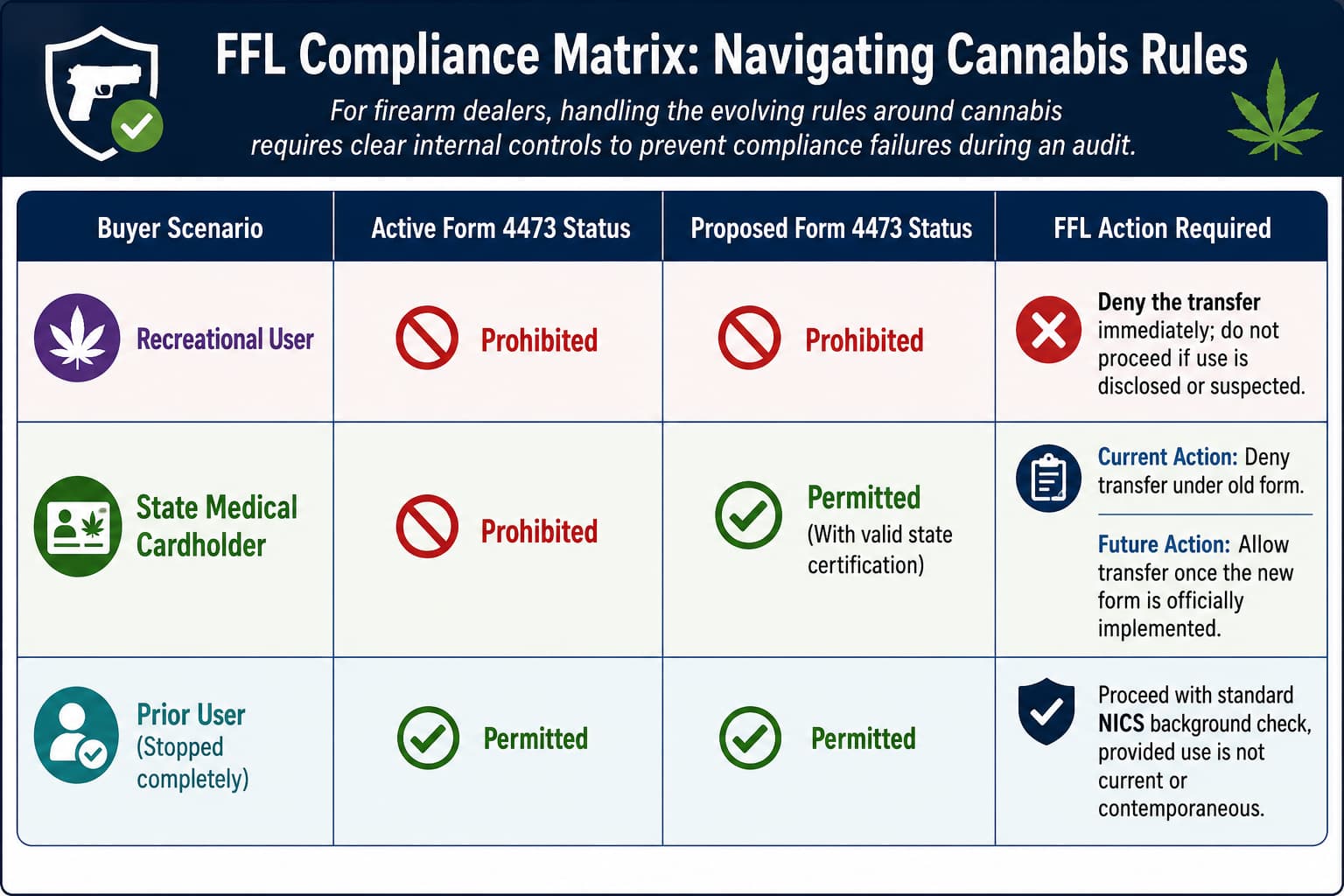
In response, the ATF published a draft revised Form 4473 in the Federal Register. This proposed update marks a massive shift in how the federal government treats medical cannabis patients, though it leaves strict prohibitions firmly in place for recreational users.
Visualizing the Evolving Cannabis Rules at the Gun Counter
10 Critical Questions and Answers: Cannabis and Gun Compliance
A: On the current, legally binding version of Form 4473, Question 21.f asks: “Are you an unlawful user of, or addicted to, marijuana or any depressant, stimulant, narcotic drug, or any other controlled substance?” This is immediately followed by a strict warning: “The use or possession of marijuana remains unlawful under Federal law regardless of whether it has been legalized or decriminalized for medicinal or recreational purposes in the state where you reside.”
Under this current framework, any cannabis use—medical or recreational—requires a “Yes” answer. Answering “Yes” requires the FFL to immediately stop the transaction and deny the transfer. Answering “No” while actively using cannabis constitutes a federal felony.
A: The ATF’s newly proposed draft form removes the blanket warning that treated all cannabis use as categorically illegal. Instead, the updated warning states:
“You can be an unlawful user under federal law, even if your possession is legal under state law. Federal law does not permit the use or possession of marijuana for recreational purposes.”
By explicitly targeting recreational purposes and omitting medical cannabis, the proposed form acknowledges that state-licensed medical marijuana patients utilizing Schedule III cannabis products are no longer considered “unlawful users” under federal firearms law. Once finalized, state-legal medical cannabis patients will no longer have to choose between their doctor-authorized medicine and their Second Amendment rights.
A: No, not yet. This is a critical point where many gun owners face legal risk. Although the federal government has reclassified medical marijuana to Schedule III and the ATF has drafted a new form, the proposed Form 4473 is still in its mandatory public comment period and is not yet legally active.
Until the ATF officially publishes the final version and updates the physical and electronic forms at gun shops, the old form remains the law of the land. Signing the current form and answering “No” while holding an active medical card still exposes you to severe federal prosecution. Proactive compliance means waiting until the final rule is fully implemented.
A: Absolutely not. The federal reclassification applies exclusively to state-regulated, physician-authorized medical marijuana. Recreational cannabis use remains entirely illegal under federal law.
If you use marijuana recreationally—even in a state that has fully legalized adult-use recreational cannabis—you are still classified as an “unlawful user” under 18 U.S.C. § 922(g)(3). You must answer “Yes” to the controlled substance question, which will result in an immediate denial of the firearm transfer.
A: To clear up long-standing confusion, the ATF issued an interim final rule updating the definition of an “unlawful user.” Historically, the government used vague timelines to determine if someone was an active user.
The current standard focuses on whether the cannabis use has occurred regularly over an extended period continuing into the present day. The law looks for a pattern of use that is contemporaneous with the purchase or possession of the firearm. A single, isolated use months in the past does not automatically make you an active user, but regular, ongoing recreational use definitely does.
A: Yes. Under federal law, an FFL cannot transfer a firearm if they have “reasonable cause to believe” that the buyer is a prohibited person.
If a buyer walks into a gun shop wearing clothing that promotes cannabis culture, smells strongly of marijuana, or mentions using cannabis to a store employee, the FFL has an obligation to halt the sale. This applies even if the buyer checks “No” on the physical form. FFLs are trained to prioritize strict compliance over making a sale to safeguard their business licenses.
A: While the proposed ATF form protects medical patients from the charge of lying on Form 4473, a major legal conflict remains regarding physical possession. The federal government’s legal position in ongoing federal court cases continues to argue that cannabis consumers can be barred from carrying firearms. Until the U.S. Supreme Court issues a definitive ruling or Congress amends the Gun Control Act directly, state-legal medical cannabis patients who own firearms should exercise extreme caution, ensure their medical records are perfectly maintained, and avoid carrying a firearm and cannabis at the same time.
A: Because marijuana users face strict restrictions at the gun counter, some individuals attempt to have a non-using friend or family member buy a firearm for them. This is a severe federal offense known as a straw purchase. Question 21.a on Form 4473 explicitly asks if you are the actual buyer of the firearm. Buying a gun for someone else to help them bypass the cannabis prohibition is a standalone federal felony under the Bipartisan Safer Communities Act, carrying penalties of up to 15 years in prison. The law treats the proxy buyer and the underlying cannabis user as co-conspirators in a federal firearms trafficking offense.
A: In some states, holding a valid concealed weapons permit allows a buyer to bypass the standard background check step at the point of sale. However, it does not exempt the buyer from filling out Form 4473.
Even if you hand the dealer a qualifying state permit, you must still complete Section B of the form and personally answer the controlled substance question under penalty of perjury. Having a state-issued concealed carry permit does not override federal law, nor does it grant permission to misrepresent recreational marijuana use on a federal affidavit.
A: If an FFL discovers after a transfer is finalized that a buyer lied on Form 4473 regarding cannabis use (for example, if local law enforcement informs the dealer of a subsequent drug arrest), the FFL must protect their business by documenting the situation immediately. The FFL cannot alter the completed form after the fact. Instead, they should create a formal internal memo detailing when and how they discovered the information, noting that they had no “reasonable cause to believe” the buyer was a user at the exact time of the transfer. This document should be filed alongside the original Form 4473 to demonstrate transparency and a commitment to compliance during future ATF inspections.
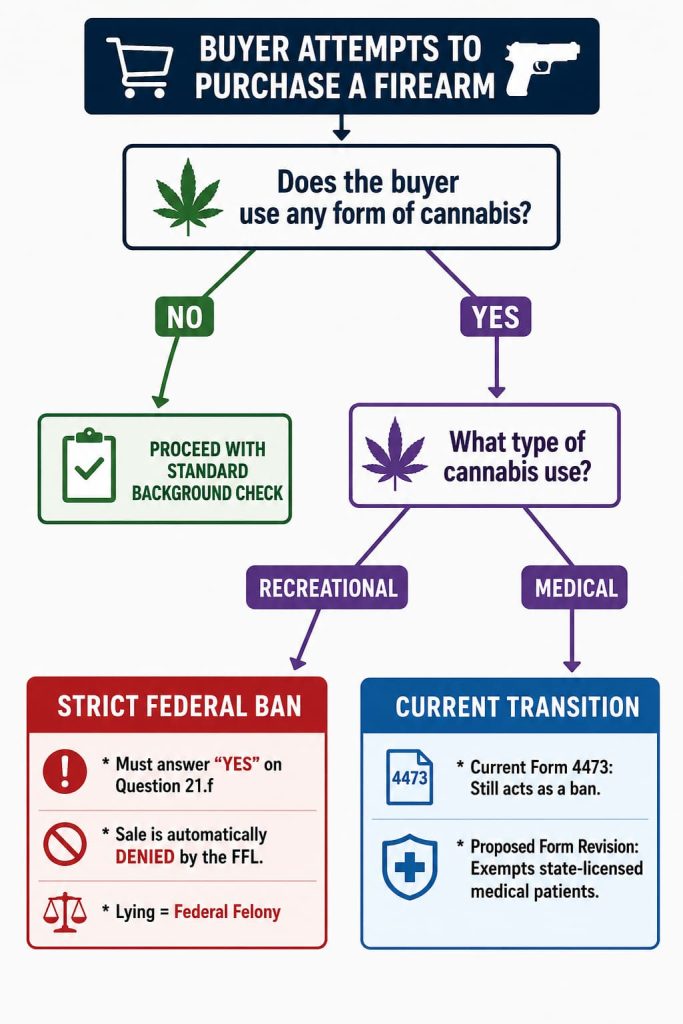
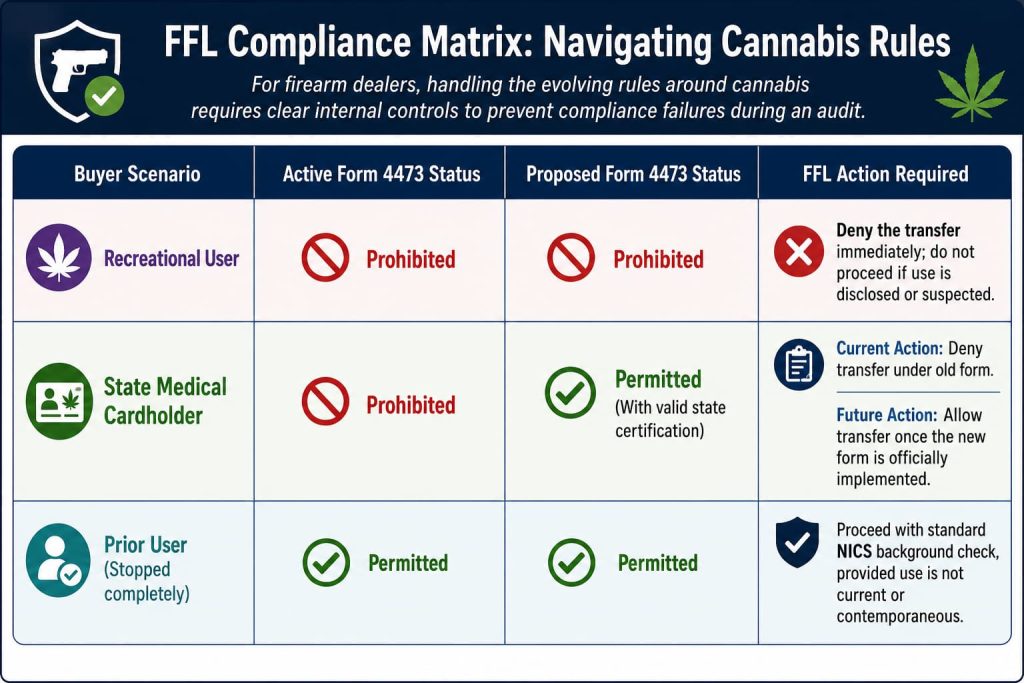
FFL Compliance Matrix: Navigating Cannabis Rules
Conclusion: Protecting Your Rights in a Changing Legal Environment
The intersection of gun ownership and cannabis law highlights the ongoing tension between evolving state realities and rigid federal regulations. While the federal reclassification of medical marijuana to Schedule III and the ATF’s proposed updates to Form 4473 point toward an accessible path for medical patients, the transition period requires careful legal compliance.
Clerical errors or a misunderstanding of timing can lead to severe criminal charges. Whether you are an individual gun owner navigating medical options or an FFL updating your retail compliance protocols, having experienced legal counsel is your best protection.
If you are facing compliance questions, audit concerns, or need clarity on your rights under the changing firearms laws, proactive legal representation is essential. Contact the team at CentralLaw.com today to schedule an in-depth consultation. We will help you navigate this shifting legal landscape with confidence and clarity.